
Citizen group raises alarm on silica sand project
Advertisement
Hey there, time traveller!
This article was published 16/06/2020 (2272 days ago), so information in it may no longer be current.
A group of concerned citizens gathered last Tuesday on Centre Line Road southeast of Anola to oppose a Calgary-based mining company’s plan to extract and process silica sand in the area.
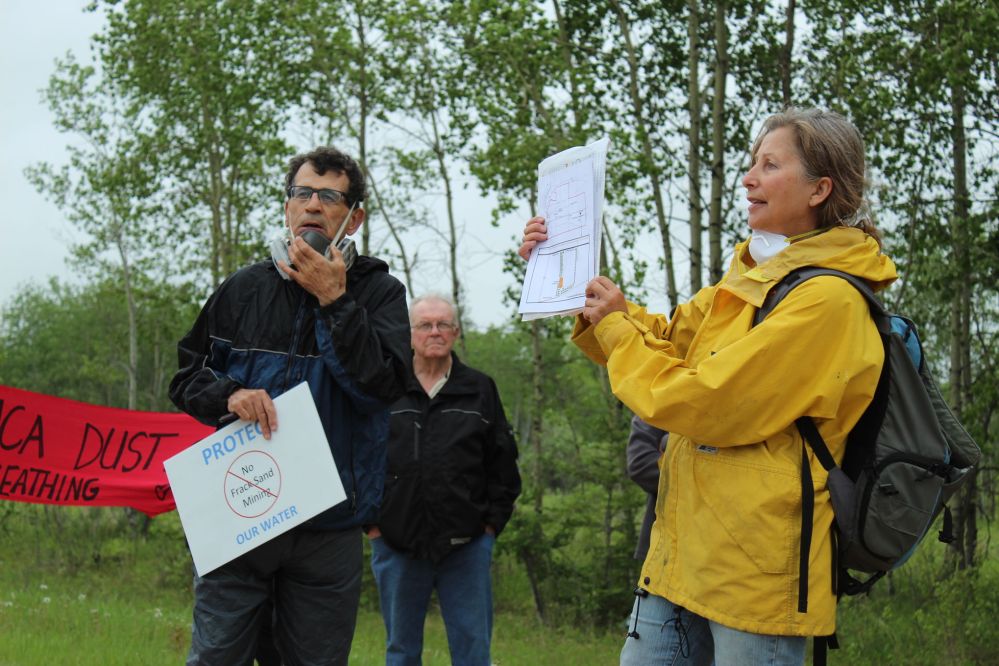
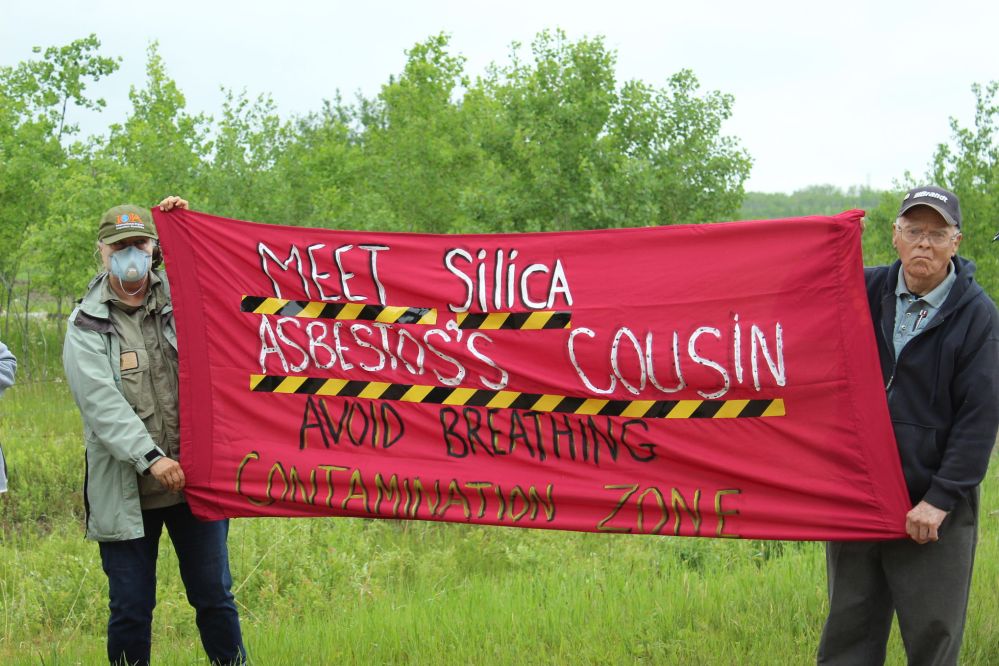
Group members held placards and unfurled banners bearing slogans warning of the health risks associated with the inhalation of silica dust particles. Several members also wore face masks to drive home their point.
Encircled by about 25 onlookers, group members explained they were also worried that the drilling needed to extract the sand would disturb the underground aquifer that supplies Springfield and other municipalities with drinking water.
CanWhite Sands Corp. is pursuing two Environment Act licenses that would allow it to extract and process sand on private property near the corner of Highway 15 and Provincial Road 302. Construction of a processing facility could begin as early as September, the company has said.
Prior exploratory drilling has established the existence of silica deposits located 60 metres (200 feet) underground.
Last month, CanWhite moved a public information session about the processing facility online, owing to the COVID-19 pandemic.
The group assembled last Tuesday said they want the company to hold a “true open house” in Springfield and present more specific facts and figures.
They also want the Manitoba Clean Environment Commission to convene a public hearing over the project, a move that requires a referral from Conservation and Climate Minister Sarah Guillemard.
Tanzi Bell of Anola helped organize the group opposing the silica project. Bell said she worries about groundwater contamination after finding unsealed well heads while picking wild mushrooms and berries near the company’s test sites.
Addressing the gathering, Bell called silica dust “asbestos’s cousin.”
Visible in the distance was a large pile of sand, one of several Bell said was on the property.
Bell said footprints and tracks from dirt bikes and all-terrain vehicles have been found on the sand piles.
“People aren’t aware of the dangers of silica, especially when you stir it up with a motorcycle,” said Dennis LeNeveu, a biophysicist and former safety officer with Whiteshell Laboratories near Pinawa who joined the group.
Janine Gibson, a Pansy-based organic agriculture inspector and consultant, called CanWhite “very irresponsible in leaving the silica above ground and not covering it.”
Gibson, a Green Party candidate in past federal and provincial elections, said group organizers approached her to join because of her past work protecting drinking water.
Gibson said she’s concerned the water-intensive slurry extraction process would tax an aquifer already at capacity.
LeNeveu said his analysis of CanWhite’s plans led him to contact Manitoba Workplace Safety and Health last week with several concerns about human and environmental health.
He warned of “disastrous aquifer damage” if CanWhite’s plan continues unabated.
“The air and the water are going to be compromised.”
The group also questioned the market viability of the deposits CanWhite has found, saying the silica isn’t pure enough for use in the solar industry.
Curtis Buley, a councillor in the neighbouring RM of Reynolds, held a banner with Gibson during Tuesday’s rally.
Buley said he hopes to persuade Reynolds council that the health risks associated with the project aren’t worth the 40 to 50 jobs the processing facility would create.
Buley urged those in attendance to send concerns to Lac du Bonnet MLA Wayne Ewasko.
RM of La Broquerie reeve Lewis Weiss also attended the event. Weiss said he doesn’t share the group’s concerns about air quality, but is opposed to the company “drilling holes and messing around with drinking water.”
“Let’s just leave our water source alone. It’s sacred,” Weiss said.
Anne Wowchuk, who lives about eight kilometres from the proposed processing facility, isn’t affiliated with the group behind Tuesday’s event, but shares some of their concerns.
Wowchuk said she questions CanWhite’s credibility after receiving unsatisfactory answers to questions she posed during last month’s virtual open house.
“They were very vague as to how they were going to extract the silica sand,” Wowchuk said.
“What I expect from any industry that’s coming into Springfield…is that they conduct business responsibly and ethically.”
Wowchuk has forwarded her concerns, which include the presence of uncapped test wells and uncovered sand piles, to Springfield council and is awaiting their response.
In the meantime, she’s worried about “brown crap” coming from an outdoor tap on her property. She said the problem started last fall.
“We have livestock, so I had to empty out all the troughs,” Wowchuk said.
Not everyone who turned up to the event opposed the mining project.
Station Road resident Gladys McDonald said her well water hasn’t been affected by test drilling. McDonald said noise from nearby quarry pits concerns her more than silica dust.
Company responds
Brent Bullen, CanWhite’s chief operating officer, responded to the group’s concerns in a phone interview.
He said he was surprised to hear no signage was visible near the sand piles.
“It’s not like it was left that way.”
Fall site work was halted suddenly by the October snowstorm. Bullen said contractors knocked down the piles to below tree height before packing up.
“That property is actually private property, and we actually had gates and complete signage when we left the property,” Bullen said. “Those have all been taken down and removed.”
Bullen said no one should be hiking or driving an ATV on the piles, as the property is not a designated recreation area.
He said the company plans to remove the piles, which were generated during the testing process, “before the end of June.”
Bullen also disputed the group’s claims about the production of silica dust.
The piles contain “larger-grain sand,” he said, not the “micro-fine” variety that can cause lung problems.
“They incorrectly compare us to other sand facilities.”
Bullen maintained the piles aren’t representative of the production process CanWhite has planned.
“There will not be piles of sand at the extraction areas,” Bullen said.
Pandemic restrictions on travel and working in close quarters have so far prevented onsite work from continuing this spring. Bullen said CanWhite has applied for essential service status.
“Once we have that approval, we will immediately have people on site.”
As for the unsealed wells, Bullen said the Centre Line Road property remains an active test site. Wells on inactive sites were sealed, he said.
“To see a well that’s maybe been opened up is concerning to us.”
Bullen said the company looks forward to releasing independent engineering studies that show its slurry extraction method won’t cause aquifer “subsidence,” or collapse.
The company has also been monitoring water quality near its testing sites.
“We’ve not seen any discolouration at all,” Bullen said.
As for market viability, Bullen said independent tests have found the silica has an average purity of 99.85 percent.
He added the company hopes pandemic restrictions on travel and gatherings relax enough to allow CanWhite to hold an open house event in July focused on the extraction process.