
Niverville ‘skyscraper’ set for demolition
Advertisement
Hey there, time traveller!
This article was published 23/09/2021 (1690 days ago), so information in it may no longer be current.
Standing above the sprawling town of Niverville, the former Manitoba Pool grain elevator will cease to exist in the next month, a fixture in the community and a symbol of old meeting new.
While it has sat vacant for months with no corn, wheat or other grain turning over in its 40 bins, Grant Dyck has been mulling what to do with the place.
“I don’t really want to be doing this, but I don’t see any other option,” Dyck said.
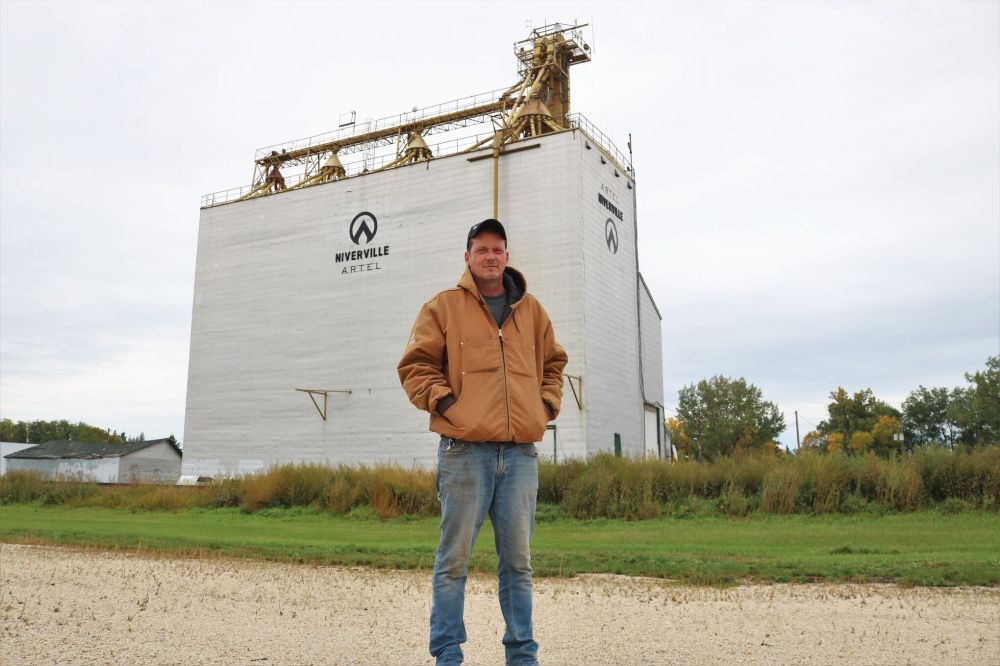
Built in 1981 to replace the former elevator which burnt one year previous, Manitoba Pool Elevators constructed the state-of-the-art facility using nearly half a million board feet of lumber, 15 tons of nails and two miles of electrical wire, all put together by a group of young men one by one. It was a new model with an open roof, a revolutionary design by the company for the type of facility. However, it would serve as one of the last of its kind as the industry modernized and moved towards concrete buildings.
In 2001 Manitoba Pool demolished or sold off many of their elevators after consolidating their business with Alberta Wheat Pool to form Agricore Cooperative Limited. Dyck, a young farmer who was looking to expand storage for the family business, Artel Farms, bought the property.
“We were in growth mode; it was a tremendous opportunity,” he said, looking up at the elevator which will see its demise by the end of October.
Over the past two decades, Artel grew its operations and in turn outgrew the elevator’s capacity; the building located off Main St. stores 4,000 tonnes while operations at Artel’s main property East of town can hold between 25,000 – 30,000 tonnes.
However, the significance of the building is not lost on him.
“I’d be lying if I said it wasn’t a sad thing to see something like this go,” he said.
The elevator sits on historical property; William Hespeler built Niverville and Western Canada’s first grain elevator in 1879 when the Pembina branch of the Canadian Pacific Railway became newly established in the prairie province. In 1923 it was demolished to make way for another elevator.
Over one century later four elevators have come and gone on the same property and Artel’s will meet the same fate.
Serving as the tallest building in town, exploring the elevator became somewhat of a rite of passage; teens often trespassed attempting to climb to its peak. Many a time Dyck shooed young people from the premises, but often played along with their antics like tagging over spray paint murals which had been marked on the property, hoping he would be hit back with better artwork than his.
In recent years operations at the facility rapidly declined and the elevator has sat empty since March. Apart from railway cars decreasingly coming to the facility due to its small capacity compared to larger elevators, neighbourhood expansion and traffic increase, Dyck found driving farm equipment to and from the facility to be increasingly difficult.
Calling it a “white elephant” Dyck said the elevator can no longer be used yet selling it for its intended purpose isn’t in the cards either.
“It’s like having a tool in the garage that’s extremely functional, but you’re not allowed to use it,” Dyck said.
He’s mulled retrofitting it into a bed and breakfast or apartment buildings like some have done in recent years across the country. However, keeping the facility up to code and cost ultimately squandered that plan. No one has approached him to secure the building as a heritage site, and Dyck said the cost to maintain it would make no sense.
“There’s a lot of needs in the town for a number of things, and it’s a unique property,” he said on the site’s potential future development.
The next month will see a specialist in grain elevator demolition chip away at Niverville’s tallest building, piece by piece until its grand finale in October where it will fold within itself, making way for another chapter of history to begin.