
Indigenous elder shares pain and healing
Advertisement
Lorraine Daniels was only six years old when she was taken from her family and sent to a residential school.
She was torn from a loving home that included her parents and grandparents and forced into a foreign environment where she and fellow students faced systemic discrimination.
“We were punished if we got caught speaking (our language) and we were shamed,” she said. “We were shamed for the colour of our skin, for who we were as Indigenous people.”
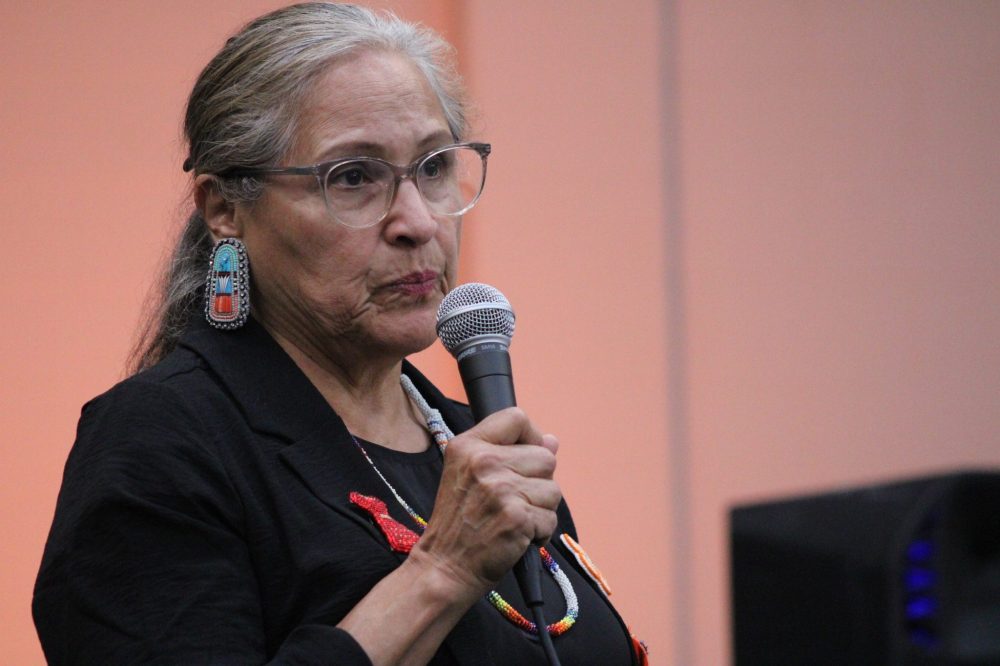
Speaking to the standing room only crowd at the Southeast Event Centre during the launch to Orange Shirt Day on Sept. 19, Daniels broke down as she recounted the pain of those early years.
The spellbound audience broke into applause as encouragement for her to continue.
“We were called savages,” she said. “The family unit was broken in the schools. You became a foreigner in your community because you lost your language and your culture, your sense of family and belonging.”
Daniels still vividly recalls the moment her younger sister was punished.
“They took her upstairs and just beat her so hard you couldn’t even see her eyes,” she said. “They brought her down to the dining room where everybody sits, the boys on one side, the girls on one side, just stark naked.”
“She was six years old,” she added. “They used her as an example, that if we didn’t listen this was what was going to happen to you.”
But Daniels said her sister has thrived despite that experience.
“Today she’s strong, she’s surviving, she owns a concession stand, she’s been on council, she also has her master’s in psychology. Isn’t that amazing?”
Daniels has also come a long way since those early years.
She is now the executive director of the National Residential School Museum, located in a former residential school in Portage.
“I’ve been on my healing journey for over 30 years,” she said.
With a goal of informing and educating the public to aid in understanding the Indigenous residential school system, it also honours present day survivors so that “something like this never happens again,” she said.
“The museum is a place where we come to learn, share and heal and move forward so that everyone understands what has happened.
There were 139 residential schools in Canada with the last one closing in 1996.
Daniels said the goal of the schools was simple.
“The government and the churches who operated the residential schools objective was to eliminate the Indigenous culture, their activities, the language and their traditions,” she said.
And there were stark differences compared to the public system.
“The public schools and private schools in Canada do not have gravesites on their properties,” she said. “It’s only the Indigenous schools that have been known to have gravesites.”
Children at those schools were not allowed to converse with their brothers or sisters she said, adding this was the beginning of the breakdown of families.
Lasting effects of the system are emotional trauma from both physical abuse and being deprived of culture.
“I’m still learning about my culture,” she said. “It took a long time to accept it because I was brainwashed into thinking that everything we did was evil and not of God.”
Many, like Daniels, are persevering and thriving as they recover from the trauma.
“I’ve come full circle, for someone who was ashamed of her culture and taught that God was a punishing God,” she said. “I became a Christian. I went to Providence Seminary. I have my master’s in Christian educational ministries. And that is why I can stand here and do this job.”
She said operating the National Residential School Museum has given her a full circle feeling.
“What was once a place of hurting is turning into a place of healing and it’s going to become a first-class museum,” she said.
But healing takes time, and Daniels said reconciliation doesn’t happen overnight.
However she added, it’s events like this that are open to the larger community that will make it happen.
“When a deep injury is done to us we never heal until we forgive. We need to let go,” she said. “Healing doesn’t mean that damage was never done. It means that the damage no longer controls your life.”
“As a survivor I am no longer a victim of the residential schools’ violent acts, whether it’s physical, emotional, mental and spiritual,” she added. “I won’t forget what happened, but I will always remember and learn to forgive.”