Steinbach Remembrance Day service draws hundreds to honour fallen soldiers’ sacrifice
Advertisement
Hey there, time traveller!
This article was published 15/11/2025 (191 days ago), so information in it may no longer be current.
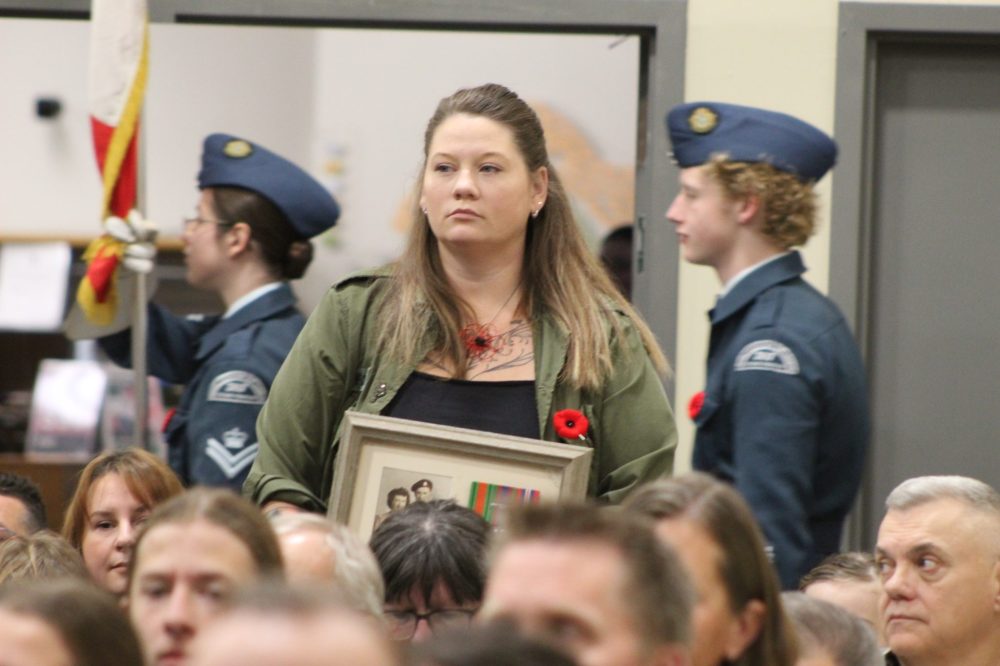
Debbie Ginter remained standing, clutching a framed photo of her grandparents and her grandfather’s medals, while everyone returned to their seats during Steinbach’s Remembrance Day ceremony inside the Pat Porter Active Living Centre. To show her pride for her family’s military service, Ginter always brings a different photo of her relatives every year to the ceremony.
“There are people in the community who have a very strong connection with the Second World War, and I feel like it’s very important for people to see that it’s not just pictures on a wall. There’s people who have photos of this at home,” she told The Carillon.
Ginter’s grandfather, Frederick A. Fox, landed on Juno Beach in France, along with other 14,000 Canadian soldiers during D-Day on June 6, 1944. He made it home after the war, and Ginter only met him once when she was three-years-old before he died. She’s had multiple family members serve in both World Wars. Ginter decided to bring her daughter along because she believes she needs to know the significance of those who fought and died.
“It’s important for her to know that these people paid the ultimate price for our freedom,” she said.
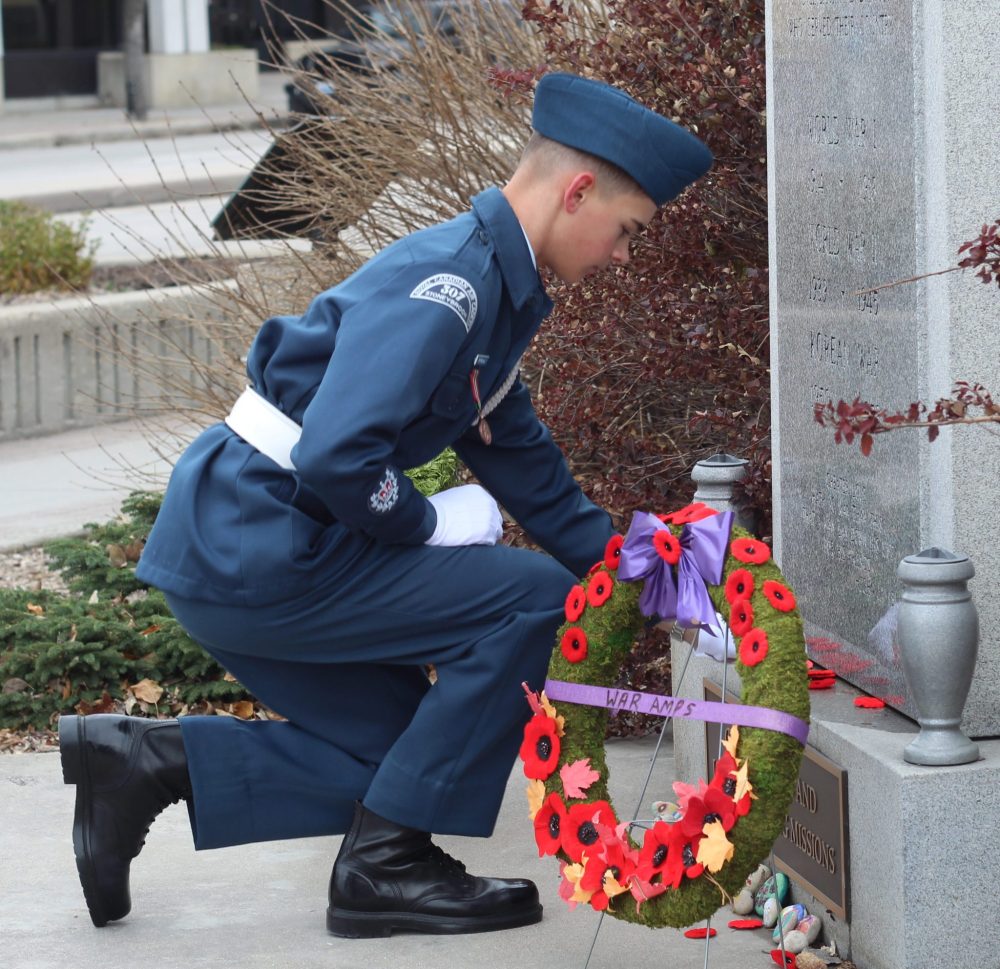
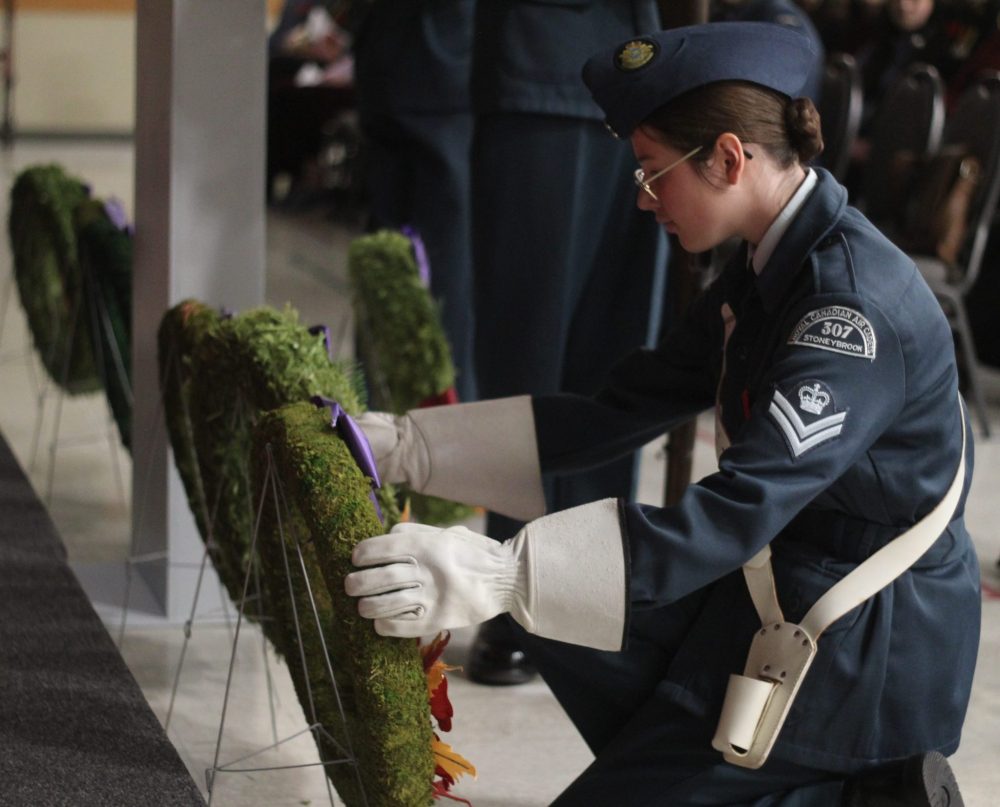
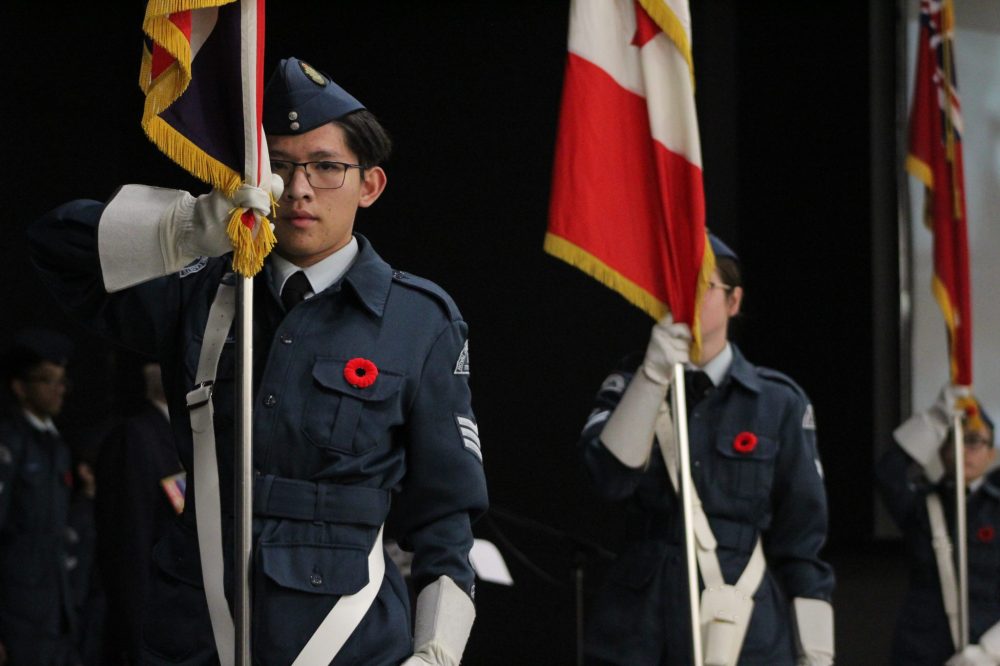
More than 400 people packed inside the active living centre’s auditorium, with provincial, federal and municipal delegations setting wreathes beside a replica cenotaph. A cadet from Steinbach’s 307 Stoneybrook Royal Canadian Air Cadet Squadron read out the 1915 poem In Flanders Fields, written by John McCrae.
Cadets Douglas Locke and Lucas Perreault stood as rifle sentries guarding the cenotaph throughout the ceremony.
Sarto resident Locke felt honoured to perform that duty on Remembrance Day, and it’s one his favourite things to do as a cadet. This year marked his third time being a rifle sentry.
His great grandfather died during the Second World War, which makes him proud to participate in honouring Canadian soldiers.
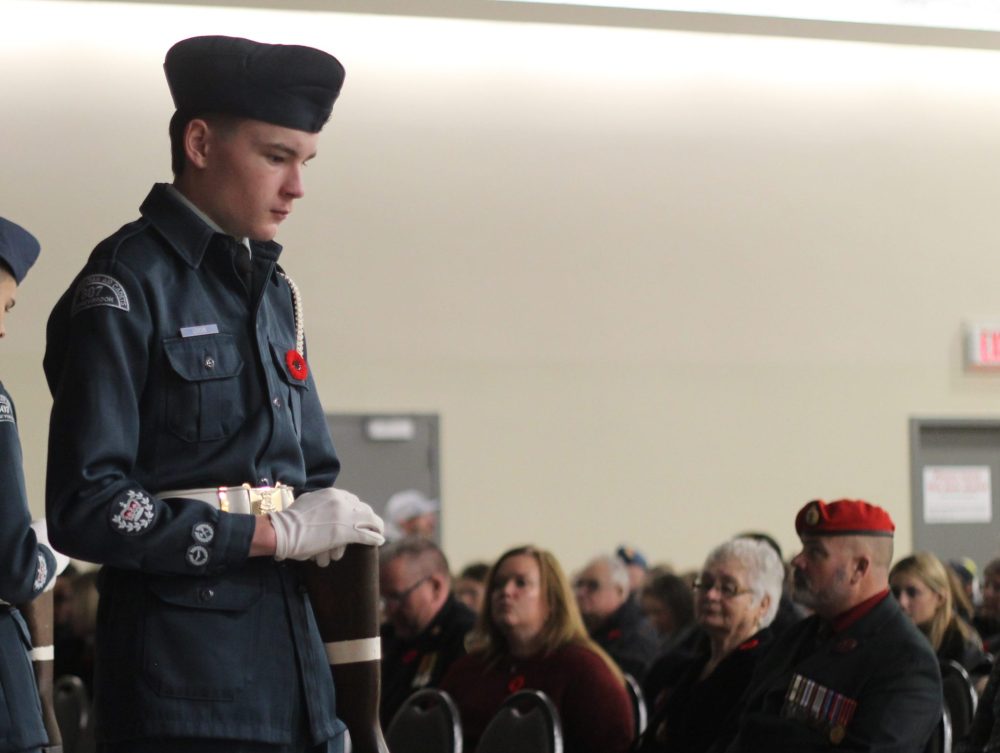
“Our goal is to make it so that we never forget the ultimate sacrifice that was paid for our freedom,” the 16-year-old said.
Wearing his uniform is a reminder for him and other younger generations to always remember veterans’ sacrifices, Locke said.
“As long as we keep defending freedom, that means that their (Canadian veterans) sacrifice will never be in vain,” he said.
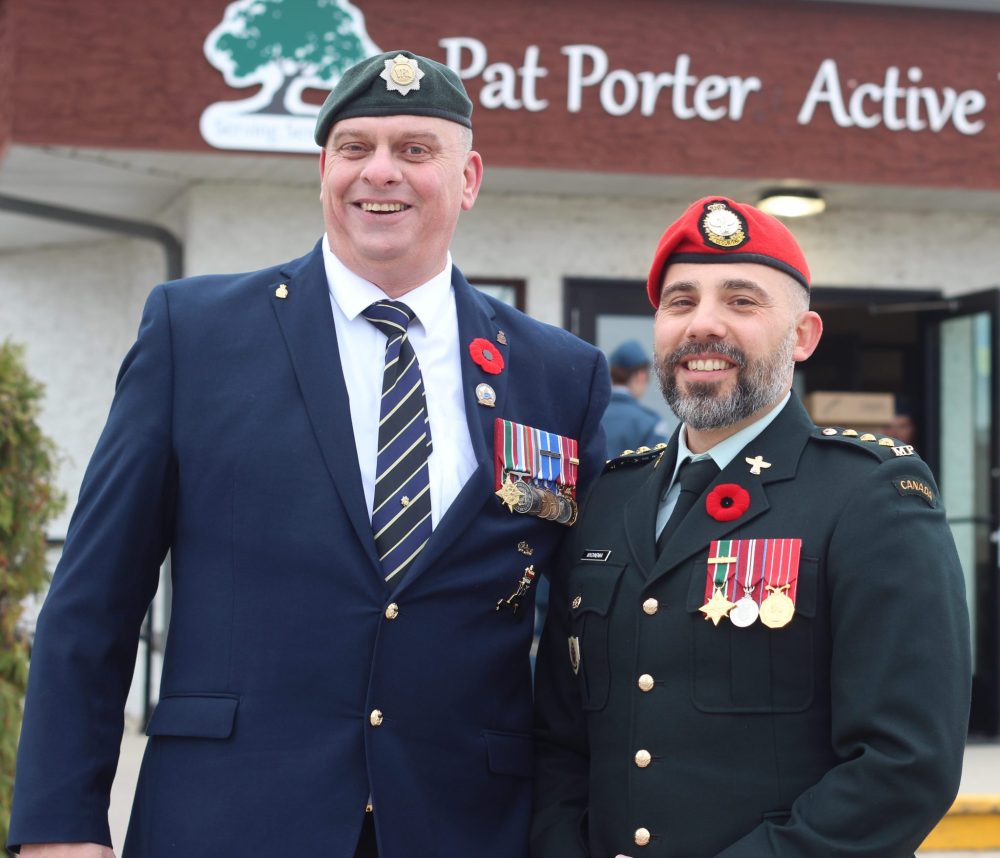
Chad Hawthorne, a retired master corporal and peacekeeper who deployed to Croatia, Bosnia, Kosovo, Afghanistan and Latvia, said he often struggles on Remembrance Day because of the friends he lost to combat and now suicide.
Hawthorne recalls fighting in the 1993 battle Operation Medak Pocket in Croatia as a Canadian peacekeeper. The battle saw Canadian soldiers face combat for the first time since the Korean War, he said. Sometimes referred to as Canada’s ‘forgotten battle,’ troops from the Princess Patricia’s Canadian Light Infantry Regiment held out against Croatian Army shelling and machine gun fire and beat back the assault outside the village of Medak, according to a 2020 Veteran’s Affairs Canada article.
“We lost a lot of men there, and then obviously lost a lot of men and women in Afghanistan. I lost a lot of very close friends of mine. I hold this day very close to my heart,” he said.
From 2001 to 2014, 158 Canadian soldiers died in Afghanistan in what became the longest combat deployment in Canadian history, according to Veterans Affairs Canada.
His grandfather was a Second World War veteran, and growing up hearing stories from him meant “everything” to Hawthorne, especially when he joined the armed forces.
“It was bred into me since five-years-old,” Hawthorne said. “My grandfather always told me ‘Serve your country. You do as you’re told. You go when they ask you to go, but when you come back, you’re modest, right and you help others.’”
As he remembers the friends he lost, feelings of anger, guilt and memories of laughter come back, Hawthorne said. Many veterans find it difficult to talk about their experiences, even with each other, and struggle with PTSD, he said.
“Whether it be physical or mental, it’s definitely an ongoing battle for them,” Hawthorne said.