
Provencher MP reacts to the federal budget approved by parliament
Advertisement
Prime Minister Mark Carney has released his first budget to make Canada stronger economically, militarily, and technologically. Budget 2025 was narrowly approved last week by 170 to 168 thus preventing a fall election.
Provencher MP Ted Falk called the budget disappointing.
“We had hoped that Mr. Carney and Mr. Champagne would be listening to Conservatives and more importantly to Canadians who were asking for relief from the cost of living and that just does not appear at all in the budget. They’re going to be spending more money, putting our country further in debt with a higher deficit and that is going to create more inflation and raise the cost of things even more for Canadians. Overall, it’s a disappointment.”
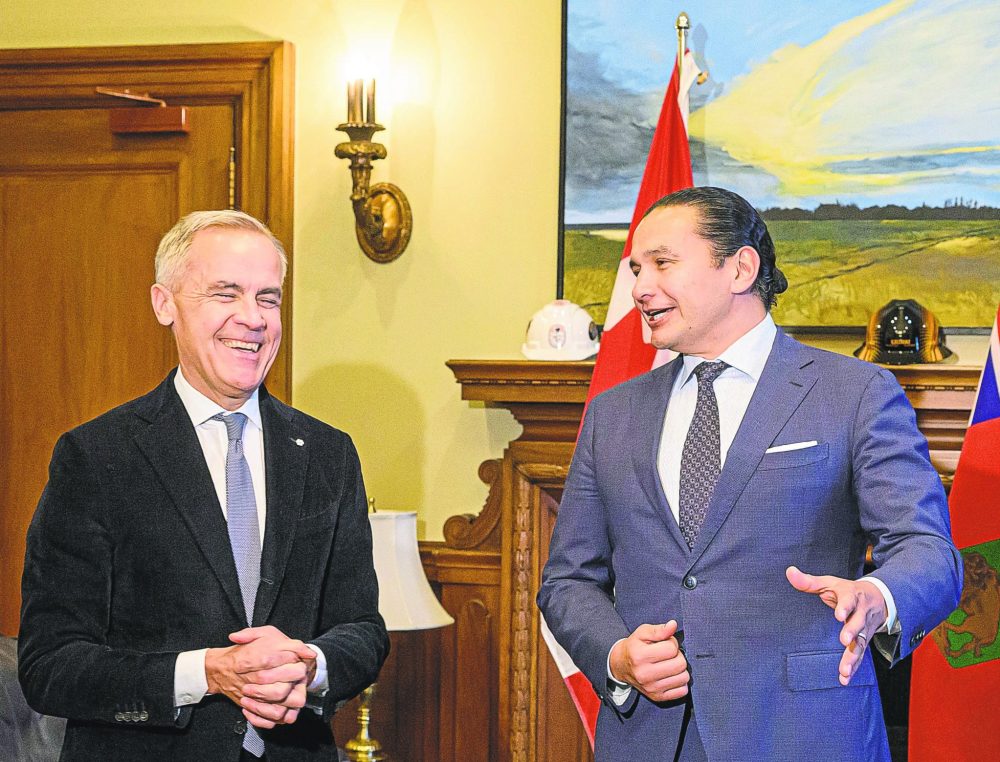
The budget enables $1 trillion in total investment over the next five years through smarter public spending and stronger capital investment. Forty-two percent, or $12 billion, of the budget will be used to strengthen Canadian sovereignty by investing in defence, tariff response, and building a strong economy. Thirty-six percent, or $10 billion, will be invested to bring down costs for Canadians through a middle-class tax cut, cancelling the consumer carbon tax, and establishing the Build Canada Homes initiative.
“Budget 2025 is our plan to build Canada Strong – with major infrastructure projects, millions more homes, new defence industries, and thousands of new high-quality careers all across our country. As we build big and bold, we will build Canadian and buy Canadian. We will be our own best customer, creating new orders, more business, and new careers in our industries across our country,” stated Carney, in a release introducing the buy Canadian strategy to reporters two weeks ago.
According to the budget, the government is introducing a capital budgeting framework to modernise its approach and deliver generational investments. This framework distinguishes day-to-day operational spending from long-term investments into the economy.
Falk said this division in the budget has never been done before in Canada and in other countries across the world. He said the move is deceptive as in the past the budget has always been presented as income verses expenses.
“Now he’s made it into a capital budget trying to say that anything capitalized is an investment and that just isn’t the case,” said Falk.
Canada has the lowest net debt-to-GDP ratio in the G7 at 13.3 percent, followed in second place by Germany at 48.7 percent and the UK in third at 94.6 percent and finally in fourth place the U.S. at 99.6 percent. Japan came in last with 130.1 percent.
Canada also has one of the smallest deficit-to-GDP ratios in the G7. Canada and Germany are the only two G7 economies rated AAA, a marker of strong investor confidence which helps keeps borrowing costs as low as possible.
The Comprehensive Expenditure Review will reign in government spending, according to the budget, saving Canada $13 billion annually by 2028-29, for a total with other savings and revenues of $60 billion over five years. Savings will be achieved by restructuring operations and consolidating internal services and rightsizing programs to be more efficient. It will also involve downsizing the federal workforce by 40,000 positions by 2029, which would include 16,000 full-time equivalents and about 650 executive cuts. Falk said the cuts to the public service remain to be seen.
Government will also close tax loopholes and over the next five years it will invest $25 billion into housing, $30 billion into defence and security, $115 billion for infrastructure, and $110 billion for productivity and competitiveness.
The budget’s climate competitiveness strategy will see Canada leveraging nuclear, solar, wind, clean hydrogen, and other renewable sources of energy. The government has also removed the carbon tax for consumers, but still has the tax on industry. Falk doesn’t believe the Liberals will abandon the industrial carbon tax and their clean fuel standard.
“They tell us those are imaginary taxes in the minds of Conservatives, but we all know that it’s not because there clean fuel standard is said to increase the price of gasoline by 17-cents a litre and the industrial carbon tax adds a cost to the energy used by manufacturing companies to make things including the processing of food. So there’s nothing imaginary about the cost of things increasing.”
The government will also launch its new trade diversification strategy to build on global agreements and partnerships, which will double overseas exports over a decade, generating $300 billion more in trade. Through a new trade diversification corridors fund, the government will improve access to overseas markets by investing in new port, airport, and railway infrastructure. The federal government has already partnered with Manitoba to develop the Port of Churchill under the major projects office, which has the potential to expand export capacity in the North through Hudson Bay thus increasing and diversifying trade with Europe and other partners, while more strongly linking Churchill to the rest of Canada.
The prime minister announced last week the government will provide funding to the Arctic Research Foundation to undertake a feasibility study to determine the path forward for future deployment and operation of specialized icebreakers, ice tugs and research vessels at the port.
Premier Wab Kinew announced $51 million for the Arctic Gateway Group to make capital improvements to the Hudson Bay rail line and to build a new critical-minerals storage facility at the port. This brings the total provincial investment in the project to $87.5 million with the joint federal-provincial investment over five years amounting to $262.5 million, including $175 million of federal funding announced in March.
“Well, that’s a very interesting concept. Its one that we as Conservatives have talked about for quite some time now. We think there’s opportunity for economic development there for some economic activity…but I think right now it could be a lot of smoke and mirrors from the Liberals because inside the budget there’s no capital commitments, there’s no procurement set up, there’s no construction schedule, and there’s no economic updates on it. So far it’s all sponge service. Conceptually, we think it’s a good idea but there doesn’t really seem to be a commitment or buy in from the Liberals,” said Falk.
When it comes to crime and safety, the government has set aside $1.3 billion for border protection by slating the hiring of 1,000 new Canada Border Services Agency officers and 1,000 RCMP personnel, modernising border technology, and strengthening intelligence-sharing. The government also launched a bail reform strategy that includes making bail laws stricter and sentencing laws tougher for repeat and violent offenders, to support the front lines, and to invest in long-term prevention. The government will also launch the national anti-fraud strategy to implement stronger protections for consumers and a new Financial Crimes Agency that will investigate complex financial crimes, such as money laundering, fraud, and online financial scams.
“We don’t think he’s got quite the right approach yet,” said Falk. “He promised 1,000 CBSA officers already eight months ago and we haven’t seen any uptick at all and now it’s in the budget again; 1,000 CBSA officers and 1,000 RCMP new officers. All those things are lip service because that’s what Canadians are wanting to see. They want to see increased security at our borders, they want to see increased presence of RCMP, so that hopefully crime rates will go down and they want to see repeat violent offenders locked up and not released on bail to reoffend.”
The military will also see an investment in the budget to the tune of $30 billion. The Canadian Armed Forces will receive the most significant pay and allowance increase in a generation costing the government $2 billion, along with major investments to support the health needs of its members.
The budget also indicates that Canada will meet the North Atlantic Treaty Organization’s (NATO) two per cent defence spending target this year – five years ahead of schedule – which is an increase of more than $9 billion this year. The government will accelerate investments in the coming years in order to meet NATO’s five percent Defence Investment Pledge by 2035. These investments will modernise Canada’s fleets, expand Arctic and maritime surveillance, bolster cyber and space capabilities, and create high-paying careers for Canadian workers across the country.
“So, if the budget claims that it can meet the two percent targets, but there have been some major allocations almost $18 billon for capability expansion and increased commitments, whether or not that happens remains to be seen,” said Falk.
Falk cited the Arctic infrastructure fund, which he said has received a $1 billion for dual purpose northern projects and defence related projects. He said the Liberals’ new Defence Investment Agency is actually designed to screen out procurement for defence items like airplanes, and boats, and capacity for national defence. Falk said a lot of industry experts see the move as just another level of bureaucracy unless the policies change.
“It won’t make any difference other than the government will spend more money on bureaucracy,” he said.
In regards to the economy, about one-third of Canada’s national income comes from exports. The One Canadian Economy Act helps break down internal trade and labour barriers, which cost Canadians as much as $200 billion in lost opportunities a year. The Act expedites nation-building projects, and unleashes economic growth, with Indigenous partnerships and inclusion.
While Falk agrees with buying Canadian, he said the interprovincial trade barriers will only come down if the provinces are on board and so far he said the provinces are lagging in removing those barriers.
“So far the federal government claims it has done its part and now it’s up to the provinces to see if they’re going to participate in that as well. If the provinces choose not to, then it will fall flat on its face.”
The new major projects office will fast-track nation-building projects and coordinate federal financing to help build projects faster. The first five projects referred to the office collectively represent $60 billion in total capital investment. Together, these nation-building projects are expected to trigger at least $150 billion in total capital investment.
In response to global economic shifts and to protect Canada’s sovereignty, the government has earmarked $3 billion for 2025-26 to support workers and industries in sectors most impacted by U.S. tariffs and trade disruptions, helping them reskill and retool. Eighty-five percent of Canada-U.S. trade is tariff-free and the average U.S. tariff rate on Canadian goods stands at 5.4 percent—the lowest among all major countries trading with the U.S., according to the government.
When asked to give some examples of what the Conservatives would have done differently in the budget if they had won the election, Falk said they would have lowered taxes for families, on work, on housing, on energy, and on investment.
He said the Conservatives would have made housing more affordable and they would have ended deficit spending to reduce inflation. He also said they would have reformed the immigration system to be in line with capacity and labour limits. Falk also said the Conservatives would have secured the border better, and he gave an example of Pierre Polievre’s suggestion more than a year ago about purchasing more scanners at the ports of Vancouver, Halifax, and Montreal to scan more shipping containers to know what is being imported and exported in the country.
Recently, Poilievre’s leadership style has come under fire for being too negative and focusing on division and anger than unity and governance, according to critics and former Conservative MP Chris D’Entremont, who crossed the floor earlier this month into the Liberal caucus.
Falk sees D’Entremont as “disgruntled” and that his criticism is “sour grapes that just shows a lack of maturity” because the caucus didn’t give him the position of deputy speaker, a position he held in the previous parliament.
“It’s kind of a little bit of a betrayal in my mind. He sat at our caucus meetings right up until the end until he actually crossed the floor. He didn’t recuse himself from any of our caucus confidential discussions, but long after he talks with Mark Carney. And he stated himself that he would not even consider crossing the floor had our caucus given him the nod to be the deputy speaker.”