
Four southeastern Manitoba municipalities end regional library pursuit
Advertisement
Hey there, time traveller!
This article was published 27/12/2025 (264 days ago), so information in it may no longer be current.
More than half of the authoring municipalities for a report on regionalizing southeastern Manitoba libraries have withdrawn from the plan after the report was released last month.
Councils in the RM of Ste Anne, Piney, Ritchot and Town of Ste Anne all unanimously passed resolutions in December to stop pursuing a regional library system, leaving only Niverville and Steinbach as the remaining members of the 2024 working group exploring the idea.
Piney Coun. Mark Bernard said joining a regional library wasn’t realistic because it would be paying for a system that wouldn’t provide a physical library for the rural municipality. Piney doesn’t have a publicly funded library for residents.
“We’d have to go out elsewhere (to access a library). So, in essence, we wouldn’t really have access more so than we have right now,” he said, adding it would be a tough sell for rate payers.
He said many residents, including his wife, pay to access physical and digital books at Steinbach’s Jake Epp library. One of the key factors is Piney’s distance to other municipalities, Bernard noted. If residents were closer to another municipality’s library, that could’ve changed council’s position. He understands that withdrawing means Piney wouldn’t have the same leverage with a regional library board if it stayed, but that the unknowns for access to facilities and potential provincial funding are too great. Piney is considering its own strategies in developing a municipal library system, but Bernard said council isn’t ready to announce plans.
“It’s not fair for our rate payers to have the unknown and go, ‘Okay, we’re in, but we don’t know how much we’re going to pay,’” he said.
The report was the final result from the working group, which began work in September 2024. It detailed that discussions were held with provincial officials and other existing regional library systems. If formed, a regional library in southeast Manitoba would would serve 110,870 residents, the second largest library population in the province. Forming a regional library could provide improved provincial funding, larger book collections, while centralizing governance and administration with the regional library board. Costs would be shared between municipalities, with each one providing a facility and contributing funding based on its population size, the report said. If a municipality didn’t have an existing library, it could share one with a neighbouring municipality.
The report lists potential new programs, including a mobile library, public access computers and gathering spaces. Each municipality would have one elected and non-elected representative on the regional library board.
A regional library system, including the working group municipalities, St Pierre Jolys, and the RM of De Salaberry could generate between $827,590 to $1.6 million in annual revenue. The provincial contribution could range from $307,630 to $755,260 depending on how much municipalities chip in, depending on each municipality’s chosen per capita tax rates. In 2024, Steinbach’s Jake Epp library received $187,311 from the province.
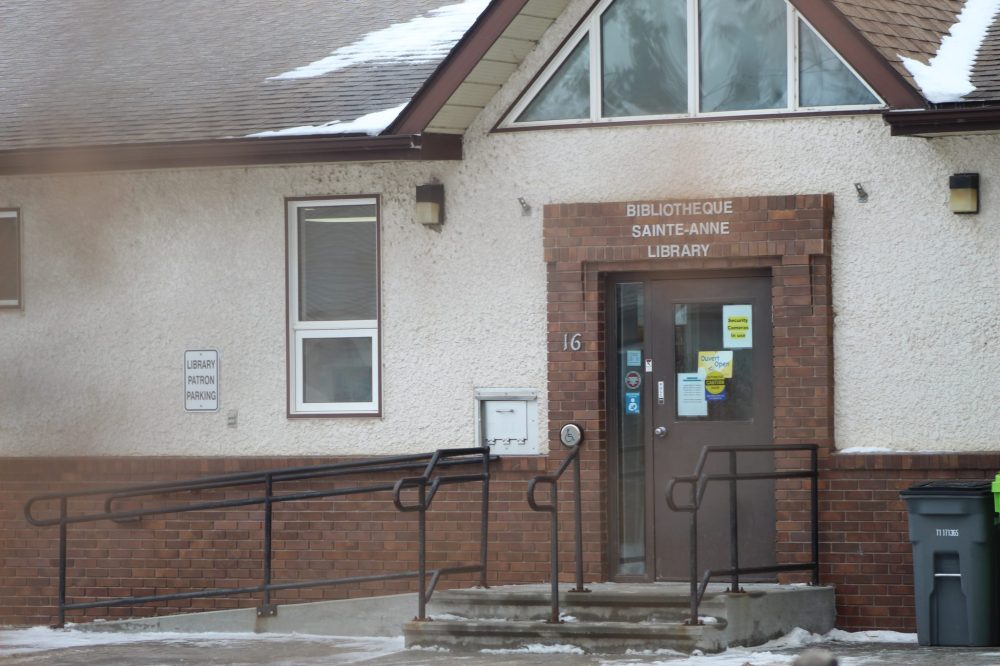
Town of Ste Anne Coun. Jason Einarson said the town’s library hired a new librarian and wants to focus on growing its local users first before making the jump to a large-scale regional system.
“It’s at the point right now at the library where we are just feeling like we’re getting our feet under ourselves again. We have a librarian who’s been with us now for a year. So we want more time for her to really establish herself and provide programming to the residents,” he said.
Einarson is open to developing a smaller regional system with the neighbouring RM of St Anne, who also voted to withdraw from a potential regional library.
Ritchot Ward 2 Coun. Jason Bodnarchuk echoed the concerns raised by Bernard and Einarson. He also noted since Ritchot is a bilingual municipality, there wasn’t a clear model from the report on how both English and French books would be included in the regional libary. The rural municipality’s two libraries in Saint Adolphe and Ile des Chênes are shared with schools, and that also complicated how it would incorporate into a larger library system, Bodnarchuk said.
“We’re very happy with the services that we provide for our libraries currently,” he said.
Aaron Moore, a University of Winnipeg political science professor, said he isn’t convinced there is money saved in regional libraries unless resources are combined to improve circulation and collections.
“If you’re one of the municipalities that was considering participating in it, so that people living in your community had access to the library, but the library wasn’t actually in your municipality, you’re probably not going to want to contribute quite as much as somebody whose municipality has a library,” he said. “When we got the invitation to sit down with this group, it doesn’t hurt to sit down.”
He understands the concerns with autonomy, when many municipalities previously only developed smaller partnerships with neighbours rather than having a larger body providing oversight and administration. Building stronger and smaller municipal relationships can be a more manageable place to start instead of having a large scale partnership, Moore noted.
“Just by making it bigger doesn’t necessarily mean it’s going to be better, or more financially stable, or anything like that,” he said.
Niverville Mayor Myron Dyck said no resolutions have been passed on whether to continue exploring creating a regional library, but he still supports the idea.
“We’re looking to increase library services for our residents. Whether it’s done in our community or as part of a region or both, we’re exploring all options,” he said.
Dyck said he values partnerships and the recent decisions by other municipalities to withdrawal from a potential regional library hasn’t dissuaded him.
While Niverville doesn’t have its own library, it opened its first Take One, Leave One library on Oct. 27. The volunteer-run library offers books for users at the Niverville Centennial Area.
Dyck said the town is already looking to improve on the project and views it as the “next step” for Niverville’s library services.
Steinbach Coun. Jac Siemens, who serves as the council’s representative on the Jake Epp Library board, said the report was received and it will be presented to council for a vote in January.