
The case of the invisible teacher
Advertisement
Braeden Martens was a ghost in plain sight.
In recent years, he had stood at the front of a vocational classroom at Steinbach Regional Secondary School instructing students. Once the bell rang, he moved to the football field, serving as a mentor and coach for the school’s teams and coaching the province’s elite U-18 club.
To parents, students and football leagues of Manitoba, he was a trusted authority figure. But to the government of Manitoba, Martens did not exist.

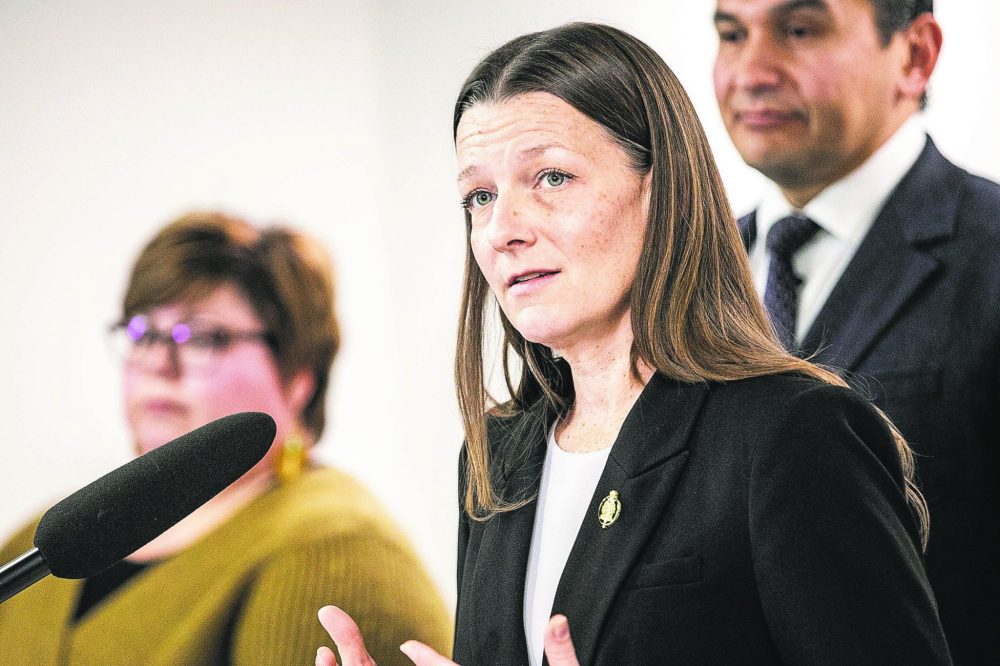
“Our department, and really across the government, have been paying a lot of attention to this issue… we’re still in a fact-finding mode,” Education Minister Tracy Schmidt said in a phone interview earlier this week, expressing her shock.
“It’s a serious issue. As a Manitoban, as a parent, as a mom, I have serious questions about how there could be someone teaching here in Manitoba that is completely off the radar.”
A Free Press investigation has revealed that Martens — who was charged in April 2025 by the RCMP’s Internet Child Exploitation Unit with luring and invitation to sexual touching following allegations involving two teenaged girls and stemming from his role as a teacher — taught outside any regulatory oversight.
He was removed from the classroom when the allegations surfaced last January. His charges are still before the courts and he is presumed innocent.
In a startling admission, Schmidt confirmed that the province has “no record” of Martens holding a valid teaching certificate.
Furthermore, the Department of Education has no record of a limited teaching permit being issued in his name.
“My understanding is that this individual, possibly, was in a classroom without either of those things, contrary to our legislation,” Schmidt said, stressing the province is still in the early days of probing the matter.
“As far as the department’s concerned, this individual was never on our radar, and ought to have been, because to teach in a classroom here in Manitoba, you either have to have a teacher certificate, which you get from our department, or have a limited teaching permit, which you also get from our department.
“So, I have a lot of questions about how exactly this individual was in a classroom at all. I don’t have the answers to that question yet.”
Because Martens was uncertified, he operated outside the jurisdiction of the province’s Commissioner on Teacher Professional Conduct, despite being paid by the Hanover School Division and being a member of the Manitoba Teachers’ Society.
And since no permit was issued, the mandatory provincial safety checks that accompany that application were never triggered.
For education and child safety experts, the discovery was chilling.
“It is beyond egregious. If the division ignored The Public Schools Act… then this appointment was illegal,” said Cameron Hauseman, an associate professor of education at the University of Manitoba.
“Either the system is rotten to the core, or some of the folks who oversee these processes dropped the ball at some stage. I’ve never heard of anything like this happening in any other jurisdiction in Canada. I’m at a bit of a loss here. I can’t believe it.”
Hauseman added: “Where we go from here, the hard question is: how many more of these ghost teachers exist within the system?”
How does a teacher work in a public school without the province knowing he exists?
In Martens’ case, Hanover superintendent Joe Thiessen said the division was not required to apply for a permit for Martens, a Red Seal electrician, once he graduated from RRC Polytech’s Technical Vocational program in the fall of 2024.
“Once a teacher has graduated… a limited teaching permit is no longer required,” Thiessen wrote in an email, saying the division waits for the teacher to apply for their own certificate.
But Schmidt says a “graduation exemption” does not exist: the law requires that an educator hold either a certificate or a permit to be in the classroom — there is no grey area.
At the very least, Martens was teaching for several months without a certificate, before he was removed following the allegations.
It is unclear whether limited term permits were applied for in Martens’ case.
Hanover said they were, while Schmidt says her department has no proof they exist, meaning Martens was possibly shielded from oversight from the moment he stepped into a classroom.
Had Hanover applied for the permit, Schmidt said, that would have triggered the necessary background checks.

Last January, the province introduced a new teacher disciplinary oversight mechanism, which included the appointment of an independent commissioner to increase transparency when it comes to professional misconduct and to make schools safer.
The registry lists all teachers with a teaching certificate dating back to 1960, and provides a discipline outcomes list that names teachers who have faced serious disciplinary measures, including a suspended or cancelled certificate.
Martens is not on either list.
When Commissioner Bobbi Taillefer was asked if the province’s independent watchdog could investigate him, she said her hands are tied.
“Under the legislation, the commissioner does not have legislative authority to investigate a report or complaint involving anyone other than a certified teacher or school clinician,” Taillefer wrote in an email. Uncertified staff, she confirmed, are outside her reach.
When asked if the Hanover School Division, RCMP or any other agency had attempted to flag the case for her office, Taillefer stated she could not comment on individual cases.
However, Martens was still a member of the Manitoba Teachers’ Society. President Lillian Klausen said in a statement that union membership is automatic for anyone who “fills teaching positions in public school,” regardless of their credentials.
Hauseman calls the division’s lackadaisical approach to ensuring whether a teacher was properly licensed, combined with the glaring gap in the province’s oversight system, a stunning institutional failure.
“They and their practice would stand outside of the bounds of all of these accountability structures which have been put in place to protect students,” Hauseman said.
“It’s incredibly problematic… that the division would allow somebody to teach in the classroom without going through those various steps. And Hanover needs to answer for that directly.”
Those regulatory blind spots have brought in sharp focus the severity of the allegations Martens faces.
On April 14, 2025, he was charged with one count of luring and one count of invitation to sexual touching.
The invitation to sexual touching is alleged to have taken place between Dec. 1, 2024 and Jan. 10, 2025, while the luring charge is alleged to have spanned more than a year, between Sept. 1, 2023 and Jan. 10, 2025.
Steinbach RCMP confirmed they received information regarding the accused on Jan. 10 and immediately launched an “extensive investigation.”
A spokesperson stated the charges stem from Martens’ role as a teacher and confirmed they were in close contact with his employer “from an early stage,” providing information on the nature of the investigation.
However, police did not issue a news release regarding the charges. The RCMP said public notifications are not automatic, but are determined after investigators review evidence, electronic devices and interview witnesses. In this case, the RCMP added, “the process was followed.”
Court documents indicate the charges involve two separate victims. However, three girls currently have protection orders against Martens.
He was released on bail last April on several conditions, including that he stay away from Steinbach Regional Secondary School. He is also not permitted to continue or start any employment “in a capacity that involves being in a position of trust or authority over a person under the age of 18.”
Despite those conditions, Martens remained a union member until August, according to MTS, meaning he was technically considered to be a teacher for four more months.
Martens did not respond to a request for comment. His lawyer declined to answer a list of questions.
Combine all the factors surrounding Martens’ case and the result is a fractured system, Hauseman said.
Child safety experts agree.
“We like to wait until something bad happens and then all point the finger at somebody else,” said Christy Dzikowicz, the executive director at the Toba Centre for Children and Youth.
“Instead, we should all be looking within and ask: what could I have done about this?”
Martens was also a prominent figure on Manitoba’s football scene, serving as junior varsity coach for the Steinbach Sabres and as a position coach for the provincial U-18 team.
His bio from Football Manitoba states he spent three years with the Steinbach Regional Secondary School varsity team as quarterback and wide receiver coach.
But just as he flew under the radar of the Department of Education, he was invisible to the body overseeing high school sports.
“He was never listed anywhere as a head coach in our system. In fact, he’s not even in our user database,” said Chad Falk, executive director of the Manitoba High School Athletics Association.
“I had another person here run his name and it didn’t show up anywhere, in any version of spelling of the name.”
Jeffrey Bannon, commissioner of the Winnipeg High School Football League, says Martens has not coached in the league since the 2024 season.
While Bannon, who was general manager of the U-18 provincial team while Martens was on staff, knew the former coach had been removed from his post, he — along with the rest of the league — was not told why.
When he pressed some of the Steinbach coaches, Bannon was told Martens was on administrative leave and, later, that his contract hadn’t been renewed.
“I knew him well and we always had a candour. He’s a family man,” Bannon said, noting that Martens had mentored his son.
“But if you’re telling me there are charges, this is the first time I’m hearing this.”
According to Falk, the MHSAA relies on schools to vet their own staff — a policy that was echoed by Football Manitoba.
“The schools do these, we don’t,” confirmed Bill Johnson, executive director of Football Manitoba.
Court documents obtained by the Free Press show that Martens, upon his release, agreed to conditions that restrict his digital activity.
He’s banned from using computers or cellphones for anything other than banking, medical emergencies or communicating with legal counsel. Other conditions prohibit him from “continuing employment” or “becoming a volunteer” in any position of trust over minors.
Despite those restrictions, until Friday morning Martens was still active on X (formerly Twitter) as “Coach Martens,” posting play-by-play analysis of NFL games and engaging with the sports community. His X bio had identified him as a coach with Football Manitoba and at Steinbach.
Shortly after the Free Press contacted Martens and the RCMP for comment, his social media accounts were set to private or restricted.
The Martens case should be a warning sign for an education system that increasingly relies on staff who face fewer regulatory oversights than veteran teachers.
According to freedom of information data obtained by the University of Manitoba, the use of limited teaching permits in this province has surged. There were 771 permits issued in the 2023-24 school year — nearly a 58 per cent increase over the 489 permits issued in 2019-20.
Despite this growing reliance on permit holders — albeit still a relatively small number compared to certified educators — the province’s new teacher safety framework explicitly excludes them.
Taillefer says legislative amendments to bring permit holders under the jurisdiction of her office are unnecessary, since she is confident the minister can handle the regulatory oversight.

Noni Classen, director of education at the Canadian Centre for Child Protection, is shocked by that position.
“Her answer is so perplexing, it doesn’t make sense. Why wouldn’t they be included?” Classen asked.
“They have a permit to be teaching, so they should be held accountable under the same standards as a teacher.”
By leaving permit holders out of the independent registry, Classen warned, the province is creating a “gap in child protection” that allows potential predators to move through the system undetected.
“Sanctions can be imposed beyond the employer, and it can be tracked across school divisions, in case the person ends up moving around,” Classen said.
“We know that the gap exists, and now we’ve just, in a different way, identified an even bigger problem.”
Hauseman said the minister of education has the authority to address this failure. He pointed to the Education Administration Act, which gives the minister broad powers to investigate school boards.
If Hanover School Division claims it submitted paperwork that the province denies receiving, or if it bypassed the law entirely, the minister has the authority to seize records to determine the truth.
“One hundred per cent, the minister of education should be calling an investigation or an inquiry to determine what exactly happened in this situation,” he said.
Schmidt said she is prepared to explore all options to find out what happened in this specific case and to address the bigger issue of oversight gaps.
“Considering the increase of limited teaching permits we have here in the province, maybe it’s time for us to look at limited teaching permits and how those are reflected on the registry,” Schmidt said.
“Legislative changes would be required for that. I think it’s too early days to see exactly where we could go, but I think nothing’s off the table….
“We’re going to ask the hard questions, we’re going to get the answers, and we’re going to address this issue, for sure.”
“We’re going to ask the hard questions, we’re going to get the answers, and we’re going to address this issue, for sure.”
Beyond this case, experts agree the law must be changed. They argue the distinction between a certified teacher and a permit holder is a bureaucratic line that means nothing to a child in a classroom.
“We should expect that when a child or family is coming forward with concerns, that they are met with people who are trained, who have the competencies to be handling and receiving the information,” Classen said.
Braeden Martens was a ghost in plain sight.
In recent years, he had stood at the front of a vocational classroom at Steinbach Regional Secondary School instructing students. Once the bell rang, he moved to the football field, serving as a mentor and coach for the school’s teams and coaching the province’s elite U-18 club.
To parents, students and football leagues of Manitoba, he was a trusted authority figure. But to the government of Manitoba, Martens did not exist.