
Farmers claim provincial drains have not been maintained for 80 years causing flooding
Advertisement
An RM of Hanover councillor is calling the flooding of farms and the lack of provincial drain maintenance a problem.
“It’s not a NDP problem. It’s not a PC problem. It’s a provincial problem,” said Ward 1 Coun. Travis Doerksen.
Farmers in the RM are saying provincial drains have not been maintained since they were built 80 years ago, causing overland flooding on their fields.
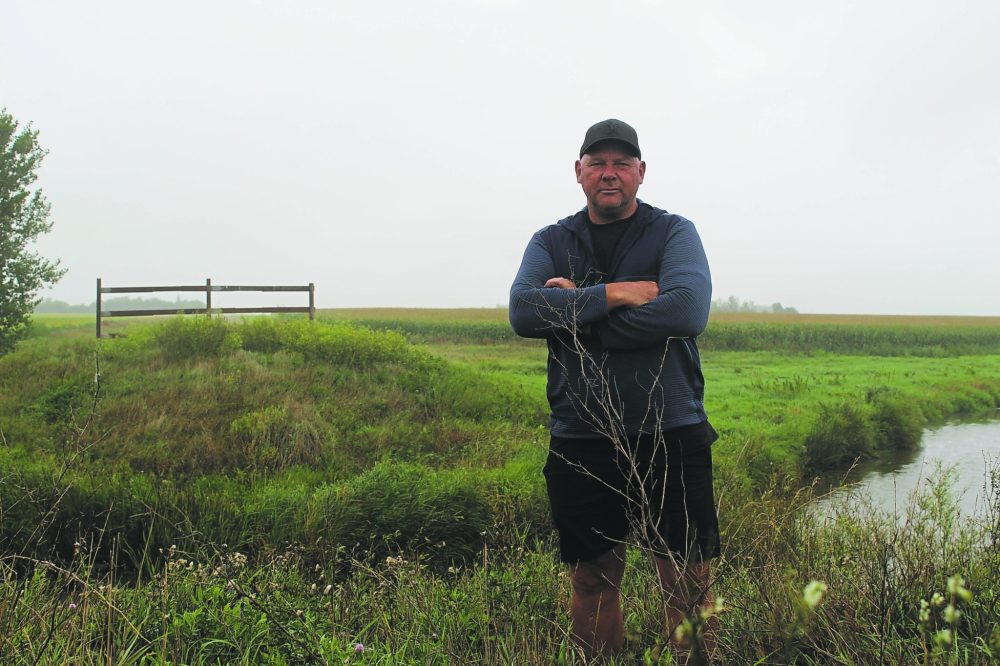
“I think there’s concerns for quite a while. It’s just something that’s been building, and obviously last fall we had a few large rain events, in the last maybe even few years, so there’s definitely a growing concern over the lack of maintenance in some of the provincial drains, specifically, I guess, in the Southeast area,” said Kevin Peters, vice-president of Keystone Agricultural Producers (KAP) and District 4 director. Peters operates a 7,000-acre grain and oilseed farm near Randolph, which includes hog production.
Peters said there are probably five drains that are a concern in Hanover (near Kleefeld, New Bothwell, and Niverville), with the biggest concern being the Manning Canal, which runs across PR 206 and along PR 311.
All those interviewed by The Carillon said the provincial drains were built in the 1940s and 1950s and since then there has been little to no work done to maintain them, causing sediment to flow in, banks to collapse, beavers to build dams, and vegetation growth, all blocking the flow of water.
The situation has gotten worse, especially in the last couple of years when Hanover experienced two large rain events in September 2025, where two months’ worth of rain fell in a couple of hours (13.5 centimetres) leading to flooding in the City of Steinbach, preceded in September 2024 when 15 cm fell in Hanover.
“So, it’s not just a farmer issue, I’ll say. I think it does affect everybody,” said Peters, who noted KAP has been lobbying the government for maintenance of the drains.
The issue has been a sore spot for Scott Rempel whose family has had a farm in the Tourond area since the 1940s. His problem is with provincial drains D20 and the Tourond. The issue had such importance for him that he got area farmers to call their municipal and provincial representatives. MLA for La Verendrye Konrad Narth called a meeting in December where about 30 farmers showed up to discuss drainage, including Rempel.
“These farmers see a great deal of frustration when a year’s worth of work in nurturing a crop that has successfully come to harvest can be devastated by a larger fall of rain,” said Narth.
Rempel and Peters estimate damages to farmland in the Southeast are in the millions of dollars. Rempel said if the province doesn’t fix the drains, farmers are considering lawsuits.
“And don’t get me wrong, I expect water to be standing on my fields after a big rain. It’s part of what we live with. The problem is when you start stretching that water standing there for two weeks and three weeks, that’s when the real damage starts to occur and the frustration level gets very high at that point. Because, I mean, we were in the middle of harvest and there wasn’t much we could do,” said Rempel, noting last September’s floods were the worst he’s experienced in his 40 years of farming.
Rempel and Narth said the province told them that they have gone out to check the drains, and that there are no issues. “It’s kind of like, well, you didn’t ask anybody,” said Rempel.
RM of Hanover manger of works and operations Wes Fehr said, speaking to his counterparts at the province, the issue as to why work on the provincial drains hasn’t been done has to do with funding.
He concurred that provincial drains are affecting about 1,400 km of municipal drains, the most destructive being the Manning Canal, which affects Mitchell, Kleefeld, and New Bothwell, and which Fehr would like the maintenance of extended further into the municipality.
In a statement, the province reported that Manitoba Transportation and Infrastructure “continues to work co-operatively with municipalities to address water management concerns, including drain maintenance, where possible.”
The government has about 264 drains across the province, with a total length of about 4,750 kilometres. Most drains are found in south central Manitoba and the Interlake area, with about 175 km of drains in or adjacent to the RM of Hanover.
The province spends about $150,000 annually on drain maintenance within the RM of Hanover, including vegetation and noxious weed removal, sediment clean-out, snow removal, and structural repairs.
The province said it is or will be working on a number of drains and bridges in and around the municipality well into 2030, including the rehabilitation of 11.2 km of the Manning Canal, which is anticipated to be completed in 2030 or 2031; rehabilitation of 6.4 km of the Prefontaine Drain is anticipated to start in 2026 or 2027; 2022 flood damage repairs to Joubert Creek extension drain is ongoing and anticipated to be complete in 2026 or 2027; replacement of two culverts on the North Arm Upper Manning Canal anticipated to start in 2027 or 2028. Bridge work for the Manning Canal and Tourond Creek drains will start this year and finish in 2030.
Farmers are not allowed to clean out provincial drains and the rural municipalities need permission from the province to do so or act in partnership with the government to clean them out. Doerksen said Hanover has done minor maintenance on provincial drains such a mowing, but that it comes at a cost.
“So, the argument is we’re using municipal funds for provincial infrastructure,” he said.
Hanover CFO Derek Decru said Hanover spends about $250,000 annually on drain maintenance in its five communities and the rural areas. Last year, the RM spent $344,471.
The prospect of the municipality taking over maintenance of provincial drains from the province is not feasible, according to Fehr, as the financial burden to ratepayers would be too high. Doerksen said if the funding was there by the province, Hanover would be receptive to the idea.
Doerksen, who attended Narth’s meeting, said the RM held a strategic planning session two weeks ago where the municipality was in preliminary discussions to invest money into drainage and create a master drainage plan.
“We all know the water moves northwest. So, we really have to start in that area and move towards the south. We’re working on a bit of a plan there on Hanover’s part,” he said.
While flooding is seen as a maintenance issue, so is the issue of capacity. Seine Rat Roseau Watershed District (SRRWD) manager Joey Pankiw said the drains were never designed to take on as much water as they have in recent years as they were “designed for the realities of farming 70, 80 years ago.”
“And we’ve gone to a place where every square inch of farmland is now drained, putting all that extra water into these systems,” he said. Pankiw noted the growth of urban centres has also put pressure on the drainage system.
Rempel was told the drains were designed for a 2-inch rain capacity, maximum of 3 inches, with “the water being held on the field that extra inch.”
“So, we’ve obviously maxed out the capacity,” said Rempel.
“Yeah, we need to get these drains cleaned out, but it’s not a cure-all. We have to look at how we design drainage systems,” said Pankiw.
Pankiw was recently at a conference in the United States where he learned that America is moving away from canalized drainage and into more water retention pools in low-lying areas. He noted buffers, such as growing grass along drains, are also being employed to prevent sediment from flowing into the waterways.
The effect on the watershed from flooding has seen sediment and phosphorous flowing into the system.
“Especially areas southeast of Steinbach, where we’re seeing massive amounts of bush clearing converting to cultivated crop. All that used to be a giant sponge for this water, but we don’t have that sponge anymore. That water is just racing down off that towards Steinbach and then into the Red River Valley,” said Pankiw.
“It just gets here quicker. We’ve seen a lot more flooding, localized flooding now, especially the last couple of years since September…There’s no kind of safety nets holding anything with the water back. We’re trying to get rid of it as quick as possible.”
Pankiw said the watershed district has funded about 15 water retention projects in the Southeast where every year it builds two to three water retention structures, such as dry dams which hold back water for a week, at anywhere from 100-acre feet to 25 to 15 to 10 acre feet in size.
“An acre foot is just a foot of water over one acre,” said Pankiw, noting nine producers have already participated in the projects in the Southeast. Fehr said Hanover is actively participating in these retention projects with SRRWD.
“We’re always looking for areas and people to work with who would like to invest in these types of projects where we can hold water,” said Pankiw. “It’ll help dry up some of these areas so instead of draining, let’s hold water in small areas to protect the rest of your land instead of putting a giant ditch across the field. This negatively impacts everybody else downstream.”