
1946 to 2026 Watching Steinbach grow: Teaching a part time job at early Steinbach schools
Advertisement
Early Carillon News subscribers learned a lot about the history of education in Steinbach when the weekly newspaper published its very first “Progress Issue” in December of 1947.
A three-page feature article tracked the attention given to education from the time when early village settlers volunteered their time as teachers and their homes as schoolhouses, to a time when 19 teachers in three schools taught a school population that had grown to over 600.
Education in Steinbach has no little red schoolhouse in its background, but its beginnings were more humble than that.
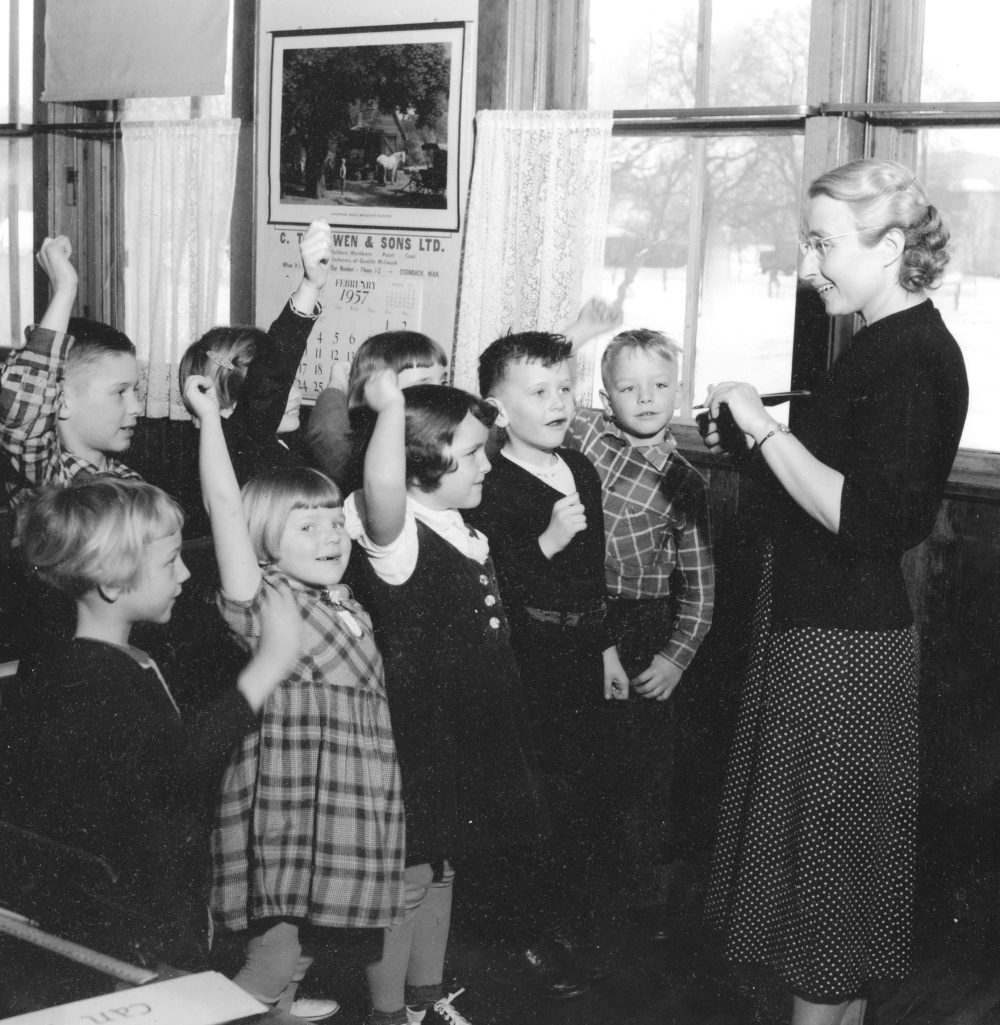
When the village was founded in 1874, there was little enough time to prepare houses for shelter without anyone taking time to work on a school building. However, the community realized some instruction should be provided and Rev. Jacob Barkman and Klaas Reimer offered their services for free.
A log schoolhouse, with a thatched roof, was built in the fall of 1875, on a Main Street lot which later became the site of the post office, then later Steinbach town office and finally the present location of the Toronto Dominion Bank.
From the turn of the century, the increase in school enrolment was fairly steady, necessitating additions to the staff until the number of 19 teachers was reached in 1947.
The number of teachers employed in Steinbach schools in 10-year intervals was as follows: 1887 – one; 1897 – two; 1907 – two; 1917 – three; 1927 – six; 1937 – 10; 1947 – 19.
Of the three Steinbach school buildings those 19 teachers taught in, the oldest was an elementary school, built in 1912-13. In 1947, it was providing its 35th year of service. The Steinbach Collegiate followed in 1936, and a new intermediate school was first used in the spring of 1947. Enrolment in Grades 1 to 12 in Steinbach was over 600 that term.
High school instruction started with one classroom in 1920, with Jacob G. Kornelson and A. P. Friesen as instructors. It was expanded to two classrooms about five years later and moved into the new Steinbach Collegiate building in 1936.
In 1946, with a record number of Grade 12 students, the three senior high school grades had well over 100 students.
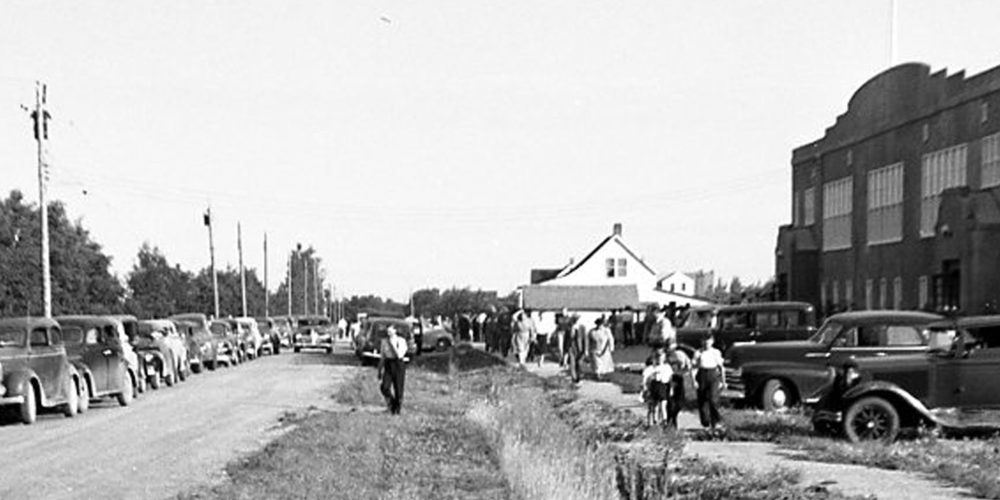
Most prominent on the list of past and present Steinbach teachers is the name of Kornelsen, for no less than five members served for varying lengths of time.
G.E. Kornelson was the second teacher hired in Steinbach in 1876 and taught for 22 years. In later years three of Kornelson’s sons, William G., Jacob G., and Gerhard G., taught school in Steinbach for many years along with granddaughter Mary Kornelson, who began teaching in 1929 at the age of 16 and was principal of Kornelson School when it closed in 1964. When Kornelson was named a Centennial Citizen of the week in 1967, she claimed to be the oldest active teacher in Steinbach.
Peter S. Guenther also enjoyed a similar distinguished record of service to the community. He taught elementary school children for 41 years, starting with Randolph School in 1920. Guenther, who retired in 1962, was principal of Kornelson School from 1936 to 1946.
Steinbach schools were well up-to-date in 1947, with students enjoying many of the brighter facets of the provincial education system. A good general education was provided in the lower grades and at the high school, courses like shop, home economics, and business training were offered as electives.
At that time, many changes to the public school system were about to take place. The editor of The Carillon News wondered how people had managed to flourish in an educational system that had ignored psychology and aptitude tests, which were soon to be part of a new public school system.
It is hard to imagine the reaction of those early readers of The Carillon News, had they been confronted with today’s vision of “artificial intelligence.”
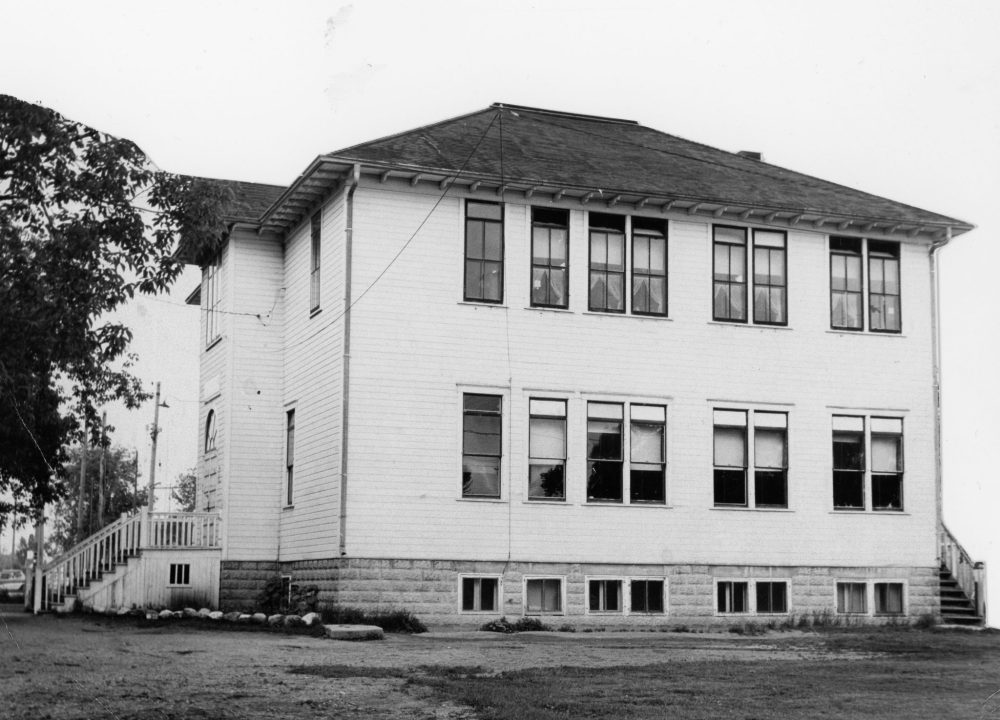
Those early Steinbach schools taught the “Three Rs”, but in Steinbach’s case there may have been four, Reading, ‘Riting’, ‘Rithmatic’ and Religion. Assemblies of all students for religious exercises every morning in Steinbach schools continued for years.
But it wasn’t long before the government’s restrictions on the teaching of religion in public schools, in part, prompted another emigration of Mennonites, as 1,500 left southern Manitoba for Paraguay in 1948.
For years, The Carillon News included in its community news a column from a Paraguayan correspondent, keeping relatives in Canada in touch with day-to-day life of their Mennonite relatives in South America.