
Feasibility study on Sundown Ridge project deems project not worth the money
Advertisement
A recently completed feasibility study regarding the construction of a water drainage project in the RM of Stuartburn has determined that the project is not worth the cost of construction, yet municplaities are still considering the initative.
The feasibility study for the Sundown Ridge project was conducted by the Seine Rat Roseau Watershed District (SRRWD), who submitted its findings to the RMs of Stuartburn and Piney (who are partners on the project), ultimately deeming “the projected benefits (of the Sundown Ridge Project) do not justify the estimated $3 million capital cost,” according to a press release from the SRRWD.
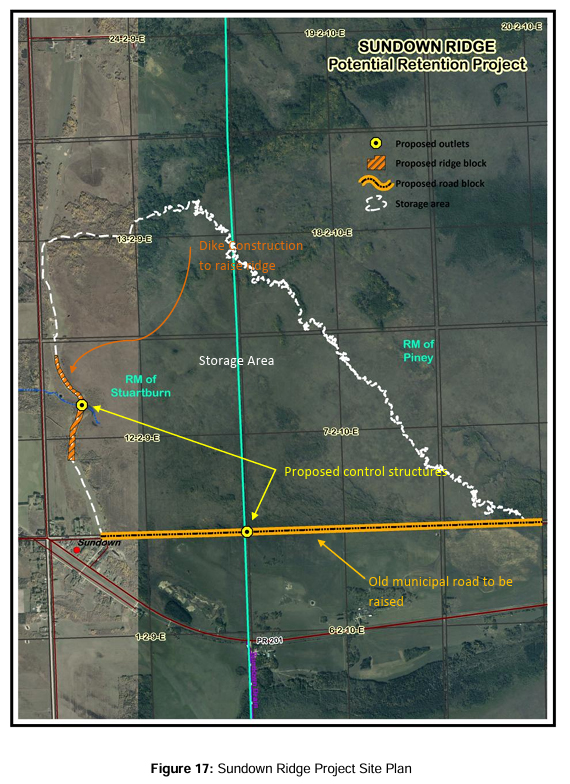
Pankiw said the Sundown Ridge project is not a water retention pond or reservoir as it will not permanently hold water, rather it is a dry dam that will hold water temporarily and then slowly release it when conditions deem it possible. The dam will have two L berms to the north and south with a spillway at each berm that will slowly release water when it hits a certain elevation.
SRRWD manager Joey Pankiw told The Carillon that the cost is a very conservative amount if the project were to proceed.
“So, there have been water management issues in (Stuartburn) for a long time,” said Pankiw.
“The RM of Piney and Stuartburn are looking at what options there were in the area for holding back some water.”
In 2024, SRRWD applied for and received $68,300 from the Federation of Canadian Municipalities’ Green Municipal Fund to do the feasibility study. Stuartburn Reeve Michelle Gawronsky was asked what her thoughts were on the project not being worth the money and she did not respond.
Gawronsky has been a vocal supporter of the Sundown Ridge project for a number of years, and she said Stuartburn is naturally wet.
“We are naturally a wet municipality. We have bogs, we have swamps, we have natural water here. We get the water from the U.S. side up the Roseau River. We get the water off of Horseshoe Lake (and Piney).”
The town of Sundown flooded last fall and the province was involved in helping mitigate the flood. Gawronsky didn’t know the costs involved.
Since 2014, a number of studies have been done regarding flooding in Stuartburn and the Sundown Ridge project.
In 2016, the Roseau River Distributed Water Retention Study was done by the province’s water science and management branch as part of its support for the development of the Roseau River integrated water management plan, which looked at possible water retention throughout the whole Roseau River Watershed, which includes Stuartburn and Piney.
About two or three years ago, Pankiw said the two RMs and SRRWD formed a committee to see if the Sundown Ridge project was feasible with SRRWD taking on the coordinator and liaison role.
SRRWD asked provincial engineers at the water management branch to provide a report on possible design and cost options. The province suggested three designs: One that could potentially hold 2,600 acre feet of water (one foot of water over one acre); the second option would be 300 acre feet of storage; and the last option was for 17 acre feet. The committee decided on 1,300 acre feet at an estimated cost of about $3 million.
“So, that has been in the works for a very, very long time. It’s very expensive to do it. No one wants to take any responsibility for it,” said Gawronsky, noting she has documentation on the Sundown Ridge project and flooding from Horseshoe Lake from 2017.
Stuartburn received a grant of $100,000 from an insurance company to do an engineering study of the municipality as it relates to flooding and drainage. Stuartburn has paid $50,000 to Strategic Systems Engineering to do the work. Gawronsky said the municipality has been fixing drainage issues piecemeal, which is like putting a “Band-Aid” on the problem rather than having an overall plan in place to address issues in a way that won’t cause more flooding issues in the municipality.
The location of the Sundown Ridge project is at the northern edge of the town of Sundown and according to a provincial study it is expected to have a drainage area of 90.98 sq.km.
The feasibility study also noted that several considerations need to be taken into account should the project go ahead, such as securing local landowner support, obtaining participation and agreement from affected landowners for licensing and permits, and addressing potential technical challenges during design and construction.
One of the considerations that also need to be taken into account is the type of soil that is located in Stuartburn.
A provincial study found the majority of the soil in the RM is sand, about 44 percent, followed by loamy at about 18 percent and organic/peat at about 14 percent with stoney/cobbly soil. Soil drainage is classified as being very poor to imperfect with a high water table.
Pankiw, Gawronsky, and Piney council and administration all agree that this is just the beginning of the Sundown Ridge project, which can take years before construction begins as there are many questions that need to be answered, especially regarding costs.
“But the problem is…(the feasibility study) is not giving us a true benefit of what we’re getting because these are things that you could have, but maybe in the distant future. So, could you do something different with $3 million plus to benefit the individuals in the area, and how did it impact all of the area, like even farther down, how did it impact Vita drain and so forth, and we really didn’t get that,” said Piney Coun. Ken Prociw, who sits on the committee.
“We have these proposals and we’re trying to see what is the best benefit for the (Piney) area.”
Piney CAO Martin Van Osch said considerations as to liability, hiring skilled labour to manage operation of the dam, who is affected by the release of the water downstream, who will maintain the dam, construction of the dam, how will costs be divided, further studies that might be needed, and other factors need to be considered and questions answered.
“I don’t really know where the next step sits, to be perfectly honest. These are questions that we have (and need answers to),” he said.
According to Van Osch, the RM of Piney sits at a higher elevation than Stuartburn and holds the headwaters for the Seine, Rat, and Roseau rivers, and because of this the water generally flows into Stuartburn and the water within Stuartburn flows in a northwesterly direction.
The two RMs share municipal drains along their borders and meet about every six to 12 months to discuss the maintenance and cleaning of the drains, which both claim are difficult to maintain as a number of factors have to be considered when doing maintenance on shared drains. Both cite beavers as being the main source of blockage for both shared and municipal drains.
Prociw believes that should the Sundown Ridge project go ahead, the province should bear the brunt of the costs as it was responsible for redirecting the water from Horseshoe Lake and flooding residents near Municipal Road 54E and PR 201.
Located 6.5 kilometres east of the town of Sundown, just across the Stuartburn-Piney municipal boundary, Horseshoe Lake (also known as Sundown Lake) was created by Ducks Unlimited Canada (DUC) in 1956 and has been known to flood the Sundown area as water has been overflowing its banks for years. Gawronski said DUC has walked away from Horseshoe Lake and its maintenance.
Another issue with Horseshoe Lake is a provincial drain that was built to maintain the water elevations of the lake, but it led to flooding at the end of the drain located along Municipal Road 54E and south of Provincial Road 201 (between the towns of Vita and Piney).
The province refuses to address the issues of flooding past this drain, which has caused farmland to become unusable – essentially a bog, according to Piney Reeve Wayne Anderson in an interview with The Carillon in 2024 about the matter.
DUC wasn’t able to give an interview, but a spokesperson stated in an email that the organization hasn’t received any calls from residents or the reeves of Stuartburn or Piney this year. He states that DUC has reached out to the reeves and is waiting for a response.
“I can also confirm that we are operating (the Horseshoe Lake dam) project in accordance with dam safety regulations and scheduled inspections. An inspection is scheduled for this week (the week of April 28),” he wrote.
While SRRWD has ended its involvement in the Sundown Ridge project, it will still fund construction with $160,000 over five years up to $200,000. But as the funding is from the province, Pankiw said SRRWD might not be able to hold the funds indefinitely.
Should this project come to fruition, Pankiw said it will be the biggest dry dam in the Southeast.
“The Sundown Ridge, like I say, it’s a long time in coming it’s been many, many years,” Gawronsky said. “Numerous councils have been trying to deal with water issues in the RM of Stuartburn and this council is no different than any of the others and we’re doing the best that we can to make sure that we’re looking for long term solutions.