
Stuartburn resident sues municipality over flooding, reeve said municipality is naturally wet
Advertisement
Manitoban Bill Dell and his wife moved from Thunder Bay, Ont., to a property three kilometres north of Sundown, near Municipal Road 53, in June 2024. The couple felt the area was ideal for retirement and more importantly it was closer to Winnipeg as their daughter, who lives in Red Lake, Ont., frequently comes to Manitoba with her children for visits and shopping.
Initially, Dell had no problems with living on his 11-acre plot, until the water came.
“And there was no water when we bought the house, and the ditches were dry, and everything was wonderful. And then they put the drain across, and the water started coming slow. But when we got water at the end of October (2024), the rains were coming pretty hard,” he said.
Dell started noticing the ditches surrounding his property were beginning to fill up with water and were clogged by trees that were “growing into them.”
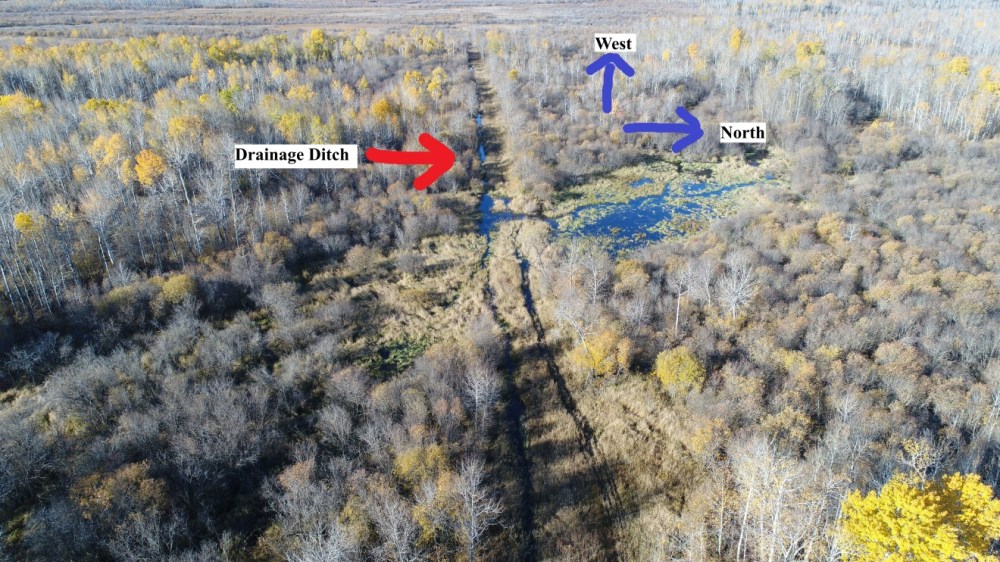
He noted there wasn’t a functioning drain to the south of his property, but two months after moving in, the municipality dug a drainage ditch 500 meters south of his home across the ridge.
He claims the municipality directed water from one side of the ridge to the other into ditches surrounding his home, which eventually overflowed and flooded his property in 2024.
Dell has now taken legal action against the RM and in his affidavit he also claims the municipality has not been maintaining the drainage system around his house and in the RM for the years that he has lived there, as the drains are “infested by beavers and beaver dams.”
According to Dell, the water from his property is supposed to go from east to west across the ridge into the ditch on Road 53, and then across Road 53 via two culverts to a drain that removes water from the west side of Road 53.
“And then it runs into the ridge again, so it can’t go north any further. So, they’re just making a big lake around my house,” Dell told The Carillon.
He noted the municipality failed to complete the work by extending older drains that would have relieved the pressure on the ditch near his home.
“They failed to follow their own policy on managing drainage ditches,” he wrote in his Feb. 12 affidavit.
Dell first voiced his concerns regarding the flooding on his land on Oct. 21, 2024, when he went to an RM council meeting. He was told that, according to the public works manager, the water level in the ditch around his home was normal.
Dell was told by council that he needed to fill out a form if he wanted the drain cleaned, which he did. At a council meeting following his application, Dell had his request denied by council once more for the same reason that the public works manager stated the water level was normal.
On Oct. 25, 2024, he sent another email to the municipality asking for the drains to be cleaned, but nothing was done.
Dell’s concerns about the drainage around his property were validated when on Oct. 29 he informed Reeve Michelle Gawronsky that his property was flooded and the concrete crawl space under his home had about two to three inches of water at its highest point.
“All of a sudden, (water) is just gushing out of there (drain) and into the ditch, and the ditch isn’t handling the water…” he told The Carillon.
“And if they wouldn’t have dug the drain across the back of the ridge that they did in 2024, everything would have still been fine.”
Dell states in his affidavit that following the flooding to his land on Oct. 29, his neighbors had informed him that they were unaware of any water issues on his property prior to him moving there.
He also cited lifelong resident of Stuartburn Dale Dooley, who was employed by Manitoba Infrastructure and Transportation as a roadway construction technician, who told him the gradient of the ditch the RM built near his property was faulty.
Through a Freedom of Information and Protection of Privacy Act request, Dooley gave The Carillon documents from the RM showing past requests for drainage work. From 2015 to 2023, a total of 208 applications were completed fairly quickly within a month or so, with 23 applications that were cancelled or removed from the drainage works list during that time. Documents also show 45 recent applications that are classified as current/ongoing.
Gawronsky couldn’t comment on Dell’s situation as it is in litigation, but she did say that Stuartburn is naturally waterlogged.
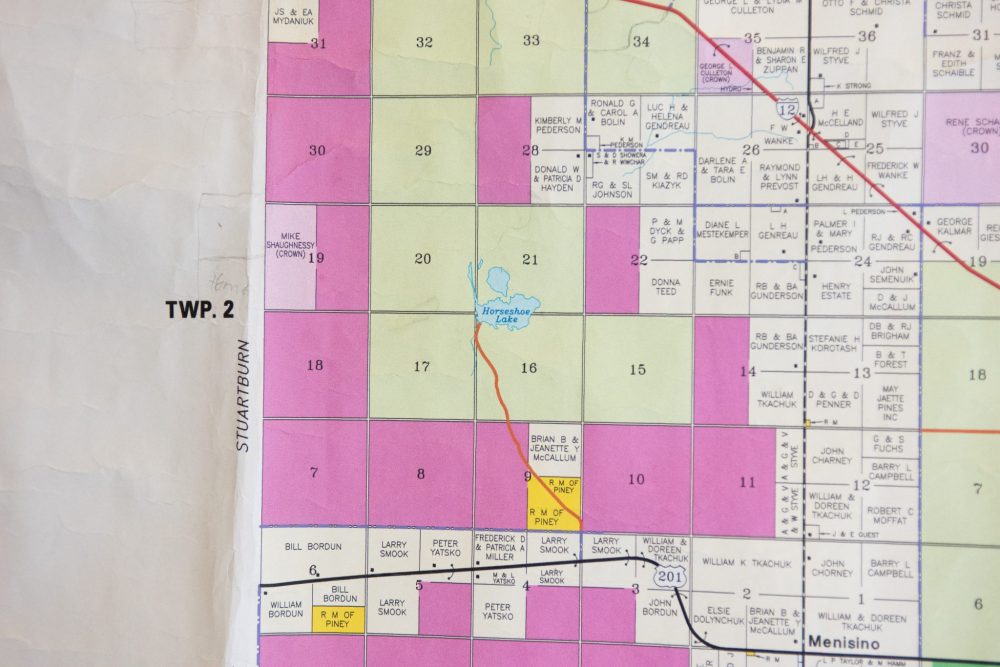
“We are naturally a wet municipality. We have bogs, we have swamps, we have natural water here. We get the water from the U.S. side up the Roseau River. We get the water off of Horseshoe Lake (and Piney).”
Part of Dell’s affidavit states the RM has not been spending all of its drainage budget pointing to the municipality’s financial plans from 2020 to 2024.
In his affidavit, Dell claims from 2020 to 2021 the municipality spent more than the budgeted amount for drainage during those years. Although council increased the budget to about $100,000 from 2022 to 2025, the municipality has been gradually spending less, in some years around 75 percent less, on drain maintenance.
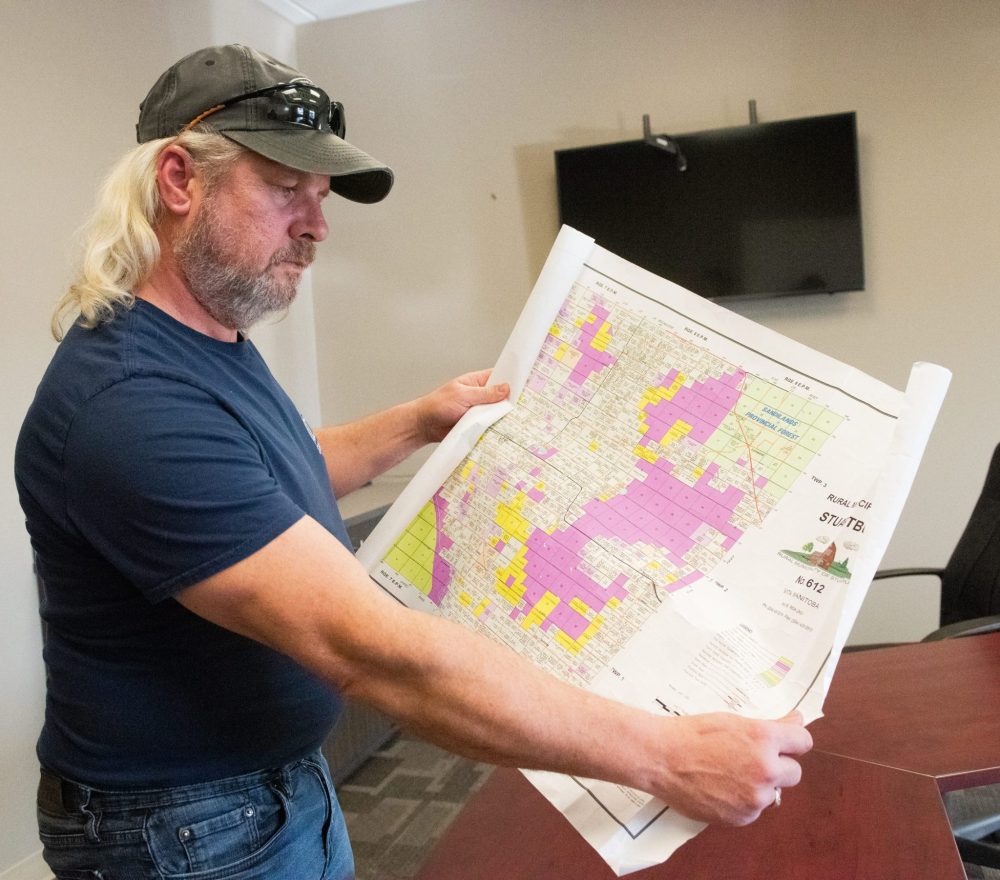
During her interview with The Carillon, Gawronsky was asked why there was such a large discrepancy in the financial plans of what was budgeted and what was spent on the drainage line item, especially between 2023 to 2024. She said the dollar difference was spent on brushing and culverts and other drainage projects in other line items, although she couldn’t specify what all the line items were that fell under the drainage budget.
CAO Brittany Fisher, substantiated in an email, Gawronsky’s assertions regarding the budget to be true in that “drainage-related expenditures are not captured under a single line item,” but didn’t say what lines in the budget go towards drainage.
She submitted no further comment as the municipality is in litigation with Dell.
Since Fisher and Gawronsky couldn’t clarify the budget line items, The Carillon couldn’t verify how much of the budget was being directed towards drainage.
Dooley also blames the RM for not properly maintaining or neglecting its drains over the years, which has contributed to flooding on his property and his family’s property near Sundown.
“So, it’s this constant thing and a lot of us in this area are seeing this neglect as them using that as a tool to try and justify building this retention pond, this Sundown Ridge project,” said Dooley. “Because we have all these flooding area issues and all this is because we need this retention pond where, in fact, our problem is we have zero maintenance of our drainage systems, our ditches, RM drains, provincial drains, all those things.”
Dooley also noted the Sundown Ridge project will further flood his land.
Should the Sundown Ridge project proceed with its proposed location, Dooley’s property will be on the west side of the dry dam, while his family’s 70-year-old property, where his mother currently lives, will be on the lower east side of the project.
Dooley noted his mother’s property is already affected by on again/off again overland flooding due to a lack of drain maintenance connected to Horseshoe Lake, which also floods its banks and the drain that leads from it.
Dell believes council intentionally flooded his house and is not maintaining the drains in the RM in order to “support their want of a water storage lake (Sundown Ridge project) near (the town of) Sundown.”
The Sundown Ridge project (a 4,864 acre-foot dry dam that will hold and release water) is a partnership between the RMs of Stuartburn and Piney. It has had many studies done from provincial and municipal governments since at least 2014. Its location is expected to be at the northern edge of the town of Sundown and according to a provincial study it is expected to have a drainage area of 90.98 sq. km.
“It’s very expensive to (build the Sundown Ridge project). No one wants to take any responsibility for it,” said Gawronsky, noting she has documentation on the project from 2017, although the project has been worked on for more than 20 years according to her.
Recently, a feasibility study was completed on the Sundown Ridge project, which concluded it was not worth the $3 million it was estimated to cost for construction. Gawronsky questioned the validity of that conclusion.
Gawronsky said about two years ago, Stuartburn council decided they were going to try to fix the drainage issues in the RM with a long-term drainage plan, as the RM was just putting “Band-Aids” in repairing drains piecemeal.
“And this council, we took a look at it after two years. And we decided, alright, putting the Band-Aids works for a little bit in a small area, but it doesn’t fix the overall problems. And all we do is move the problem from one piece of property to another piece of property to another piece of property,” she said.
Currently, $50,000 is being spent from a $100,000 grant from an insurance company to fund an engineering study. The study has no set deadline.
“Once we know where water is, where it’s supposed to go, where would be good places to be able to have a natural storage (site) as well. And we want to be able to store water, release it when we can, so that it is not hurting any farmers, any land, anybody’s homes. We want to be able to control it,” said Gawronsky.
In a previously published provincial study on Stuartburn, the government found the majority of the soil in the RM is sand, about 44 percent, followed by loamy soil at about 18 percent and organic/peat at about 14 percent with stoney/cobbly soil. Soil drainage in the RM is classified as being very poor to imperfect with a high water table.
Although Dell’s property will run alongside the south end of the Sundown Ridge project, he doesn’t know if it will affect his land (water runs northwest in Stuartburn), but he thinks it will flood other properties due to the permeable soil.
“They’re going to put a lake on top of sand, and the water’s going to raise the water tables in the area because now you’ve got more pressure, and it’s going to flood out. Like when we had the water here and you drove around the little town of Sundown, everybody’s yard was wet. You could see water,” he said.
“It looked like they all had houseboats. Now if they put that lake in there, it’s going to be worse. What you have to do is remove the water from that area.”
The town of Sundown flooded last fall and the province was involved in helping mitigate the flooding with the RM. Gawronsky didn’t know the costs involved with that endeavor.
The RMs of Stuartburn and Piney share municipal drains along their borders and meet about every six to 12 months to discuss the maintenance and cleaning of the drains, which both claim are difficult to maintain as a number of factors have to be considered, such as the impacts on endangered species such as the western prairie fringed orchid and its pollinator the Sphinx moth. Both cite beavers as being the main source of blockage for both shared and municipal drains.
La Verendrye MLA Konrad Narth sat on the Stuartburn councillor for 12 years and said maintenance of drains needs to be constant otherwise clogging issues can get out of hand as the situation gets compounded year after year. Narth said he’s been getting phone calls from residents about the lack of drain maintenance in the RM.
Narth believes that further surveys of the RM are unnecessary as his council at the time did a survey using Lidar technology. He believes the results from that study should be used to create an overall plan for the municipality and work should start as soon as possible.
“Put a surveyor on the ground, get the work done, and just keep working each and every year.”
Gawronsky said she is unaware of any surveying or overall drainage plan from the previous council.
As to the maintenance of provincial drains, the Eastman Regional Municipal Committee Southern Sub-Committee sent a letter in December last year to Minister of Environment and Climate Change Mike Moyes urging the province to clean its drains in the Southeast.
“The province is not maintaining these drains and, by default, sometimes assigns responsibility to municipalities – often referencing policy or the Municipal Act – without municipal consent or benefit,” stated the letter.
The letter further proposes that the government develop a five-year and 20-year strategic drainage plan to prioritize, invest, and improve coordination across departments. The letter urged the province to work with the municipalities regarding drainage issues.
“The plan should identify priority drains, outline timelines for maintenance and rehabilitation, and integrate climate resilience measures,” stated the letter.
Narth said provincial drains haven’t been maintained for 50 years.
“It’s a long, ongoing neglect of the provincial government and I won’t even defend our party when we were in government. It was a neglect on infrastructure maintenance for a great number of years,” he said. “I served in municipal government under the NDP, then under the Conservatives and it was neglect under both.”
Narth sees handing over ownership and maintenance of the provincial drains to the municipalities with the government funding the maintenance of those drains.
“The municipalities know the drainage situations the best. They’re able to timely respond to the needs. You know, it’s their rate payers, it’s their residents that are affected by these,” he said.
Gawronsky thinks the maintenance of the drains should not fall on the municipalities as it will be a cost to the taxpayer, but she said if the government funds all the maintenance costs then the RM would consider it.
Gawronsky said if that were to happen then the survey that is currently being done would be even more important as it would determine costs. Her concern is would the provincial funding keep up with rising costs of maintenance and be available every year.
“When they can guarantee that to me, then we can sit down and talk about it, but until then, I think it would be the dumbest idea. It definitely would not be in the best interest of municipalities today in my view.”
According to the province, $5 million will be invested this year in Stuartburn regarding the Gardenton floodway flood protection enhancement. In Piney, whose waters flow into Stuartburn, the government will work on the Piney West Drain at a cost of $480,000.
As for Dell’s lawsuit, he has decided to represent himself and is seeking $20,000 in reparations due to “decreased property value, quality of life, and the significant amount of work to remove the water from beneath my house because of this event (flooding).” He is also asking for $2,000 in general damages.
Presently, his home is valued at $400,000 and is insured for $3,300 a year, without flood insurance.
Dell’s first hearing is on June 24.
“This is the shot across the bow,” he said. “You know, fix this, and if you don’t, well then, I’m going to sink your ship. I will retain lawyers and go after them because it’s just so ridiculous.”