
1946 – 2026 Watching Steinbach Grow: K.R. Barkman Centennial Citizen of the Week
Advertisement
Former Mayor K.R. Barkman was named by The Carillon as the newspaper’s first Centennial Citizen of the Week in January of 1967, for his contribution to the early development of the Town of Steinbach.
Before Barkman became Steinbach’s first mayor in 1947, its affairs were run by a board under the municipality. Actually, he was elected by acclamation in the fall of 1946, but didn’t take up his duties until the new year.
For a while, the new town council set up office in a part of the old credit union building. Later, part of the Goossen block on Friesen Avenue was rented. In these inauspicious surroundings, Barkman led the formation of a new system of town administration.
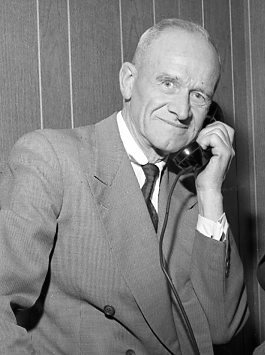
Born and educated in Steinbach, he also attended the Mennonite Collegiate Institute, but Barkman claimed Foam Lake, Saskatchewan, was the place where he really got the education he needed for his position as mayor of a town. Barkman and his wife, the former Maria Fast of Steinbach, made their home at Foam Lake for 23 years, and for 18 of these years, Barkman served on the town council there.
Barkman moved his family back to Steinbach, where he and his sons established Barkman Plumbing and Heating and later the Barkman Concrete Plant.
As the story goes, Steinbach citizens had been struggling with the pros and cons of incorporation for several years, when Barkman and his family moved back to town from their home in Foam Lake.
Barkman became the town’s first mayor, by acclamation on January, 1947. He retained the position, always unopposed, until he resigned 10 years later. The effects of his 10 year “reign” are still very evident in Steinbach.
The streets of Steinbach were a mess when the town was incorporated in 1947. There were no paved streets, and some were not even gravelled. Paving Main Street was the first task that the new town council undertook under Barkman, and it was the first of many improvements that caused the rapid growth of Steinbach in the 1950s.
An extra shot in the arm was the installation of sewer and water, 10 years later. Business and industries became established and grew, and continued to do so.
When Canada celebrated its centennial in 1967, the total assessment for Steinbach was 10 times the amount that it was at the time of incorporation, and much of the credit for this growth must be given to the men who sat on the town council during those early years of incorporation.
Barkman also realized the importance of connecting Steinbach to other towns and cities in Manitoba, and became one of the organizers of the Manitoba Urban Association.
He was also appointed to the Manitoba Good Roads Association and was made honourary life member of the association.
Barkman, who was no longer active in the business at age 73, still was keenly interested in community welfare and remained involved in organizations such as the Canadian Cancer Society, Manitoba division, of which he was a director. Both he and his wife were active in the work of the Mennonite Central Committee, the relief agency supported by most Mennonite churches.
He also had a keen interest in Eden Mental Health Services, which he helped to develop and organize. Eden Health Care Services was founded in 1957 by the Mennonite Churches of Manitoba and its mental health facility in Winkler opened in 1967.
Though claiming to be home bodies, dates had to be jostled to suit the Barkmans’ schedule for an interview for this Centennial Citizen of the Week report.
At the time, they were leaving Steinbach to spend a number of days in Winkler, attending a meeting of the board of the Eden Mental Health Centre.