
1946 – 2026 Watching Steinbach Grow: Treble Teens enjoy spotlight for 25 years
Advertisement
The Steinbach Treble Teens, which for 25 years ranked among the country’s best choral groups, had its beginning with the inspiration of one young housewife, who wanted to do more with her music degree than sing to a sink full of dirty dishes.
Speaking with Carillon feature writer Faith Eidse in 1976, Shirley Penner remembers, in 1963, there was little musical activity of any kind for Steinbach. The only thing of musical significance seemed to be happening in church choirs, but even there, Penner felt she could not ask enough of her choir. It was while directing the Emmanuel Church teens choir that she decided she would like to start a more specialized choir of her own. That’s why one Monday evening in 1963, a small group of teenaged girls gathered in her living room, oblivious of the success that awaited them.
Since its birth in 1963, until it shut down operations in 1989, Treble Teens came a long way. The two dozen girls who stood primly on their risers and sang sacred music in full, six-part harmony, so many years earlier, grew to a choir of more than 60 voices, and fanned out on a fully equipped stage complete with lighting, electronics, props, costumes and choreography. Their performances included a wide selection of music, from madrigals and sacred music to the latest hits on the pop charts.
For the Treble Teens there was nothing quite as sure as change. No single year resembled the previous, and each year the choir took on different characteristics, with the perennial cycle of new singers, changing accompaniment, and a growing group of instructors and management personnel.
In spring, the most experienced voices inevitably moved on and in fall, new ones came in and, for them, the training program started all over again. The average membership time for a Treble Teen was five years. Usually, a singer would come in cold; just an ordinary teenager with a love for music.
Treble Teens provided a choir member the opportunity to develop her voice and refine her taste in music, as she was exposed to some of the best in sacred, classical and secular compositions.
A University of Toronto music course was built into the Treble Teens program and by the time most girls were ready to move on, they had completed their Grade 8 in music. Midway through their 25 years, the Treble Teens choir already boasted alumni of 150.
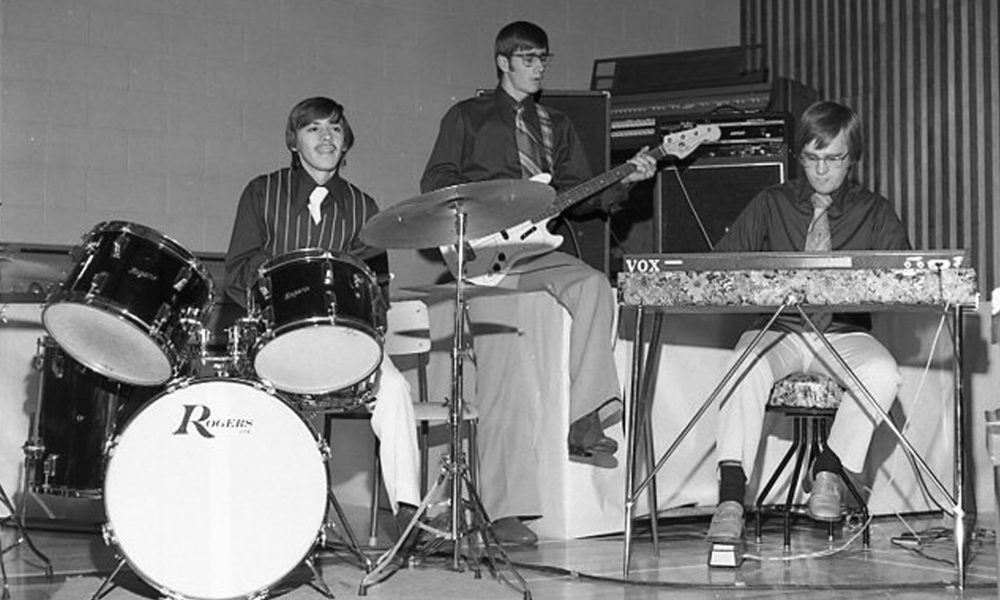
Changes in accompaniment were just as transient as the Treble Teens themselves. Particularly notable were the local bands playing with the Treble Teens in the 1970s. The first was made up of Dennis Pidsadny on drums, Vern Falk on organ and Jim Reimer on bass guitar. Bill Doerksen and Leroy Bartel, on violins, also accompanied the singers that year in a performance of musical works by Bach and Elgar.
The following season, 1972-73, saw John Goossen on lead guitar and Ron Rempel on bass guitar, while Kurt Barkman sat at the drums, Doug Penner played the trumpet and Dorothy Sonya played the Glockenspiel, a gift from the alumni. Faith Reimer, always at hand when her sister, Shirley, needed a pianist, frequently accompanied the group. Other pianists were Darlene (Siemens) Dusevic, Maureen Aubrey, Irene Schellenberg, Dorothy Sonya and Gerald Loewen.
Penner would be the first to credit her ever-increasing teaching staff for some of the “remodelling” done with the teens group over the years.
Johanna Dyck, who was with the choir as a director for more than a decade, introduced hand bells to the choir in 1970, and became its hand bell director. She explained to The Carillon how that dimension was added to the choir.
“We had heard several hand bell choirs and decided to order the bells. The three-octave set of hand bells came with a set of ten lessons. I had never played bells before, so we all learned together.”
Marni Loewen, who was the Treble Teens artistic director, came along to add choreography to the choir’s stage presence. Loewen, who was a professional actor before her marriage, recalled the first Treble Teens concert she attended in 1971.
“It was a very lovely musical concert, but there was little to see. That was about the time the ‘swing choir’ was just starting to happen, and Shirley Penner felt her Treble Teens would have to branch out.”
Branch out they did, as soon as Penner asked for Loewen’s assistance. The process was a slow one at first, but over the years, the improvement was tremendous.
“Without Marni, we would have still been standing on our boxes,” mused a senior singer.
Penner was grateful to Loewen for her part in helping the girls to feel free on stage, to communicate moods and character roles in songs. She knew the importance of an infectious smile and communicating a message through expression and action. Feeling rhythm was also important to the music they sang.
Each year, the choir faced the public with a new image. Each year boasted its own characteristics and achievements.
The first big break for the Treble Teens came in 1967, when after topping all competitive choirs in the province at a centenary festival in Brandon, they were chosen to represent Manitoba at the Canadian Centenary Festival of choirs in St John, New Brunswick. That same year, they received an invitation from the Centennial Commission in Ottawa to perform at Expo ’67 in August. The teens used the opportunity to perform at Parliament Hill and in the People’s Church in Toronto.
The Treble Teens rounded off a memorable 1967-68 season by topping both the intermediate folk song choirs and the intermediate female voice choirs at the Manitoba Music Festival and ended the year with their first television appearance on CBC, May 16.