
Striking nail bar workers finally get paid ending their protest in Winnipeg, Niverville
Advertisement
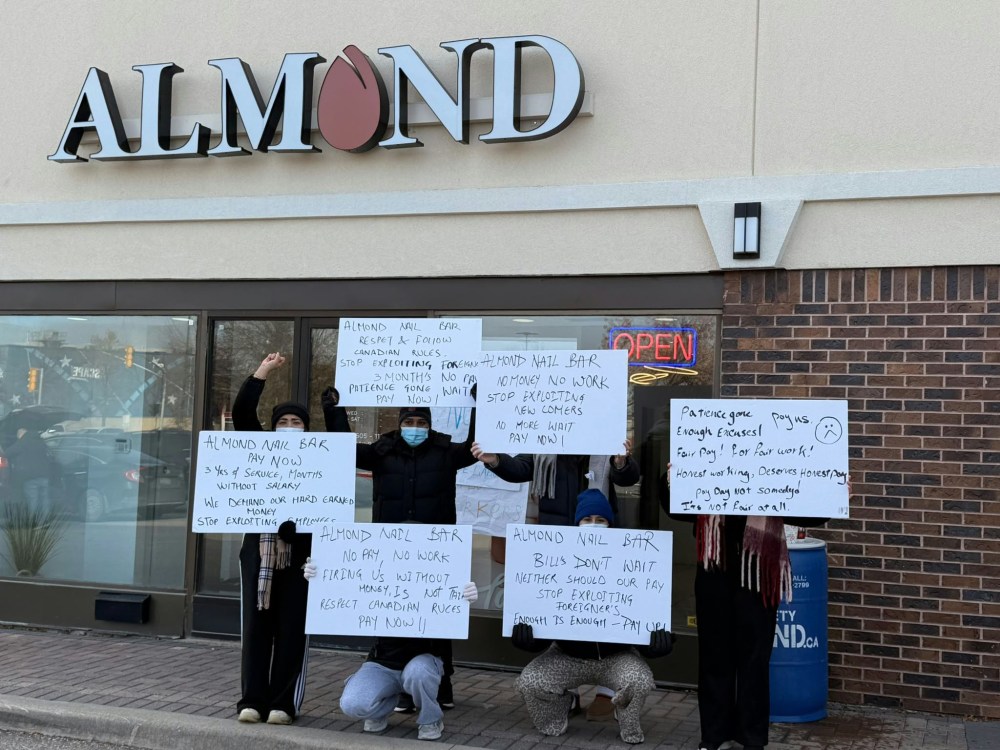
Striking workers from a local nail bar have finally received their pay ending their week-long protest over what they said were unacceptable conditions.
Nail technicians and supervisors from Almond Nail Bars in Winnipeg and Niverville ended their strike after receiving their withheld pay as of Monday, according to the company.
“This is not just about money. It’s about respect for workers who gave their time, effort, and skills,” said a Niverville employee to The Carillon in an interview before the company sent its statement. The employee wished to remain anonymous in order to share what has been happening without fear of reprisal.

The company had failed to pay more than a dozen employees a month’s worth of wages which led to their strike in Niverville and at the Meadowood and Polo Park locations in Winnipeg.
The employee, who has been working for Almond for two years, said the company routinely lapsed in paying their employees on time between the months of September and October as sales were usually slow during these times, but the employees always ended up receiving their pay.
In an Oct. 3 email to employees, CEO and co-founder Thomas Nguyen wrote that employees will get paid by Oct. 31. Despite receiving paycheque stubs every week in October, the company failed to deposit money into the employees’ accounts, prompting the strike.
The women are not unionized and about eight of them have filed complaints with the employment standards branch.
The Oct. 3 email also informed employees that the Niverville location would be temporarily closing on Nov. 2 and some employees will be reassigned.
The employee, who is a permanent resident, shared that Almond was her first Canadian job since she moved to Canada two years ago.
She said the effect on her life from the lapsed payments has been a financial hardship on her family.
Management from Almond’s head office in Winnipeg issued a statement to The Carillon that the lack of pay at the three locations was due to “cash flow challenges” and that all employees have now been paid. The company stated that resolving payroll concerns has been its “immediate priority” and it recognizes the hardships this has caused.
“Our focus moving forward is on strengthening financial oversight, improving payroll procedures, and evaluating the responsible reopening of our temporarily closed locations,” read the statement.
All the women at the three locations are immigrants with either permanent resident statuses or temporary workers with work permits from the Philippines, India, and Ukraine. The employee said the temporary workers were afraid to speak up or file complaints with the employment standards branch because they were worried their hours will be cut, which will affect their permanent residency applications.
Prof. Lori Wilkinson, Canada research chair-migration futures at the University of Manitoba who studies immigration, said the conditions these workers were living with is not common, but the fear that temporary workers feel is common.
“You do whatever you can to stay here,” she said. “Most people who come on temporary work permits are coming because they are looking for a better life. They do realize that they can’t stay here permanently, but there’s pathways to permanency sometimes…So, it’s a logical decision for them (to come here for work), but it puts them in such a precarious situation.”
She said if the same situation was happening to Canadian citizens people would be up in arms and that with temporary workers it’s a system of exploitation. “It’s not just a Manitoba thing, right? It’s all over. There’s all kinds of employers that are trying to take shortcuts, but there’s also all kinds of employers that are extra, especially good to their people too.”
Associate Prof. Bruce Curran, who teaches employment law at the University of Manitoba, said employment situations like the ones the Almond Nail Bar workers faced are not uncommon.
He said regardless of whether the employees are permanent residents or temporary workers they have the right to fight for their wages and make a complaint with the employment standards branch, who will take their claims very seriously.
“One of the other things to bear in mind is that there are, for lack of a better term, anti-provisional or anti-reprisal provisions in the employment standards code, such that…it’s illegal for an employer to terminate one of these employees if they make a complaint for unpaid wages,” said Curran, noting that even if the store closes the employer is still obligated to pay the wages of the employees and the employment standards branch will try to pursue the wages on the employees’ behalf.
Ultimately, the employee said she will not be returning to work at Almond, even if they re-open the Niverville location, citing “It’s not worth it.”