
COLUMN: Tales from the Gravel Ridge – A rural school serving an entire community
Advertisement
The community of my childhood had various unique features. To my mind the dominant of these was its gravel ridge. Unlike many thoroughfares, which, back in the pioneering and homesteading days were often created from following trails of either wildlife or humans, our roadway was, in a sense, one of its own creation. It could perhaps be argued however, that it was the enormous body of water produced by receding Lake Agassiz that actually produced the ridge that, in time, had the effect of an elevated roadway that remained high and dry under most conditions.
When the Rosengard School District was established as a public school in 1927, the building which housed its students for the next 40 years, was built alongside the gravel ridge running somewhat diagonally through the northeast quarter of Section 12-6-5 East.
The location of the school was unique in several respects. Normally school buildings were constructed next to a government road allowance. The Rosengard School was built in the middle of a section of land. The site was an excellent choice, the gravel ridge being an all-weather road during any season of the year, something not to be taken for granted in days gone by. The school grounds similarly provided excellent play areas throughout the year.
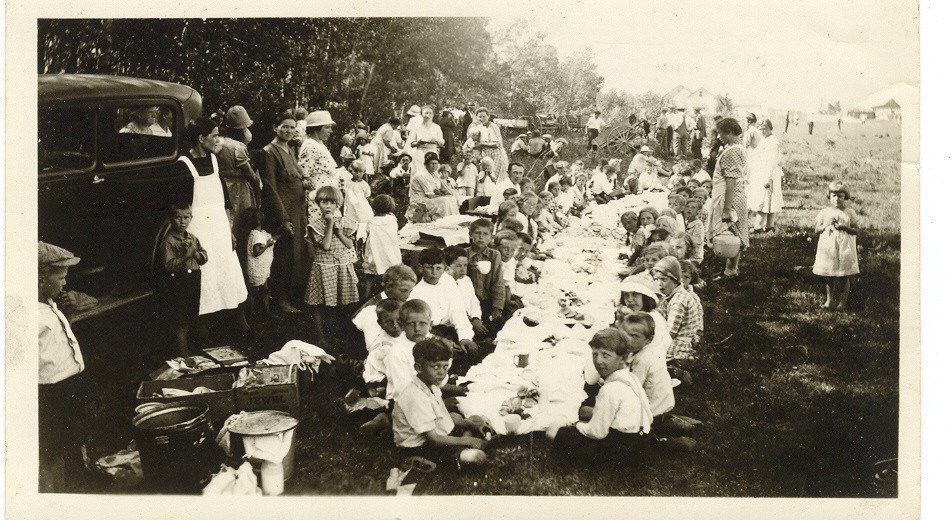
There was another feature of this location which was noteworthy. The school was virtually surrounded by farmyards. It was, in some respects, at the centre of the community. In retrospect, I see this relationship between the school and its constituents as being beneficial for all concerned. It seems to me that the entire community had a sense of owning the school.
I wonder how the school looked through the eyes of neighbours who were in the empty nest category. The Herman Isaak family left Rosengard many years ago, and I know of them only from the stories I have heard about them from my family, and from the photographs in our album. Mr. & Mrs. Isaak were senior citizens, whose farmyard was located immediately to the west of the school. The windows and the door to the school building faced in their direction. I imagine these senior citizens could tell what time of day it was by the ringing of the bell announcing the beginning of the school day, the end of morning recess, the beginning of classes after lunch, and again at the end of the afternoon recess.
The activities at the school must have had an effect on the Isaak household. During the summer, when the windows were open, they may have heard the children, led by the teacher, singing the national anthem at 9 a.m., and God Save the King at the end of the day. At other times they will doubtless have heard children’s voices raised in song during a music lesson. The melodic tones, along with those somewhat lacking in pitch, must have floated through Mrs. Isaak’s kitchen window.
The Isaak house was in closer proximity to the school than any other residence in the community. There were other families whose children no longer attended school who nevertheless must have been influenced by the daily activities they observed. The George Nikkel family lived to the east of the school grounds, just beyond the teacherage. The seasons of the year would be particularly demarcated by the activity on the playground. When the goal posts had been firmly planted in the ground, and the soccer ball was being kicked around, winter was definitely on its way. As soon as the snow was gone, the ball and bat would be out, and the Nikkel family could rest assured that the baseball season was soon to begin.
In between seasons, and for a bit of variety from time to time, students might engage in other sports activities. These would range from Ante Ante Over to Kick the Can, or perhaps Prisoners’ Base. I would think that hearing the laughter and shouts of children, and seeing their enthusiasm would be energizing to all concerned.
To the south of the school lived the Frank Nikkel family. John, the youngest of their children, probably completed his last year of studies at Rosengard in 1948. The family nevertheless continued to live in the community. Although their house was located at the end of a somewhat long driveway, the school was fully visible from the farmyard.
There are many advantages to keeping in touch with children and young people long after the last school report has been brought home to parents. At Rosengard, young and old alike contributed to the well-being of the community.