
St Pierre lagoon adds wetland cell
Advertisement
Hey there, time traveller!
This article was published 27/10/2019 (2418 days ago), so information in it may no longer be current.
The Village of St Pierre has found a chemical-free way to comply with stricter wastewater regulations introduced by the Manitoba government.
On Oct. 17, council and staff toured a new wetland treatment cell added at the municipal lagoon just west of town.
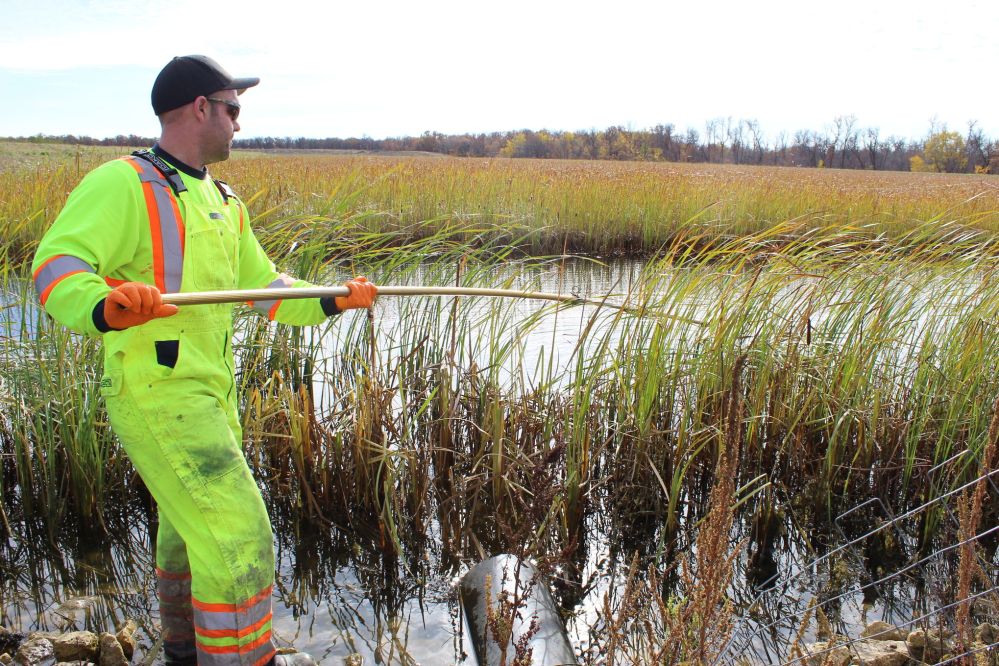
The 21-acre man-made wetland harnesses the filtering power of cattail to remove phosphorus and other contaminants from effluent entering the Rat River.
A similar treatment wetland has been used at Oak Hammock Marsh since 1993, but St Pierre is the first Manitoba municipality to get this design up and running.
Treatment wetlands rely on a natural process known as “phytoremediation,” or plant-based remediation, to treat wastewater entering waterways.
The cell is seeded with cattail, a native reed prized by ecologists for its ability to absorb algae-causing phosphorus.
It takes 14 days for wastewater to zigzag through a series of ditches cut into the wetland to maximize contact with the reeds.
“Cattail is a workhorse,” Bruce Friesen-Pankratz, a wetland scientist with Native Plant Solutions, said as he tramped along the edge of the wetland cell, which went into service last week.
A branch of Ducks Unlimited Canada, NPS designed and constructed St Pierre’s wetland, and trained the village’s public works staff to monitor and maintain it.
Maintenance is minimal—basically, muskrats must be kept out—and the lack of chemicals means no desludging is necessary.
A system of valves and pipes allow the municipality to control the amount of wastewater entering the wetland from the adjacent lagoon.
Daniel Forest, St Pierre’s assistant public works operations manager, showed council how he takes a water sample using a long pole.
In its first year of operation, water samples must be submitted weekly. Toxicity tests must also be performed.
Wastewater regulations introduced by the Manitoba government in 2016 require municipalities to reduce phosphorus discharge levels to 1 milligram per litre.
Friesen-Pankratz said St Pierre’s wetland cell far exceeds that target. Phosphorus levels in effluent exiting the wetland are measuring 0.03 mg/l—cleaner than the river it’s entering.
Getting to this point took more than two years of work. The wetland was landscaped and seeded in 2017, and commissioned last year.
Councillor Raymond Gagne said the opening of the wetland cell is a huge step forward for a village that had to halt development in 2012, when it learned its lagoon was at capacity.
Gagne said the province’s tighter wastewater regulations make sense, but are a challenge for small communities to meet.
With the primary lagoon expanded and wetland cell added, Gagne said development proposals are once again coming across council’s desk. The village is also refreshing its development plan.
Civic wastewater projects are expected to play an increasingly important role in reducing the phosphorus load entering the algae-plagued Lake Winnipeg watershed.
According to the Lake Winnipeg Foundation, municipal wastewater treatment contributes about 19 percent of the phosphorus load entering Lake Winnipeg from within Manitoba.
Gagne said the council opted for the wetland cell because it had available land, and wanted the reduced operating costs that come with chemical-free solutions.
Friesen-Pankratz said St Pierre’s treatment wetland is about a year ahead of a similar project in the RM of La Broquerie. The RM of Ste Anne is also creating a treatment wetland.
St Pierre’s treatment wetland cost about $2.6 million, including a land purchase, though government grants offset a portion of the cost, CAO Tina Bubenzer said.
Friesen-Pankratz said provincial environment officers will use St Pierre’s wetland as a model for other communities. Environmental science students from Providence University College have also toured the site.