
Grocery store managers reflect on pandemic year
Advertisement
Hey there, time traveller!
This article was published 24/03/2021 (1872 days ago), so information in it may no longer be current.
As the COVID-19 pandemic enters its second year, managers of Steinbach’s two largest grocery stores are looking back on a rollercoaster year that posed new challenges to staff and shoppers alike.
Lee Kotowicz, franchise owner-operator of Sobeys, said the past year demanded “a bigger focus on the customer experience.”
That entailed not only more cleaning and sanitation measures, but also paying closer attention to the day-to-day actions of government.
“Learning what code orange and red is, that’s something that we never had to know before.”
By and large, Kotowicz said consumers stopped panic buying once they realized grocery stores wouldn’t shut down.
“It took a few weeks before that levelled out, where people kind of got into a new normal.”
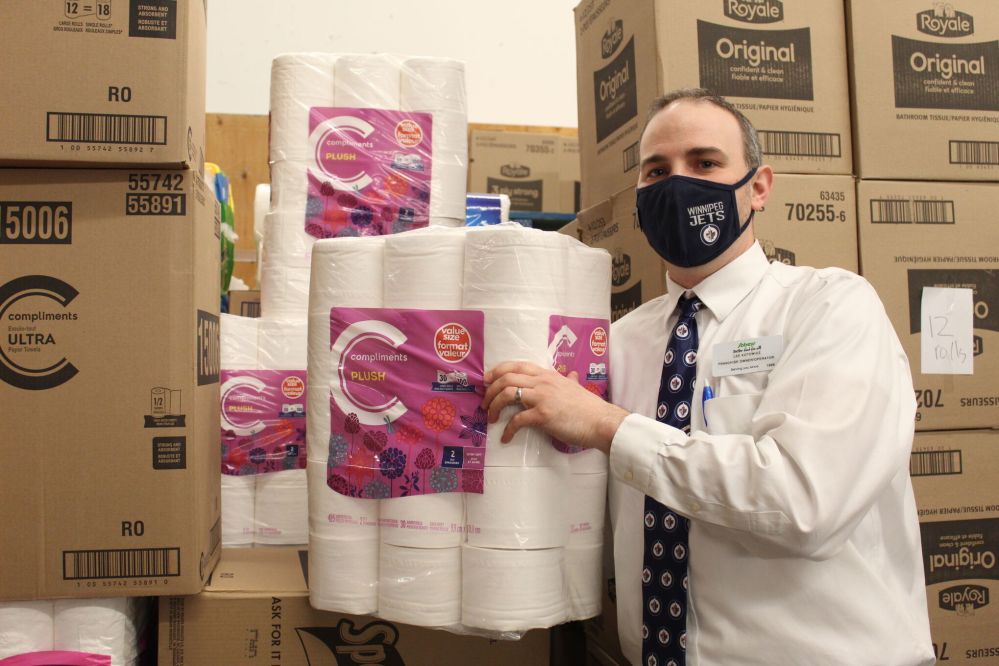
An empty toilet paper aisle wasn’t something Kotowicz was used to seeing after more than two decades in the grocery business (he got his start in 1998 as a clerk across the highway at Safeway).
A year later, Kotowicz said many customers are still shopping less frequently and buying more during each visit to reduce their number of trips outside the home.
Kotowicz said a spring run on baking staples was even more pronounced in Steinbach and persisted into the summer, when shoppers normally trade their electric mixer for a barbecue grill.
“We really noticed that people were buying a lot of flour, a lot of sugar, and doing their own baking at home.”
Low COVID-19 case counts in July and August offered a reprieve for staff and customers. In November, when code red restrictions arrived, Kotowicz said shoppers took them seriously.
“People really hunkered down when the case counts rose out here,” he said. “Our customers throughout this whole thing have been very supportive and understanding.”
Though the second wave was more severe than the first, it was easier on grocery stores.
“There was no panic buying in the second wave.”
When Christmas arrived, Kotowicz said turkeys and hams still sold.
“It was a different Christmas for peoples’ buying patterns, but at the same time, you could still tell people were celebrating with whatever immediate family they had in their household.”
With grocery stores in Manitoba now allowed to operate at 50 percent, Kotowicz said everyone “can see that there is some light at the end of the tunnel.”
He credited the store’s 140 staff members for persevering through a difficult year.
“They’re really heroes,” he said. “I could not do what I do and work hard to keep everybody safe if I didn’t have great staff that was willing to do the same thing.”
The pandemic continues to cause the occasional supply hiccup. Kotowicz said China Lily Soya Sauce, a Canadian-made product, only recently returned to store shelves.
“It was out pretty much all of COVID,” he said. “People just can’t get enough of it.”
Looking ahead to the future, Kotowicz said some store measures adopted during the pandemic may become permanent.
“It’s really hard to know if these things ever do go away again.”
Next door at Real Canadian Superstore, store manager Paulo Sousa said he has made a habit of checking in more frequently with staff and customers over the last 12 months.
“I find that I’m doing a lot more of that than I did in the past.”
The store he oversees employs just over 200 staff.
“No doubt about it, I think all of us have dealt a little bit with fear and anxiety and so forth over the course of the year,” Sousa said.
He said he’s proud of store staff for providing an essential service throughout the pandemic.
“There’s not a day that doesn’t go by when one of our customers comes into our store and thanks us,” Sousa said.
A 32-year veteran of the grocery business, Sousa has managed the Steinbach Superstore for seven years. He said the past year has taught him to be patient and take curveballs one at a time.
Sousa said the first wave of the pandemic was the most challenging to navigate, “only because it was still unclear what we were dealing with at that point.”
In addition to toilet paper, “stock-up items” like bottled water, flour, sugar, paper towels, and even pet food flew off the shelves, Sousa said.
He surmised that evolving government restrictions have been more challenging for shoppers than for staff, except for the essential items list, which required the store to drape plastic sheeting over entire aisles of product.
“That was very tough because that list kept changing,” Sousa said.
The two-month gap between the implementation of store mask policies for shoppers and the Manitoba government’s mandatory mask order also posed challenges, Sousa said.
“From time to time we’d have customers that would come into the store and would refuse to put on a mask. As those issues came up, they were a bit challenging,” he said.
Today, compliance has become the norm.
“I think it was just a matter of everybody getting used to it.”