
Outdoor learning gains ground during pandemic
Advertisement
Hey there, time traveller!
This article was published 16/06/2021 (1951 days ago), so information in it may no longer be current.
Jamie Felsch’s classroom has a few critters, but he doesn’t mind.
Felsch is an outdoor education teacher at Roseau Valley School in Dominion City. Each day, he spends 40 minutes teaching in a dry creek bed nestled in a wooded area on the outskirts of the school’s playground.
It’s one of several outdoor learning areas at RVS, a K-12 school in the Border Land School Division that is home to a flourishing outdoor education program.
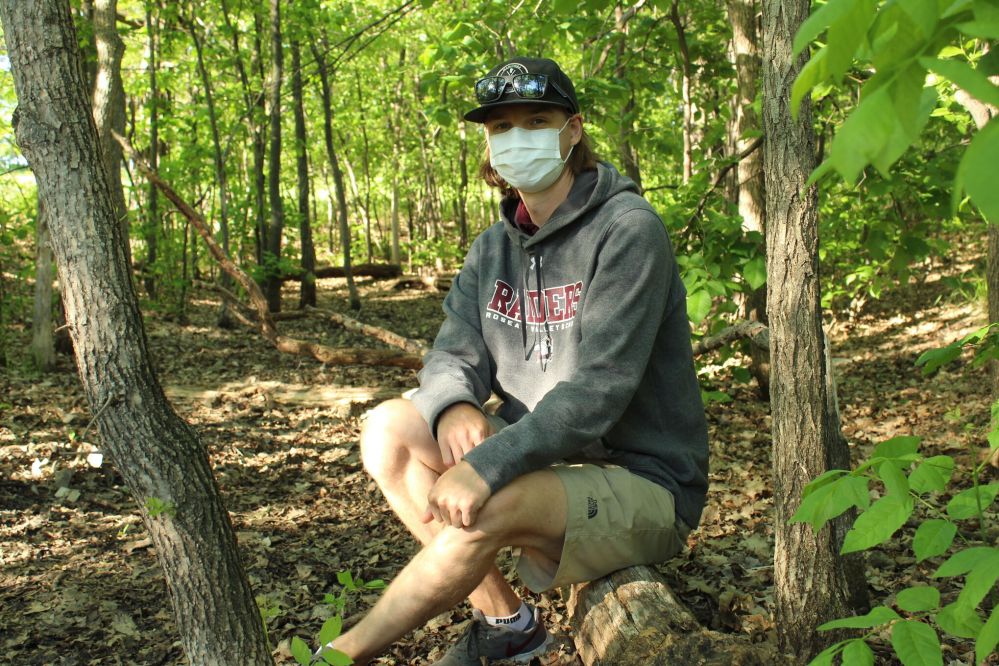
“It started as a program but now I think it’s embedded in the culture of our school,” said Felsch, who teaches K-3 students.
A typical outdoor lesson starts with a short meeting then segues into a 20-minute curriculum-connected activity, such as cataloging leaves or critter dipping.
“Especially with the science curriculum, a lot of that lends itself to outside,” Felsch said.
The lesson ends with 10 minutes of open-ended “explore time.” Felsch used to haul out a wagon filled with field guides, magnifying glasses, and shovels, but sanitizing them on the go was difficult, so students now carry their own tools in backpacks.
According to Felsch, one of the biggest benefits of outdoor learning is how it absorbs students in their surroundings.
“It’s easy to find your attention out here,” he said.
Students who squirm in a desk enjoy having the freedom to move around while completing their work.
“We don’t have behavioural problems out here,” Felsch said.
If a student isn’t interested in the designated activity, they often find a parallel task that’s just as educational.
Felsch has been teaching outdoor ed for eight years. He holds a specialized master’s degree in sustainability, creativity, and innovation. He took over the school’s outdoor ed program from a predecessor who founded it. The program was originally offered to K-8 students but has since been scaled back to K-3. During COVID-19, older students have also been using the outdoor ed areas.
RVS has a single gymnasium, and without outdoor ed, Felsch said the school would have a tough time meeting provincial physical education requirements.
RVS runs outdoor ed year-round, pausing only when there’s an extreme heat or cold warning. In addition to the creek bed clearing, the school grounds have two covered outdoor structures, a butterfly garden with picnic tables and native perennials, and cedar garden boxes with a greenhouse.
The outdoor learning spaces were created through various means, including divisional funding and external grants. The covered shelters and the garden boxes were both added during the current school year.
Over summer, the school garden becomes a community garden. Felsch has noticed local families are taking a greater interest in gardening during the pandemic.
Felsch said he loves teaching outdoors so much that he’d find it hard to go back to indoor-only teaching.
Heading outside in Hanover
Fourteen of 19 schools in Hanover School Division have outdoor classrooms. Niverville Middle School installed theirs in June 2020 and staff quickly learned a sign-up sheet was needed to organize demand.
The space used to be occupied with four portable classrooms, which were trucked away when the town’s new high school was built.
Grade 6 teacher Lynn Albig said she takes her classes there daily this time of year, for everything from silent reading to nature units.
“If we say we’re going outside to the outdoor classroom, they are all excited.”
Like many schools, NMS has swapped tables for desks during COVID-19, making group work more difficult. Students are also separated into cohorts, further reducing interactions.
“Just having that extra space available has been really nice, because kids can space out, they can take off their masks,” Albig said.
She polled her students, who said they like learning outdoors because they can work lying down or sitting up, take movement breaks, and catch a glimpse of other classes outside.
Albig said she her students seem more relaxed and engaged outdoors, offsetting the occasional distractions posed by traffic or the nearby ball diamonds.
In a year devoid of field trips, Albig said the outdoor classroom is also a way for students to experience nature and a change of scenery.
“Just small things like socializing at each other’s desks, and things that you maybe would have taken for granted any other year, those things can’t happen right now,” Albig said. “Being outside kind of changes the feel a little bit.”
Andrea Dick teaches Grades 3 and 4 at Woodlawn School in Steinbach. This time of year, not a day goes by when she doesn’t use the school’s “learning garden,” which was developed about five years ago.
.JPG?w=1000)
“It’s a little space that has a pergola, there’s some seating areas, some plantings, there’s a bit of a hill the kids like to toboggan down in the wintertime,” Dick said. “The kids really enjoy it.”
Dick uses the garden’s compass to teach cardinal directions, and finds the space is a natural fit for units on ecosystems, seasons, and plants.
“It’s really good for a number of curricular areas.”
Dick said going outdoors is a reprieve for students who have had to adjust to a lot of changes inside their school during COVID-19.
“The kids are anchored a bit more in their table spots right now, and that’s hard for little kids,” she said. “Very intentionally, I bring the kids outside every day to do something, and you can see them settle right down and be themselves, really, again.”
Dick said she’s noticed more teachers using outdoor learning areas during COVID-19.
“I think it really will continue after (the pandemic).”
Dick, who grew up on a farm and loves camping, said outdoor learning is a highlight of her day too.
“I can feel myself settle right down too when I’m outside.”
Learning meets play in Seine River
Dawson Trail School in Lorette opened its hybrid outdoor “play and learning area” in September 2019, just six months before COVID-19 arrived.
The 20,000-sq-ft. project started as a way to solve drainage problems in a little-used corner of the elementary playground. The design, developed with student input, includes chalkboards, log seats, boulders, and a log pathway reminiscent of the Old Dawson Trail.
Principal Randy Engel said it’s been a “fantastic” addition to the school.
“Certainly now, as the weather is getting warmer, it’s being used every day, all the time.”
Engel said DTS students use the space for schoolwork, movement, and social reconnection. It’s an especially popular place for three-minute “sensory breaks” for children who need to move periodically to focus on their schoolwork.
Engel said kids’ activity levels has gone down during COVID-19, and screen time has gone up. He’s emphasizing sustainability to ensure students develop a love of the outdoors.
“We know that one of the biggest challenges is that adults and kids aren’t going to want to be responsible for spaces that they don’t have a personal connection with,” Engel said. “If they’re never outside, they never have a connection to it.”
Sunrise adding another classroom
Outdoor classrooms are a common sight in Sunrise School Division, said Jacqueline Julien, assistant superintendent of learning and student services.
Julien said they’re primarily used for schoolwork as weather allows. During COVID, outdoor classrooms have sometimes proved challenging to maintain due to sanitation requirements.
“But I think generally it’s been helpful having them,” Julien said.
In the southern half of the division, Dugald School, Whitemouth School, Oak Bank Elementary, and Springfield Middle School all have outdoor learning areas. Springfield Collegiate is installing one this summer.
Some are more landscaped, while others are as simple as a green space with physically-distanced stone seating. On Earth Day (April 22), Oak Bank Elementary used its outdoor classroom to inspire students to compose poems about nature.
Julien said a principal told her the classrooms provide “a moment of tranquility” during a busy school day.