
Rare butterfly studied in Sandilands
Advertisement
Hey there, time traveller!
This article was published 11/07/2021 (1924 days ago), so information in it may no longer be current.
A Winnipeg university student is scouring Sandilands Provincial Forest for a rare butterfly that he hopes the federal government will take steps to protect.
Justis Henault is conducting a survey of the mottled duskywing (Erynnis martialis) for the Canadian Wildlife Service. Using a catch-and-release method, Henault is documenting where the duskywing is found and estimating its current population.
A small, speckled-brown butterfly sometimes mistaken for a moth, the mottled duskywing was last assessed in 2012. At that time, the Committee on the Status of Endangered Wildlife in Canada (COSEWIC), an independent body of experts that advises the federal government, assessed it as endangered.
.jpg?w=1000)
Henault said that assessment is the first step toward inclusion in the Species at Risk Act. Species included under Schedule 1—the official list of species at risk in Canada—receive legal protections and mandatory recovery planning.
The mottled duskywing is on the decline throughout North America. In Canada, its range is now restricted to “a small area of pine woodland in southeastern Manitoba,” according to a federal registry.
“It’s really only Sandilands that’s like that in Manitoba,” Henault said.
The 26-year-old, who is pursuing a master of science degree in bioscience, technology and public policy at the University of Winnipeg, there are likely several factors contributing to the duskywing’s decline.
In an assessment summary, COSEWIC said flooding, urban development, natural forest succession, inappropriate fire management, and insecticide spraying to control defoliation caused by the gypsy moth are contributing to the loss of duskywing habitat.
“There appear to also be unknown biological limiting factors contributing to the decline of Mottled Duskywing,” the committee added.
One thing is certain: the mottled duskywing’s fate is tied to that of its host plant, a shrub known as the narrow-leaved New Jersey tea or prairie redroot, which is also on the decline.
The low-lying perennial shrub grows in well-drained, sandy soil along roadsides, riverbanks, and the edge of pine forests.
“You won’t find them in a field, generally,” Henault said.
Mottled duskywings lay their eggs on the shrub and feed on it.
“Without that plant, the butterflies can’t live there,” Henault said.
Duskywings have a four-week flying season in June, then lay eggs. Larvae construct silk-leaf nests, grow into caterpillars and continue feeding until fall, then overwinter and pupate in the spring, emerging as adults in mid-May or June. Adult duskywings have a lifespan of about a week.
It’s Henault’s third summer doing the survey work, but his first working alone, owing to the COVID-19 pandemic. Equipped with GPS, a butterfly net, petri dish, and a can of bear mace, he made numerous day trips to the Sandilands over the past five weeks. With the duskywing’s flight period all but over for this season, he is now wrapping up his field work.
He may be working alone, but it isn’t a solo endeavour. Henault said citizen scientists are cataloging duskywings using smartphone apps.
“It’s quite a team effort, actually—an informal team.”
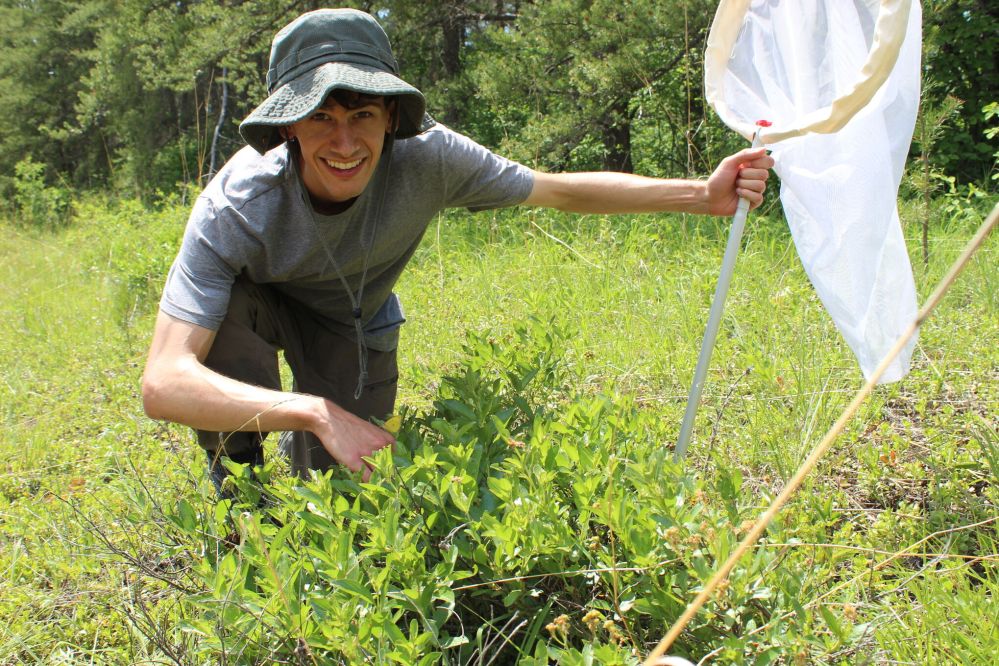
Henault hopes the data he gathered will convince the environment minister to accept COSEWIC’s recommendation and designate the mottled duskywing a Schedule 1 species. If that happens, a recovery strategy would be created.
While it’s too early to draw conclusions from his field work, Henault said he was encouraged to find duskywings in all the known sites, and a few new ones.
“We haven’t lost any,” he surmised.
Estimates are challenging, but Henault said the duskywing may number in the hundreds or low thousands in Manitoba.
The GPS maps he created will guide future surveys of the duskywing, a cousin of sorts to the better-known but more endangered Poweshiek skipperling, which prefers tall-grass prairie habitat found in the RM of Stuartburn.
“Duskywings are a skipper just like the Poweshiek, but they’re in the other subfamily,” Henault explained.
An overarching concern for Henault is finding a way for duskywing habitat and human activity to coexist.
The main issue in the Sandilands, he said, is that none of the duskywing’s habitat areas are protected and managed like the Tall Grass Prairie Preserve. A lot of it is Crown land leased to forestry companies or used for recreation purposes.
Henault said the problem isn’t that people are harming duskywing habitat in the Sandilands, but that there’s no protection plan in place. He hopes to consult on a recovery strategy for the duskywing if the Ottawa creates one.
Raised in Winnipeg, Henault said childhood hikes in the Whiteshell and Spruce Woods provincial parks kindled his interest in wildlife. He is hoping for a PhD placement next year after completing his master’s degree.