
Philosopher’s book compiles decade of newspaper columns
Advertisement
Hey there, time traveller!
This article was published 04/03/2023 (1155 days ago), so information in it may no longer be current.
A Steinbach philosopher has compiled a decade of newspaper columns into one handy compendium intended for the spiritually curious and for those wanting to deepen their Christian faith through critical thinking.
Dr. Hendrik van der Breggen published Apologia: The Columns through Amazon in January.
The book consists of more than 100 short entries that van der Breggen contributed to this newspaper between 2008 and 2018 in his recurring column, Apologia, plus a few more he wrote just for the book.
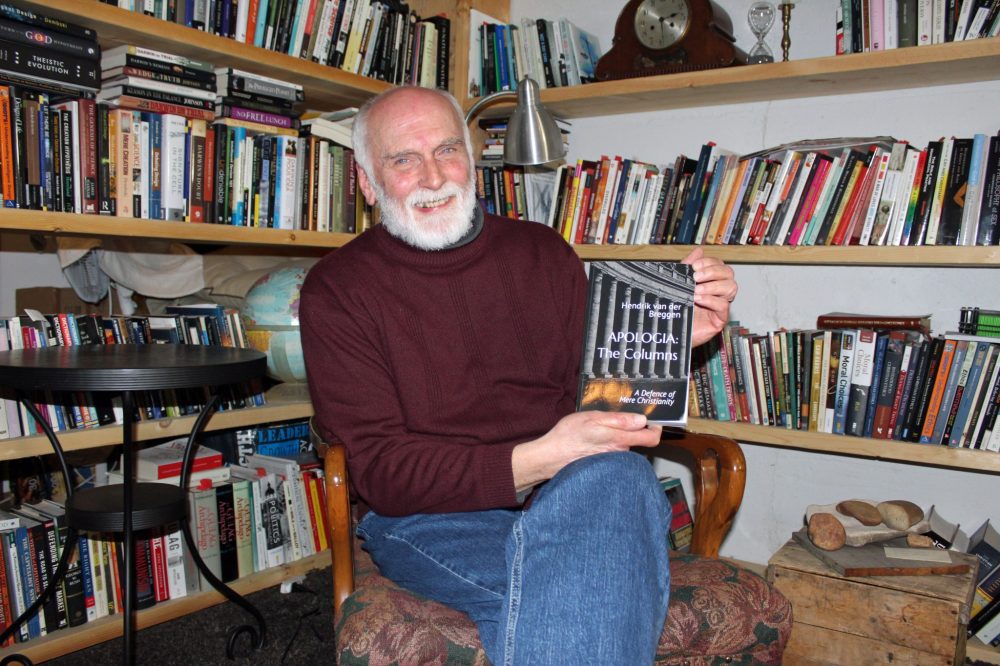
“The columns were written with the book format in the back of my mind,” van der Breggen said in an interview.
The book’s subtitle, A Defence of Mere Christianity, nods to the 1952 book by C.S. Lewis that defended the core tenants of Christian faith using a straightforward writing style.
At more than 600 pages, van der Breggen’s book is considerably longer than Lewis’s, but don’t let the heft deter you. Van der Breggen said he wrote the book in an “accessible but rigorous” style, with short chapters that allow readers to dip in wherever they see fit.
“I think you can read it in whatever order you wish,” he said.
The book is a work of apologetics, a branch of Christian thought that defends the Christian worldview through reasoned argument and evidence. The roots of apologetics stretch back all the way to the Early Church, but it remains a practice that is unfamiliar or intimidating to some Christians today.
For van der Breggen, there’s never a bad time to sharpen one’s thinking by exploring the insights of apologetics.
“We live in a time of competing claims about what’s actually true,” he said. “Those claims compete for our allegiance.”
In the book’s introduction, van der Breggen writes that society has lost sight of the notion of objective truth, abandoned the art of argument, and given in to a tendency to misuse language. It’s a situation that has led to a lot of confusion both within and outside of the church.
The tools of philosophy, like careful, critical thinking and a coherent set of ethics, are especially useful in those situations, van der Breggen said. He pointed out how many of the hot-button issues of today are new formulations of philosophy’s perennial questions. For instance, the COVID-19 pandemic brought issues of scientific trust to the fore.
Compiling the book was a gradual two-year process of sifting and sorting. The book is divided thematically into five parts, which follow some of the major branches of apologetics, like critical thinking, ethics, and the philosophy of religion. In addition to the columns, van der Breggen added lengthy footnotes for those wanting to dive deeper into a particular subject.
He opted to publish independently after learning of the delays affecting traditional book publishers.
Van der Breggen said the goal of the book is to defend the core precepts of Christianity, rather than adjudicate the denominational “in-house conversations” that take place downstream from apologetics.
While van der Breggen’s name is known to Carillon readers, his face will also be familiar to graduates of Providence University College, where he taught undergraduate philosophy for more than a dozen years. “Dr. V,” as his students affectionately nicknamed him, retired in 2019.
Van der Breggen said it was fun to revisit his columns, which often incorporated material from his philosophy courses. When he started the newspaper column, he envisioned it as an “extension of the classroom,” with applications to the world and life in general. His sense of humour inspired the book’s cover, a visual pun on the word ‘column.’
While many might assume van der Breggen has been a Christian his entire life, he in fact converted at the age of 30, due to what he described as “a perfect storm” of factors. He grew up in a pluralistic family, where several worldviews—including atheism and the Middle Eastern Baha’i faith—eventually jostled around the dinner table.
The soft-spoken van der Breggen said it’s important to be respectful while engaging with those who hold to a different worldview.
Philosophers tend to become hyper-specialized, but it isn’t an ivory tower discipline for van der Breggen, who said he enjoys applying philosophical insights to everyday life, “taking it to the streets, so to speak.”
Sometimes, that happens literally, like in his favourite column from the book, “Racism Comes to the Shire.” It tells the true story of an impromptu philosophical conversation van der Breggen had with a passerby one morning while retrieving his recycling bin from the curb in front of his Steinbach home. Van der Breggen used the chance encounter to explore the logical fallacy of hasty generalization.
The book also includes more personal columns, like “Thankful for Bethesda Hospital,” which chronicles a hospital stay that prompted van der Breggen to write about the moral imperative to care for the sick.
Van der Breggen said the book is aimed at an educated popular audience. That includes Christians who want to think more deeply about their faith, and anyone curious about the rational basis for Christianity. He said he hopes the book inspires readers to “take Christ more seriously,” and skeptics to consider Christianity “a live option.”
Copies of Apologia are available at Hull’s Family Bookstore in Steinbach or online through Amazon and Barnes & Noble.