
Niverville reels in film studio
Advertisement
Hey there, time traveller!
This article was published 01/04/2023 (1099 days ago), so information in it may no longer be current.
Manitoba’s fastest growing municipality is ready for its close-up.
Jette Studios, a $30-million film and television studio containing cutting-edge production technology used on hit shows like Disney’s The Mandalorian will be built on the town’s western edge, industry players and government officials announced last Thursday at the Community Resource and Recreation Centre.
A sod-turning ceremony for a hotel announced two years ago, and preliminary plans for highway infrastructure improvements, were also included in the announcement.
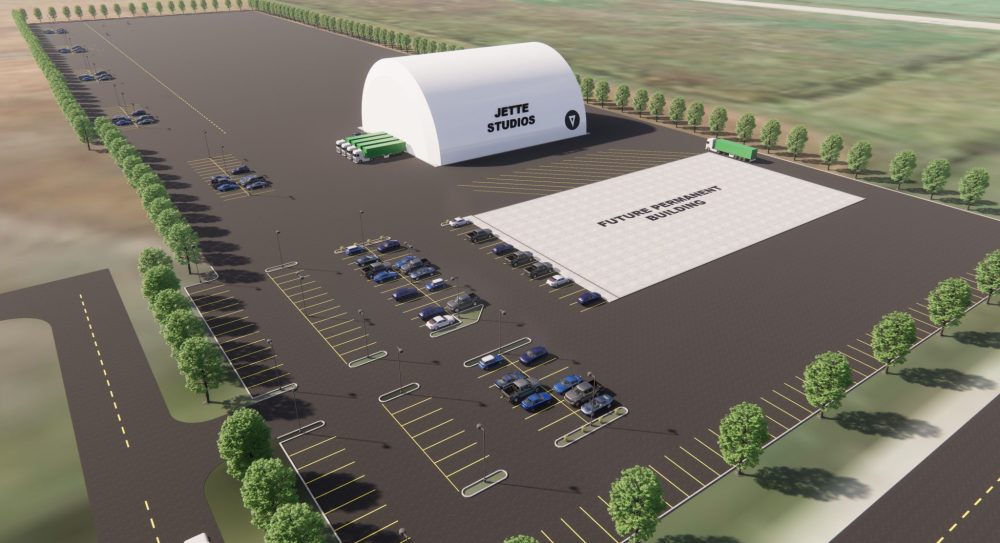
Jette Studios will be built in two phases at the corner of Provincial Road 311 and Wallace Road. Construction of Phase 1—a 20,000-square-foot pop-up soundstage—will begin this spring and be done by the fall. Phase 2, a 40,000-sq-ft. permanent soundstage, will begin shortly thereafter and be operational by next summer.
The studio’s long-term plan also includes additional outbuildings to house production offices, a carpentry mill, an online post-production facility with sound and video editing bays, and a 50-seat finishing theatre.
The studio, which will be capable of producing small and big-budget movies and television series, plus corporate presentations, commercials, animation, and gaming effects, is expected to create 300 jobs over the next three years and produce an economic ripple effect for local businesses.
Niverville’s mayor, Myron Dyck, welcomed news of “fulfilling careers for hundreds of people.”
Jette Studios will be jointly owned and operated by Julijette Inc., a Winnipeg-based film production company founded in 2004, and Volume Global, a Los Angeles-based virtual production startup that designs and builds reusable pop-up soundstages and modular wraparound LED backdrops known as ‘volumes’ that are gradually replacing green screens.
“It’s the new way of making films,” Michael Hamilton-Wright, co-CEO of Volume Global, said. “It frees you from the tyranny of locations. You can shoot anywhere, anytime. You can control Mother Nature. You can control sunsets. You can shoot in Times Square, Stonehenge, wherever you want.”
The curved backdrops, which are up to 90 feet in diameter, cost more upfront and require a crew of three to operate, but save time and money during shooting. Hamilton-Wright said streaming services’ continuous need for content means production timelines have tightened, making speed and flexibility paramount.
Volume Global can build a pop-up soundstage in four months, allowing a studio to quickly begin producing content and generating income. Hamilton-Wright said Niverville’s soundstage will be the first of its kind in Canada.
“These pop-up studios are a rapid response to a pain point of what’s going on in the production community today,” he explained. “There are so many productions—it’s the golden age of productions worldwide—and there’s such a lack of studio space. Most of these studios take years to be built while ours can be put up in 120 days.”
Film producer Juliette Hagopian, Julijette’s president and owner, is hoping Jette Studios catches the eye of major players like Netflix, Amazon, and Disney, which often rent studios on a long-term basis.
Hagopian said she was running out of studio space in Winnipeg and took note of an additional five percent tax incentive available to Manitoba productions that film outside the Perimeter.
Manitoba introduced a tax credit to attract film and video projects in 2017. It refunds up to 65 percent of corporate income tax to the company. Last year, 122 projects made use of the tax credit, supporting a total of $525 million in production over a 30-month period, said Obby Khan, Manitoba’s minister of sport, culture and heritage. The province has since made the tax credit permanent.
Khan said the province’s film industry employs 1,500 people and completed 88 projects last year. Film and television were a $364.5 million industry in Manitoba last year—an average of $1 million per day.
“Global demand for audio and visual content has never been higher,” Khan said. “The production volume in Manitoba has tripled since 2016.”
Hamilton-Wright said rural shoots have a host of advantages.
“It makes it easier in a smaller town to get in and out with production trucks and things like that,” he said.
Hagopian said Manitoba’s tax incentives and new direct flights to and from Los Angeles made her want to invest in Niverville.
Hamilton-Wright agreed.
“This province is one of the best places in the world to shoot, specifically for the tax credits and the access to everything at the airport. All those things play into decision-making in L.A.”
Infrastructure Minister Doyle Piwniuk said the Winnipeg metro area contains other natural advantages, like proximity to the United States border and a skilled labour force.
Hagopian said she has already secured a loan against the tax credit for a feature film.
Piwniuk touted four proposed improvements to Provincial Road 311 designed to support Niverville’s growing commercial economy. The projects are part of Manitoba Infrastructure’s five-year plan and have yet to undergo public consultations or detailed design work.
Provincial Road 311 would be twinned from the train tracks to Wallace Road, a traffic circle would be built midway between Wallace Road and Krahn Road, a traffic light would be installed at Krahn Road, and an approach would be built to facilitate the development of land on the town’s western outskirts into a mix of residential, commercial, and light industrial.
A sod-turning for a new $13-million hotel, first announced two years ago, was also held last Thursday along Drovers Run.
Steel Creek Developers will build the 73-room hotel, which will include an indoor swimming pool, waterslide, and fitness centre. Construction will begin this summer. The business is expected to create up to 25 jobs. The hotel will be part of the Blue Crescent chain that operates hotels and Carman and Rivers, Man. and Grenfell, Sask.