
Need for public transit backed by survey
Advertisement
Hey there, time traveller!
This article was published 19/02/2024 (984 days ago), so information in it may no longer be current.
Advocates of a public transit system in Steinbach say it’s time to work together to move forward.
Members and supporters of the South East Equity Coalition (SEEC) presented the results of a survey on public transit needs to Steinbach councillors during their Strategic Priority Committee meeting on Tuesday.
The high number of supporters forced the relocation of the presentation from a basement meeting room to council chambers, which was packed while others watched the proceedings on a television in the foyer.
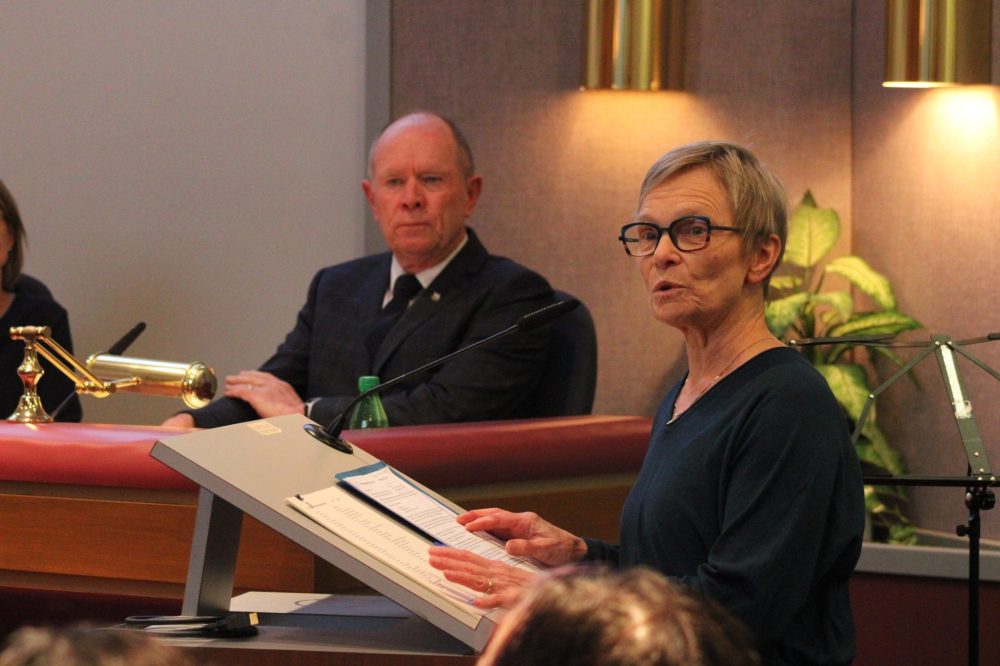
SEEC facilitator Gay Boese pointed out a feasibility study completed in 2006 recommended the city move forward on public transit.
“Public transit could help people get to the most basic needs,” she said.
Val Hiebert, the author of the research study shared the results with council.
A total of 751 surveys were completed, directed at the population in Steinbach who access what they defined as “helping” organizations or human services in Steinbach.
Nearly 80 percent of survey respondents live in Steinbach, while the remaining people live within a 13.7 km radius.
The survey established that walking and biking was the most common form of transportation at 32 percent and six percent respectively. A total of 27 percent of respondents drive, 23 percent rely on rides from others and 12 percent use a taxi.
Fifty-eight percent of respondents did not own a vehicle.
Respondents expressed their interest in public transit with 26 percent saying they’d use it every day, 27 percent would use it four to six times per week and 23 percent would use it one to three times per week.
Hiebert noted in her comments that 199 surveys came from the Ukrainian newcomer community and nearly all of them, 193, said they would use public transit.
“Anecdotally, various members of SEEC have been told that the Ukrainian community came to Steinbach because they were told there were jobs in Steinbach, but are now struggling to access those jobs because they do not have vehicles, cannot afford to purchase vehicles, and have no public transport available to them,” she wrote.
Survey respondents were also asked where they wanted to go, with 42 percent of respondents pointing to the Clearspring Centre area, which included Superstore, Sobeys and Walmart.
The second most popular need was medical appointments at 13 percent.
That’s an issue Boese said they heard about.
“We’ve heard over and over how people don’t go and get help until they’re really, really sick and then they call 911,” she said.
Others expressed a desire to go to Main Street, which includes thrift stores, pharmacies, banking, government services, the post office, crisis stabilization unit, grocery and medical.
The committee also pointed out that Steinbach, as the third largest city in Manitoba stands out for not having transit.
Both larger cities, Winnipeg and Brandon do, and Selkirk with a 2021 population of 10,504 has been operating transit since 2011. Their transit system runs as a non-profit, relying on the province for half their operating funds while the remaining comes from advertising, sponsorship and ticket sales.
But the group assured council they aren’t expecting a large fixed-route transit system right away.
Audrey Harder, executive director of the Pat Porter Active Living Centre discussed several options.
Those include onw-demand systems where people call for transit or a hybrid system that mixes on-demand with a route.
She told council of Steinbach Accessible Transit which is run through their facility with support from the City of Steinbach.
She said numbers have increased from 2022 to 2023 by 30 percent, to 5,477 riders. That doesn’t include those who need a ride but cannot be serviced by the two vehicles in operation.
Boese said she thinks a hybrid model could work, but added they need to start with what’s going to succeed.
“It may be that we need to start with on-demand, in a similar program to what accessible transit is being used, how it’s being accessed,” she said. “But I’m really hopeful that we can go beyond that, and work toward a model that would make it accessible for all.”
Councillors made no promises to implement transit but didn’t close the door on it either.
Mayor Earl Funk pledged to keep the conversation with SEEC going.
SEEC representatives also stressed the community support they had already received.
More than 20 letters of support were distributed to councillors from human services organizations such as enVision Community Living, Agape House, the Pat Porter Centre, Soups On and many more, as well as from three churches and eight businesses.
While some seem to have been written from a common template, (some paragraphs are identical from letter to letter), most included their own rationale for supporting transit.
“With a population approaching 20,000, we believe that Steinbach is a community positioned for growth and public transit is therefore a worthwhile and necessary investment for our city council,” nearly every letter stated. “By investing in public transportation, Steinbach will be poised to attract new businesses and new citizens, will be investing in the overall wellbeing of its existing citizens, and will be improving the quality of life experienced by its most vulnerable populations.”
Boese said they see great potential for partnerships with larger employers and others in the community, and said she felt good about the presentation to council.
“I’m hopeful. We always have to be hopeful,” she said after the meeting. “Was there big affirmation that something would happen? No. But we do know as the mayor said that they will continue talking with us.”
Boese added that they aren’t demanding immediate plans.
“We’re saying please work with us and let’s work with all the community that we can to build something that makes Steinbach a better place to live for all people,” she said.