
COLUMN: Carillon Flashback September 5, 1984 – Kinsmen projects help to create a caring community for decades
Advertisement
Hey there, time traveller!
This article was published 12/09/2025 (289 days ago), so information in it may no longer be current.
Compiling a list of every good thing the Steinbach Kinsmen and Kinettes have done in the more than three decades since their organizational meeting, Feb. 28, 1951, would be a daunting task indeed. Looking around the community, evidence of the club’s active response to community needs and participation in fundraising for community projects is everywhere.
While the Kinsmen find there is no lack of worthy causes, their task is to find those that meet their motto of “serving the community’s greatest need.”
Considerable Kinsmen support goes to the Association of Community Living in Steinbach. Without the Kinsmen’s help, Kindale Manor, Kindale Occupational Centre and the Kinsmen van, which provides transportation for residents and clients of ACL, would likely not operate.
Prior to the United Appeal, both Kinsmen and Kinettes were involved with canvassing for Easter Seals, March of Dimes and the Canadian National Institute for the Blind. They have also helped numerous individuals from the community obtain special medical care not available in Manitoba.
In 1964, the Kinsmen and Kinettes furnished three pediatric wards in Bethesda Hospital. Later, a heart monitor, wheelchairs, an enzyme spectrophometer and other much-needed equipment for the hospital were provided through Kinsmen fundraisers. The Kinettes recently purchased a “life-pack” for the Bethesda cardiac unit.
Both Kinettes and Kinsmen supply non-medical manpower during the regular blood donor clinics, taking care of the desk, handing out coffee and orange juice, to help take some of the load off the medical people.
The Kinettes regularly provide financial assistance to the ACL projects, as well as sponsoring the annual Elmdale School patrol field trip to a Jets hockey game. The drug awareness seminar sponsored by Kinettes has also become an annual event, as has sending a diabetic child to special camp.
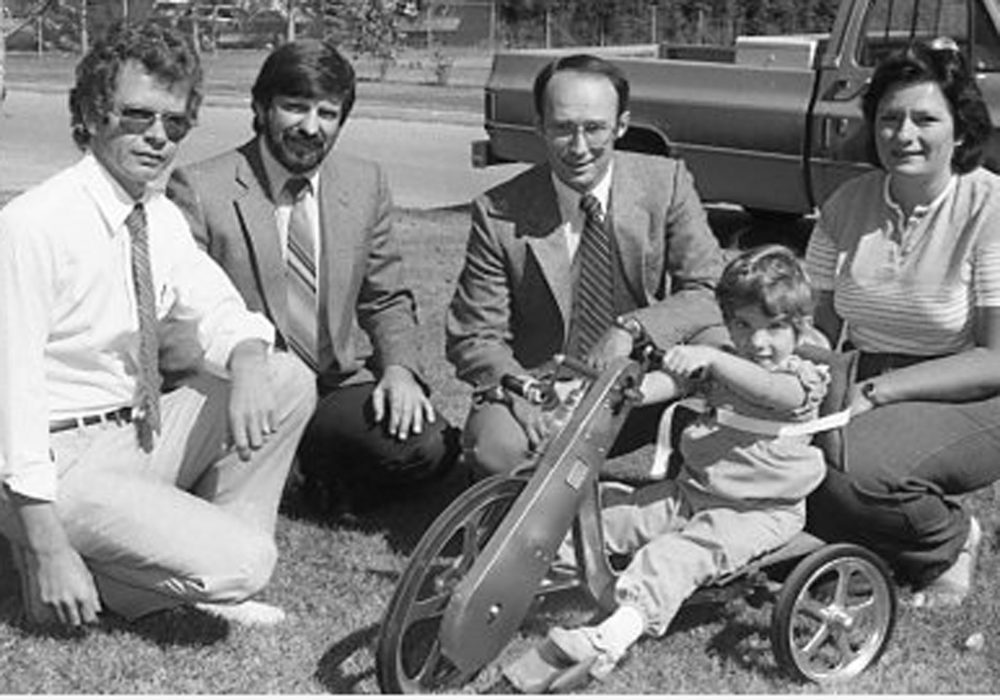
A sign language teacher has improved the quality of life for one resident at Rest Haven and a specially adapted bicycle has made life better for a youngster with spina bifida, who since birth has had no use of her legs.
“A trike for Tanya” was one of the many items the Steinbach Kinsmen struck off their “to-do” list in 1984. While most children get their first bicycle by the age of three, Tanya Klassen patiently waited a bit longer for her special tricycle.
The Steinbach Kinsmen ordered a custom-made, hand propelled trike last February at a cost of more than $700. The trike arrived more than a year later and was delivered to Tanya as soon as it was assembled.
The Kinsmen loaned the bike to Tanya for her use until she outgrows it and then the trike will be passed on to another child with similar disabilities.
Thanks to the Kinsmen, Steinbach Boy Scout troupe now has sports equipment and a number of Steinbach minor hockey teams have new jerseys.
Kinsmen and Kinettes have traditionally been involved with helping people with cystic fibrosis on a national level. The Steinbach Kinettes gave $3,000 toward this research project last year alone.
The Kinsmen clubs are unique to Canada. The fraternal organization was formed in Hamilton, Ontario Feb. 20, 1920. Hal Rogers, a young man just returned from the trenches of World War I, was lonely and looking for friendship. He also had an itch to do something for his community. His father encouraged him to get together with other young men his own age interested in the ideal of service.
The first Kinsmen Club project was to welcome new people to the city. Businessmen provided names of new employees who were contacted and made to feel welcome. These newcomers were assisted in their transition to the new area. Kinsmen helped them find homes, churches, schools and generally become acclimated to a new area. The main concern was to make things easier for newcomers.
This legacy still holds true. Newcomers to a town or city tend to gravitate to the Kinsmen and fellow Kinsmen transferred to a new place are immediately adopted by those already there.
“We consider the Kinsmen a real family,” says Bob Ticknor, of Steinbach’s club.
“There is a real connecting of people in the Kinsmen. We feel they are the nicest people in the world. The people who tend to join are those who want to help others and want to be friends with all kinds of people.”
Ticknor went on to say that Kinsmen are deeply committed to maintaining a high quality of life in their communities; which is probably nothing unique, since most people who volunteer are equally committed to their projects at hand.
– with files from Sue Barkman