
COLUMN: Tales from the Gravel Ridge – The stories our garments could have told
Advertisement
Hey there, time traveller!
This article was published 21/10/2025 (214 days ago), so information in it may no longer be current.
The stories that could be told by the wear and tear of our clothing and footwear might surprise us. Were such stories to be compiled into a historical record of some sort, they would provide us with a wealth of information. To be sure, various details of our own personal circumstances would be laid out before us by such a record. In addition to that however, the evolution of the world in which we functioned during such a range of times and circumstances would inevitably also form part of such a scenario.
None of us, it is fair to say, have such a record. Nevertheless, all of us have some recollection of the clothing and shoes we had in our respective inventories at various times in our lives. For those of us who grew up in the community of Rosengard during the 1940s and 1950s, checking any photographic collection would provide us with an abundance of information of the lives we lived, including our clothing and footwear, throughout the four seasons of each year in our part of the world.
Mending is a word that would have had plenty of application to the wardrobe of my family in bygone days. Although the word fletje or patching was perhaps the most common means of repairing clothing, there were also other methods of restoring or renewing personal or household items. Darning, or stoppe was one course of action when repairing an item, especially one made by means of knitting, such as socks, or possibly a sweater. Stitching a simple seam that had opened up was usually the easiest way to refurbish a piece that was in need of such a repair job.
Imagine the stories those refurbished items could have told, and the adventures that had been part of that torn item. I can recall a tear commonly referred to as a Dree Atj or simply a tear that ran in two directions usually meeting in a right angle. Such damage could easily occur if kids were climbing trees and their trousers got caught on a branch, or possibly also when attempting to navigate a fence that was in the way and getting stuck on one of the barbs in the wire. Under those circumstances a youngster could easily come up with several tears in one day, all with perfectly reasonable explanations. In a child’s mind that likely wasn’t an insurmountable problem, but in the meantime the stack of clothes needing mending could grow higher in short order.
In our present circumstances there are in most instances little, if any, compelling reasons for mending clothing. We need only check out what’s available in any of a number of retail outlets, or, if we are so inclined, we could also seek out what could be purchased at a thrift shop. It isn’t so for much of the rest of the world, and it most assuredly was not the case for the people of my neighbourhood when I was a child and young adult. Mending and re-purposing of clothing were an essential part of how our family functioned.
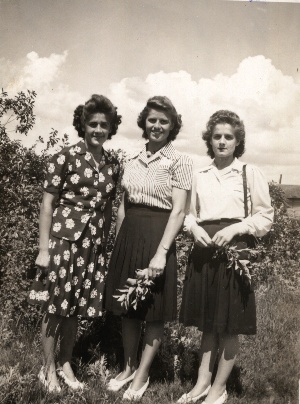
Closely related to mending and repairing generally, is the simple recognition of the importance of taking good care of the items we wear day to day, or possibly on special occasions. As I look at photographs taken by my sisters and their friends when they were working in various jobs during the 1940s, I am surprised, …indeed amazed, at how well-dressed they looked. Most often they were domestic servants in households that were somewhat better positioned financially than the families of their immigrant domestic help. The income of my sisters and their friends was a vital component of their respective family’s financial circumstances. They were helping to support their families, including making payments toward alleviation of Reiseschuld, namely “travel debt” — the debt incurred in coming to Canada. In our family’s case, that was crossing the Atlantic Ocean on the Canadian Pacific MS Melita in 1929.
Such stories are worth remembering.