
RCMP sergeant recalls early years, career as police officer
Advertisement
As it is National Women’s History Month in Canada, The Carillon spoke with four extraordinary women in the Southeast who are making a difference in their communities and have done or are doing extraordinary things. One woman will be profiled every week in October.
RCMP Sgt. Joanne Ryll grew up wanting nothing more in life than to be a police officer. Her father was a police officer and so were his friends, but it was unheard of for a woman to join the force.
“To me, it was a lifelong dream, right? As a little girl, I remember asking my mom if I could be a boy so I could be like my dad,” she said. “And I don’t know, it’s just, it’s something that is in me or was in me, and I needed to do this. I never wanted to do anything else.”

Born and raised in Angers, Quebec (today Gatineau), the 45-year member of the RCMP recalled how she was too young to join the RCMP in September 1974 when the national policing force opened its ranks to women. When she was old enough to apply, her parents recommended she get a university degree just in case the RCMP didn’t accept her.
“So, I went to college and got a degree, but I never really used it because six months after I graduated, then I joined the RCMP.”
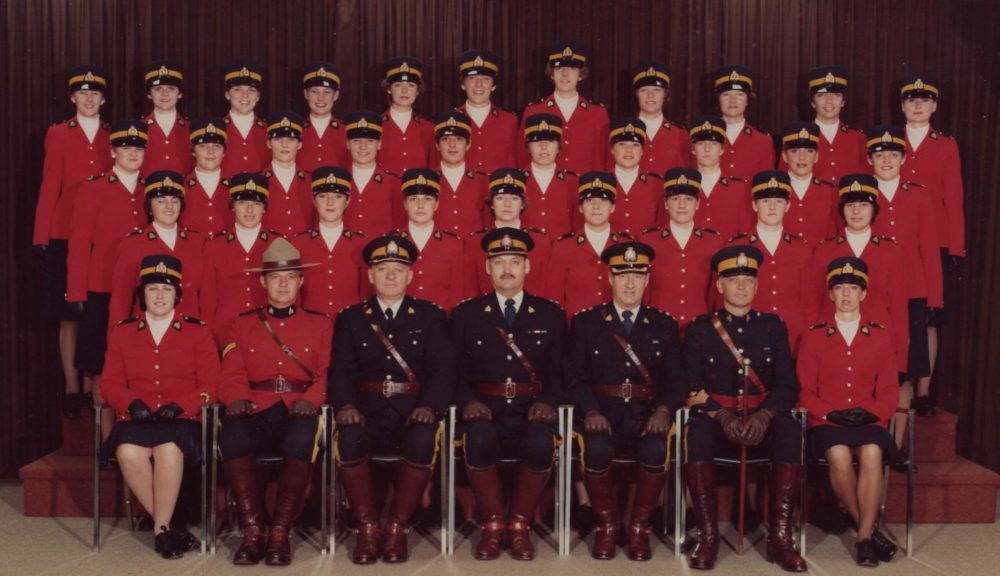
Ryll was one of 32 female cadets at RCMP Depot in Regina bucking the norm in 1980.
“We were a novelty,” said Ryll of the experience.
The troops at Depot were segregated with only two troops consisting of 32 females each allowed annually. Ryll remembers what being segregated from the male cadets felt like.
“You know, in my case, it was 32 females, and we were the only females on the base. But it made us more competitive to try maybe and outdo the male troops. But, I mean, nowadays, it’s, like I say, it’s a mixed troop.”
Spreading out the low numbers of female officers across Canada meant there were detachments that never had a female member.
“And, you know, it took time for people to (get used to female officers). I remember people would call the detachment, and you’d answer the phone, and they’d say, ‘Well, I’d like to talk to a member.’ And you would say, ‘Well, I am a member.’ And they’d say, ‘Well, no, I want to talk to a real Mountie.’ Because, you know, number one, they thought you were the clerk. And number two, well, they wanted to talk to a ‘real Mountie.’ But I mean, that was then, and this is now. So, we have evolved.”
And the road for some women in the RCMP hasn’t been easy with cases of harassment being brought up through the years. Ryll said she never experienced discrimination within the force, but she shared how a staff sergeant in one detachment where she worked felt the world was coming to an end when the RCMP Musical Ride allowed women to perform.
“Because he had been in the musical ride, and that was like, we had now invaded the last of the last things that was sacred.”
But times have changed, said Ryll, as the troops are now integrated and there are more female officers and that even the commissioner, the highest post in the RCMP, is a woman.
“The sky’s the limit now, right?”
And there seems to be no limit to what Ryll has managed to do in her career. This trailbrazer worked as an instructor for three years at Depot teaching applied police sciences and driving. She worked for six years at D Division headquarters in Winnipeg in the criminal investigations division investigating murders, serious sexual assaults, and missing persons cases and in the Criminal Operations Center which oversees the operations of the Manitoba RCMP.
But Ryll has done extraordinary things that she never would have experienced had she not been with the force. She has been the driver or bodyguard to every visiting member of the royal family. When Queen Elizabeth II visited Canada for the last time in 2010, Ryll was one of four Mounties from across the country chosen to be her bodyguard.
“I was honoured that I had been chosen,” she said.
But perhaps the biggest honour in her life came when she was chosen along with two military members who went with a group of Second World War veterans to represent Canada for the 65th anniversary of the Dieppe Raid in France.
She has great respect for veterans and had always wanted to visit Dieppe or Vimy Ridge and when she was approached to join this contingent she accepted immediately.
The Canadian raid in Dieppe saw about 5,000 soldiers from the 2nd Canadian Infantry Division land on the shores to take the area from the Germans. More than 3,300 Canadians became casualties, including 913 who lost their lives. More than 1,900 Canadians became prisoners of war.
Ryll said looking at the cliffs where the enemy was located and the shore below where the Canadians were, the Canadian troops never had a chance. She said those that survived were lucky.
“To stand there with these veterans who lost their friends was, it was very emotional. Most of the time you had tears in your eyes, and the respect and the honour that they received when they went to these places was phenomenal.”
For her 20 years in service Ryll received the RCMP Long Service Medal at 20 years of service and a different clasp every five years. She also received the Queen Jubilee Medal for long service and good conduct.
In 2006, Ryll moved to Steinbach for the second time and while she works in an operational role as the number two at the detachment, in the 19 years that she has worked in Steinbach she has always wanted to keep the community safe and help people.
“It’s important to me that this community be a nice community, a safe community. Do we have issues, you know, with like break and enters and stuff like that? Yes we do, but for the most part I think this is a very good community.”
Ryll said she hopes to be role model for young female officers and for girls in the community.
“If some people in the community see me as a role model, well, good, but I don’t go out there and just say, ‘Hey, look at me. I’m a role model.’ Yeah, it’s kind of hard to, that’s what’s tough to answer as well.”