
A St Pierre Métis soldier’s burial journey during the Second World War
Advertisement
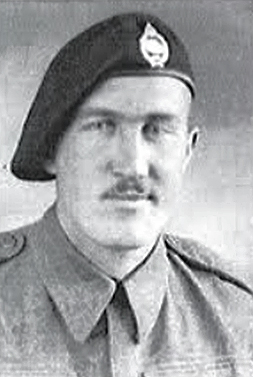
It was May 29, 1944, and Trooper Florio Carriere was with the British Columbia Dragoons 9th Armored Regiment as they made their way through the hilly terrain of Ceprano, Italy, near the town of Pofi. The tanks could only go so far and now it was up to a scout to go towards enemy lines and find out the coordinates for an attack by Canadian soldiers.
“Sarge, I’m going ahead,” said Carriere, a 25-year-old Métis from St Pierre-Jolys.
“Are you sure Florio?” replied the sergeant.
“I’m sure,” replied Florio.
A fellow soldier gave Florio a Bren submachine gun. Carriere waited for the machine gun volleys to stop, then launched into the woodlands of the Fosso Merigo channel, where the shots were coming from. Head down, Bren levelled, Florio began to advance slowly, scanning the woods and he was overwhelmed by the oddest of sensations: he felt he was walking in one of the endless forests of his homeland.
It would have been a lovely place to seek solace but he knew perfectly well that he was there to track down an enemy. It was a terrible game in which the men involved were prey.
“Here they are, the bastards,” Carriere muttered.
Carriere crouched on the ground, snapped the safety catch on the Bren and got into a firing position. He decided to fire the first burst and then run, so he pulled the trigger and the bullets began to ricochet over the spot around the machine gun nest. Carriere got up and started running, but not before throwing a hand grenade over the watercourse.
Carriere ran like a snow lynx. Suddenly, a bullet hit him in the throat. The sniper had found his prey.
This abbreviated account is from the book, The First Nations Who Saved a Nation by Matteo Incerti. While the account is a version of possible events, it provides an example of what Florio Carriere might have gone through when he died in action on May 29, 1944, as his regiment moved the line forward for the Allies’ eventual liberation of Rome.
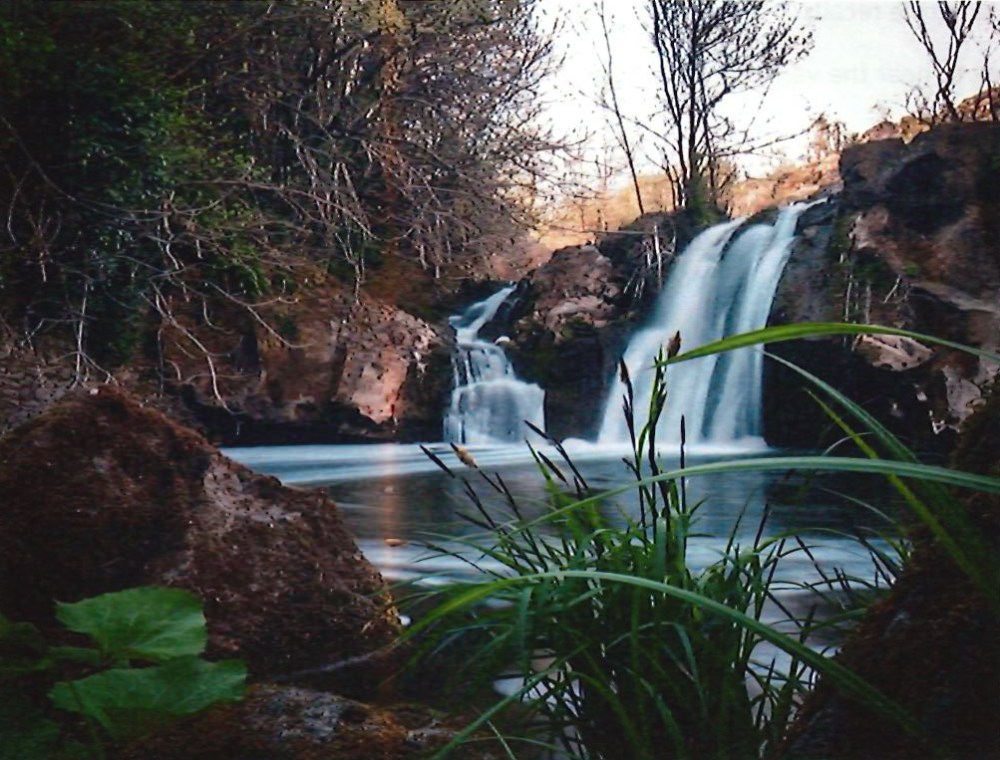
It wasn’t until the next day that Florio’s body was buried in a marked grave by a peaceful stream with an ancient Roman bridge, a waterfall, and a place where wild orchids and prickly pears grow. His marker was a stone with a carved cross on top.
While there was no name, the legend of the Canadian soldier who was buried there was folklore to the citizens of Pofi as it was the Canadians who liberated the town from the Germans.
It wasn’t until 2020 that an Italian history buff by the name of Marco Savarese contacted Florio’s family in St Pierre, through Facebook, that the family found out what happened to Florio’s body.
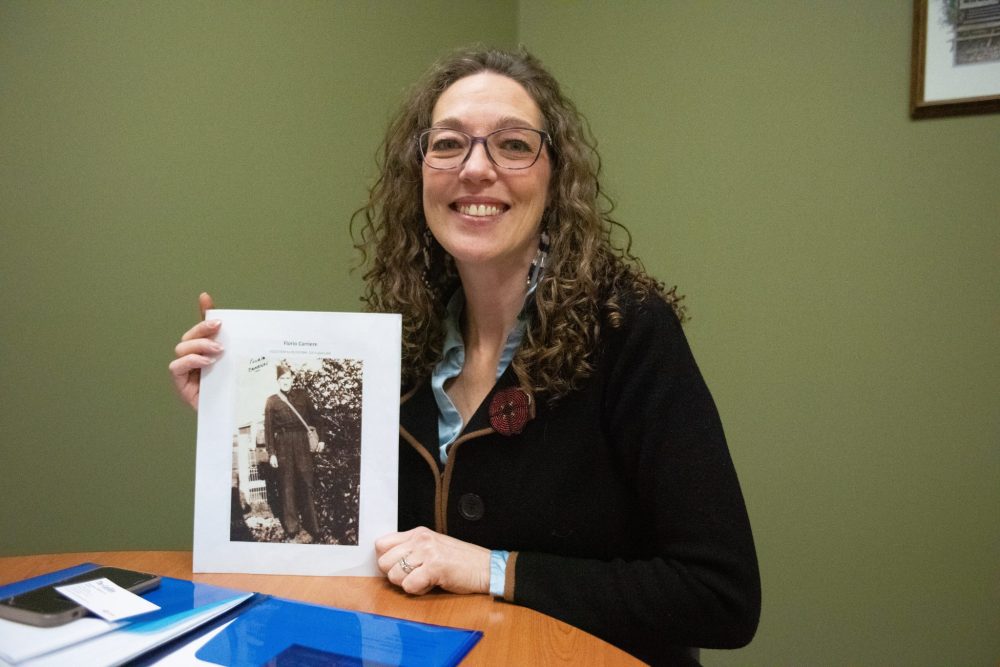
“So, the story that the family knew forever was that he went missing on…May 29, 1944. And then he was reported on the 30th as being killed in action,” said great niece Nicole Gregoire.
“No body, no tanks, nothing. And so the family always assumed that he had perished in the tank, that his tank must have gotten hit, and he (was) just obliterated….That’s always how we assumed that that was it. There was no body.”
Through military records, Savarese, who lived two miles from the Pofi’s Unknown Soldier’s grave, determined that it was Florio who was buried there. He also found out that the body was reburied in Cassino Military Cemetery, which is 40 kilometers away from Pofi, on Aug. 3, 1945.
“I know that for me and my family unit, so like my brothers and sisters and my dad, we now know the story, so at least we know he wasn’t just forgotten, laying somewhere in some unmarked grave like he was. He did have a marked grave.
“He was buried the very next day. So, somebody cared enough to place him beside this beautiful location to honour his death. It’s really cool,” said Gregoire.
The family was never informed of the burial in Pofi nor was it informed that the body had been transferred to Cassino. They always assumed the headstone in Cassino marked an empty grave.
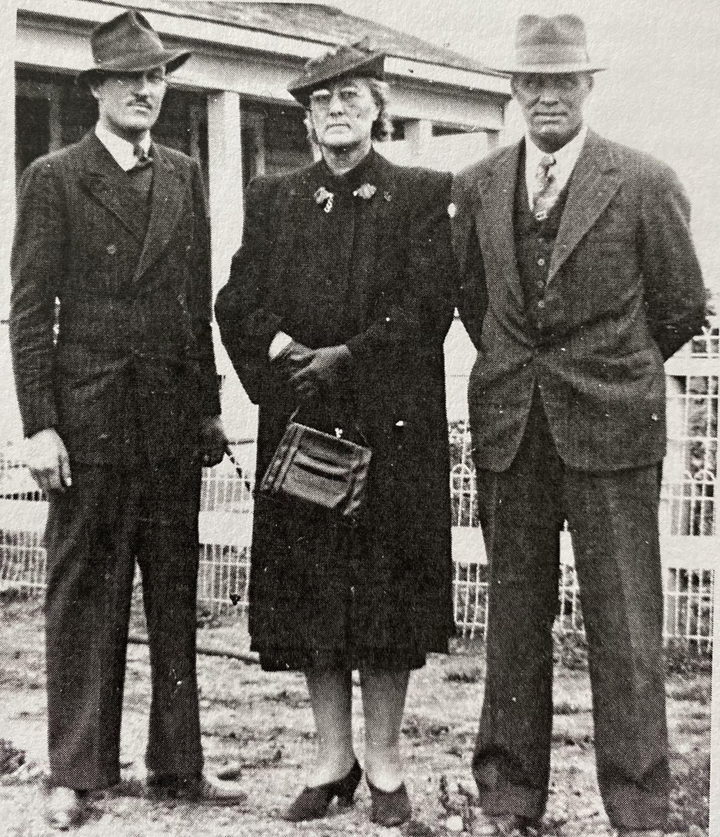
In 2001, Florio’s youngest brother, Bernie, his other brother Oswald and their wives went to visit Florio’s grave in Cassino.
Savarese’s reasons for researching Florio’s story was his interest in who Pofi’s Canadian solider of lore was and then how Florio lived as a Métis in Canada and what his life in St Pierre might have been like, according to chat exchanges on social media between Savarese and Rochelle, Gregoire’s sister.
“Pofi and St Pierre are now linked by a history; divided by thousands of miles and an ocean, but united by a brave young man!” wrote Savarese in the exchange.
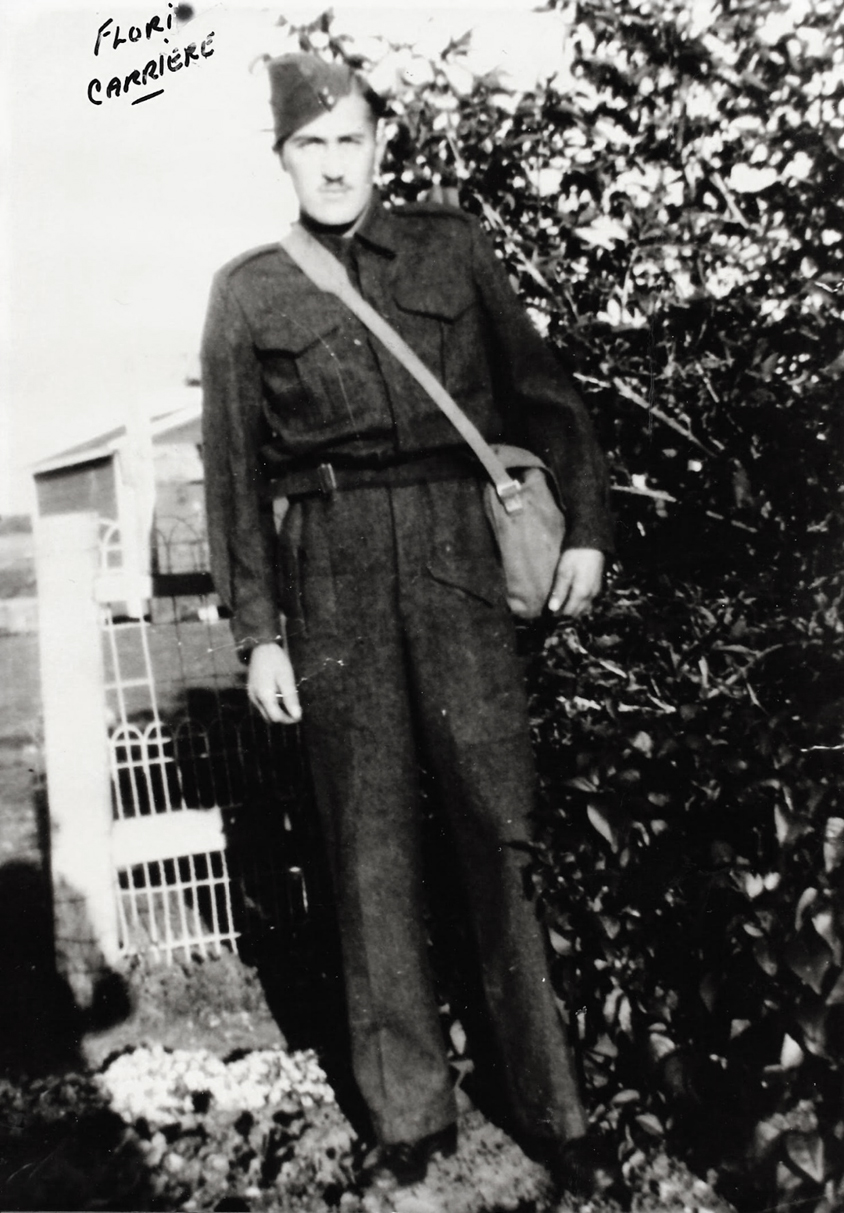
Florio was born on Nov. 22, 1918, in St Pierre to Laura and Daniel Alexis Carriere, who had 10 children. Florio left school in Grade 8 at the age of 15 to work on his family’s mixed farm. His father applied to the government for an exemption so that his five older sons didn’t have to fight in the war. He received the exemption, but Florio was determined to go and fight overseas.
“Uncle Bernie just said that he went voluntarily and he was happy to do so. I think it was a calling for him. He felt like he needed to be there perhaps,” said Gregoire.
“It was just something he wanted to do, and so he went. So, his family supported him, obviously, even though it was difficult, right?”
Florio joined the military on July 12, 1941, receiving only $1.50 a day in pay. He started with Winnipeg’s Canadian Light Infantry before moving on to the B.C. Dragoons.
Although the federal government doesn’t have an exact number, it is estimated that at least a few thousand Métis fought in the Second World War, according to Manitoba Métis Federation Minister of Red River Veterans Shawn Nault.
The government doesn’t have an exact number because it categorized Métis soldiers as either white or Indigenous depending on how they looked. It’s assumed that Florio was categorized as white as his service records do not list him as Indigenous. Indigenous soldiers faced a lot of racism before and after they joined the military, but when they were in the trenches that fell away, according to Nault.
“What I think is important is the Indigenous soldiers were the most sought after people for (the government’s) special operations groups. Coming from a hunting and basically sustenance background, you basically had to hunt for your food, you knew ammunition was expensive, you only had a limited amount, so you made your shots count. So, we were good at stalking animals so (we were) perfect for sneaking behind enemy lines because we were quiet, stealthy, and we were very accurate,” said Nault.
“Carrieres were always very proud Métis. But at one point, we just didn’t talk about it because there was that big stigma of being Métis,” said Gregoire.
Before being deployed to Europe, Florio travelled from Manitoba to Nova Scotia where he was stationed for a time. During his time with the armed forces, Florio wrote many letters to his family.
“And many letters were sent back and forth throughout. The very first letter Florio wrote from overseas, he had a lot of parts censored (by the military),” said Gregoire. “(Uncle Bernie) said most of it was censored.”
As Florio’s youngest brother, Bernie, being only 10 when Florio went to war, was the last of his siblings to die. Bernie recalled stories of Florio, but they were difficult to share as the death of his brother was very emotional.
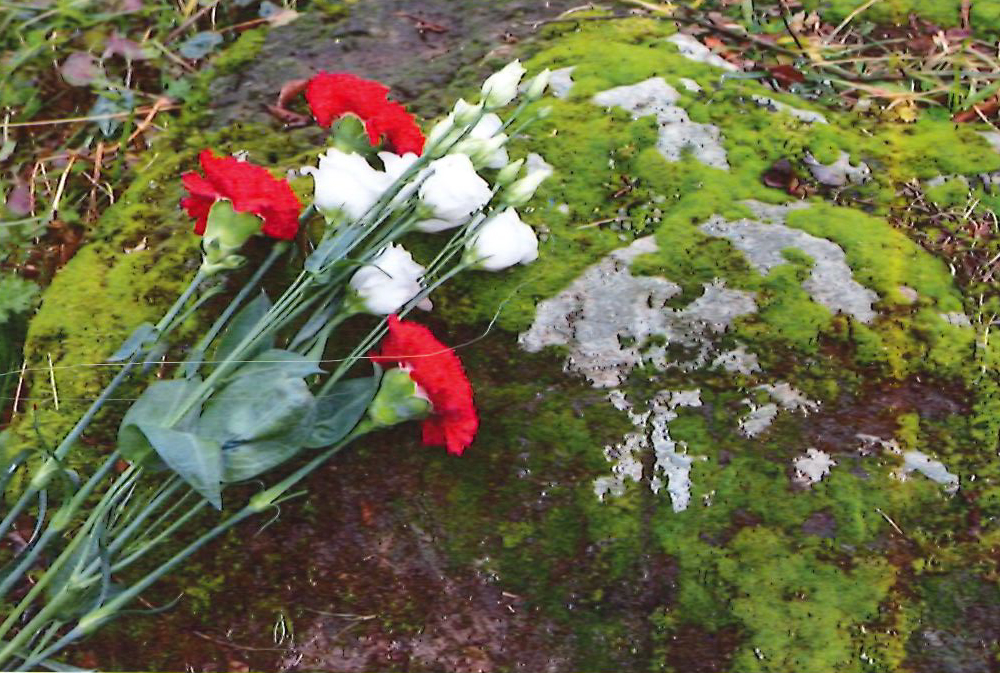
Gregoire describes Florio as being kind, jovial, and funny. He came from a close-knit family and he worked hard on the farm, where he intended to go back to when his service was over, according to military documents.
“It just left a hole, right? That’s a whole person and a whole lifetime that just ended,” said Gregoire. “Who knows what could happen, right? Would he have gotten married? Would he have had children? Like, you know, all the What Ifs. And also just that hole in all the siblings’ and the parents’ (lives)…”
Laura would write the majority of the family letters to Florio and whenever a letter was received from him, she would leave the letter out on the kitchen table so that everybody could read it.
“So, that was really sweet,” said Gregoire.
Two weeks prior to Florio’s death, the family received a letter, which Gregoire believes Florio wrote in April 1944, stating that he would be back home soon and the war seemed to be coming to a close.
In early June of 1944, the family received notice that Florio was missing in action and in late summer of 1944 they received word that he was killed in action.
“Two sergeants came to the homestead, letter in hand, and notified Daniel Alexis and Laura Carriere that Florio gave his life to serve his country in the Mediterranean Theater of War on the 29th day of May, 1944. This letter was dated June 28, 1944. So, (the family) actually didn’t know he had already passed when they had read his letters,” recounted Gregoire, as told to her by Bernie. “This was a very difficult time for the family. Laura cried daily.”
The family always felt the loss of Florio and would honour him by recounting stories over the years about his military service and personal anecdotes. His memory lives with all of the descendants of Daniel Alexis and Laura Carriere, according to Gregoire.
“I want to honour him and his life and his sacrifice. And to do justice to him and his story…That’s the best way that we could honor him is by remembering his story, remembering his sacrifice,” she said.
Florio was decorated for his service, being awarded the Defence Medal, War Medal, and the Canadian Volunteer Service Medal and clasp. In 2015, he was honoured in St Pierre with a plaque that bears his name that is displayed every Remembrance Day.
In 1995, Manitoba named more than 4,000 lakes, islands, bays and other geographical features after Manitoba’s Second World War fatal casualties under the common commemorative names project. Florio was honoured with a point named after him on remote Stevens Lake in northern Manitoba – Carriere Point.
“It’s another honor to know that Uncle Florio has his place in history overseas, but also in Manitoba. And the fact that he is of Métis descent adds that added stamp on Canadian history, Manitoba history…” said Gregoire.