
Sio Silica applies again for mine in Vivan, holds open house
Advertisement
Hey there, time traveller!
This article was published 01/12/2025 (267 days ago), so information in it may no longer be current.
Calgary-based Sio Silica has applied for the second time with the province for approval to mine quartz silica near Vivian in the RM of Springfield.
In its application to Manitoba’s Environment and Climate Change public registry on Oct. 28, the company made a number of changes such as lowering the number of wells it intends to drill from 467 per year to 167 wells per year, with only 25 wells drilled in the first year. It also reduced the amount of sand it will extract from 1.36 million tonnes per year to 500,000 tonnes maximum per year starting at 100,000 tonnes in the first year and working its way up to 500,000 tonnes at the five year mark; it has reduced the life of the project area it plans to drill from 8,235 hectares to 2,764 hectares; the company has also hired a water testing firm to monitor the aquifer; there will be monitoring of ground settlement; and the company will use UV light to treat the water and filter it before it is returned to the aquifer.
“We hope to be successful this time around,” said Sio Silica president Carla Devlin. “However, it was an approved project (before) that had a draft licence. So, we know that our science is good.”
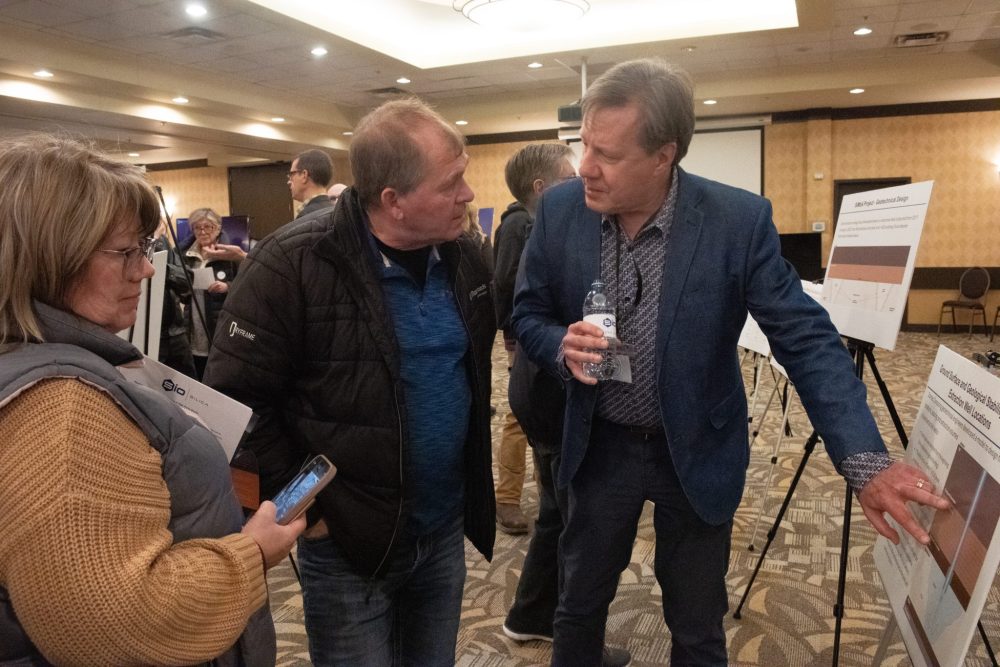
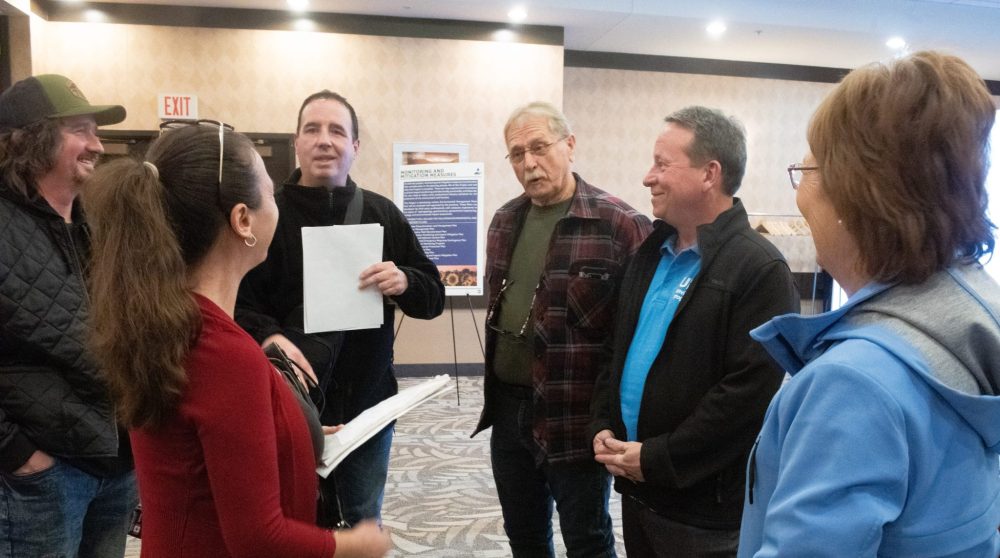
Devlin was on hand during the company’s open house in Winnipeg on Monday night where Sio Silica shared its changes and had experts on hand to answer questions from more than 200 people who came to the event.
Devlin said there is a lot of misinformation out there and that people need to focus on the science. She said the company has already drilled 75 wells and during the four years that those wells have been open there has never been an incident of water contamination.
“We don’t feel that there’s risk to water quality. And Sio Silica is putting in as many checks and balances as we can to ensure that water stays safe,” she said.
There are two aquifers stacked one on top of the other with one providing potable water from within the sandstone layer for more than 100,000 people in the Southeast and the other being non-potable. Devlin told RM of Ste Anne Coun. Kyle Waczko the mixing of those two aquifers is inevitable, but that it’s like mixing “Desani and Aquafina waters together” – there is no impact.
Waczko is concerned about the water quality should anything go wrong. He said “water is life” and that while the company had made changes and had experts on hand to answer his questions, he still has concerns.
“I took it for what it was. They’re trying to sell their product. Everyone working there is trying to achieve a certain goal. I was happy with the questions I asked…and I was firing some questions at Carla Devlin, and yeah, they know how to sell their product, right?” he said.
“Strip mining and cavern mining, you usually can see what’s going on (but) with this one it’s miles underground. We’re never going to see what happens until it’s too late,” he noted.
The NDP government refused the company’s first application in February 2024, after concerns were raised about how the drilling would affect the aquifer. Manitoba environment minister Mike Moyes told The Carillon in a previous interview earlier this month that the proposal is currently under review by the department’s technical advisory committee and the public can voice any concerns during the process over the next 30 days. He said there isn’t a firm timeline on when a decision will be made on the application.
“I sure hope that Wab Kinew listens to his heart and listens to, you know, all of the Indigenous knowledge keepers that are telling us we need to protect the water, right? And he listens to Manitobans at large, that we don’t end up being controlled by a company from out of province,” said Shawn Kettner, a Winnipegger who is against the mining project.
“I think that the science is not there to prove that this is a safe method of mining. And that if they proceed with the project and it doesn’t work, then everybody in that community is screwed. They’re all going to lose their water sources.”
During its first application to the province, the Clean Environment Commission highlighted concerns, saying that “significant conditions” would be required to allow the project to move ahead. It reported concerns with what they called “novel characteristics” saying the technology to be used had never been used for this purpose.
They advocated that if the project were to proceed it should do so in careful steps.
“This project here in the RM of Springfield was again a completely novel way of mining silica sand,” said former Minister of the Environment and Climate Change Tracey Schmidt at the time. “It has never been done anywhere in the world, drilling through aquifers to extract a resource is simply too novel, too risky at this stage.”
Devlin said the open house was the company’s way of showing transparency and correcting misinformation. She said Sio Silica has taken a number of steps to ensure the safety of the aquifer.
“We’ve introduced Aquatic Life, we treat with UV, we test, we drill, we test, we drill. You know, we’re constantly monitoring. We will implement a committee, an Indigenous committee, oversight committee, that will have a stop button…if they see something they don’t like in that real-time data, we’ll stop, we’ll assess, and we’ll start up again when we have confidence again.”
Sio Silica has made a memorandum of understanding with Long Plain First Nation, located 150 kilometres west of Vivian, where the reserve will co-ordinate technical reviews, environmental analyses, and community engagement for interested Treaty 1 Nations. Signing the agreement doesn’t signal Long Plain’s support for the project, but ensures transparency, scientific rigour and cultural grounding to assess the mine’s impact, The Carillon reported in October.
Prior to Long Plain, Sio Silica tried to make a partnership with Brokenhead Ojibway Nation, which would have seen offers of employment with the reserve receiving five percent of the project’s annual profits totaling $20 million a year, but that fell through after the band voted to reject the offer.

RM of Springfield Coun. Mark Miller was at the open house and he is still against the project as there are too many unknowns.
“They want to talk about the safeguards that are in place, and I encourage them to have those safeguards. Those are absolutely necessary, but you know what? There’s uncertainties. Mining operations go south for uncertain reasons.”
Devlin was asked if the company will drill more than the 500,000 tonnes a year reported and she said it would depend on market demand.
“I think that market also dictates that, right? So, as the world is coming to a global shortage in high-purity quartz silicon, the demand is there. AI is coming on board. AI is a massive draw on high-purity quartz because the main ingredient in AI is fiber optics. And the main ingredient of fiber optics is high-purity quartz. So, it’s really necessary to have those facilities built up with high-purity quartz.”
The silica sand at the Vivian site is 99.99 percent pure according to Sio Silica. This positions Canada to be the “premier supplier in global markets for electronics, green energy, and construction materials,” as stated in a Sio Silica information leaflet.
Devlin said the company has partnered with the University of Manitoba for a research and development program that will monitor ground movement and the aquifer. Some residents asked about the ground collapsing due to so much drilling, Devlin said the university team will be able to “determine if the aquifer moves by two inches and if the ground moves by an inch using NASA satellites.”
Doug Mclachlin, associate vice-president and geotechnical practice lead for Aecom, a consultancy firm that was hired to review Stantec’s geotechnical report for the mine, agreed with the determination that there would be no ground collapse. He said there is an overburden deposit, a competent limestone layer, a thin shale layer and then the sandstone layer. If drilled correctly and the thickness of the competent limestone is 15 meters thick or more before it reaches the sandstone there should be no collapse.
An information placard for the geotechnical side of the project read, “A trigger action response plan will be in place to monitor for ground (collapsing). (Collapse) monitoring will occur before, during, and after extraction activities and will continue long-term.”
Should residents find their wells going dry, Devlin said the company will drop their pumps deeper into the aquifer and that monitoring by the university should prevent anything from going sideways. “And so I do feel that anything that, you know, if there’s ever a red flag, it’s going to be caught before there’s an issue,” she said.
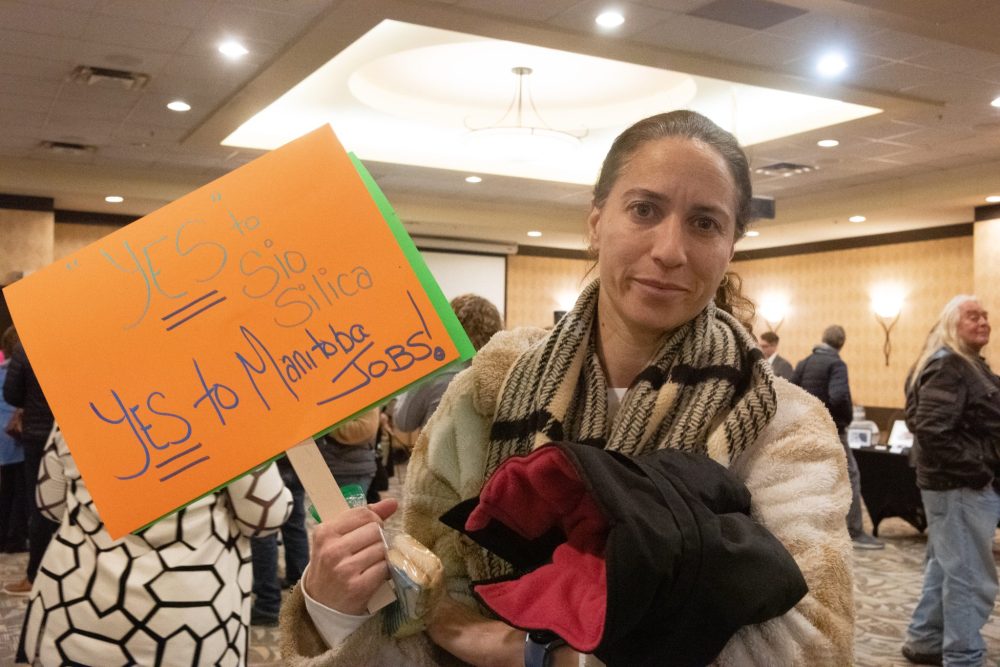
Some people at the meeting were carrying signs of support for the project citing the creation of jobs and a boost to the economy.
“I don’t know what job opportunities they will offer, but as major as they are, I believe there will be much more than what we think of job opportunities for a wide range of people here that are looking for (work),” said Shir Dandi, a Winnipegger who said residents’ concerns about water quality will be resolved by the data Sio Silica will share with the public through Aquatic Life’s website.
Sio Silica projects job growth over a four-year period to go from 100 positions to more than 18,278 positions should the project be approved. It also projects tax revenue to hit more than $312 million by 2029, with the company spending $1.75 billion annually in salaries and services.
Rumors of the company being sold upon approval of the mine for a profit were rejected by Devlin. “We’re not selling the company. I’ll just leave that there. That’s more misinformation,” she said.