
COLUMN: Grey Matters – The two Annas of Rembrandt
Advertisement
Hey there, time traveller!
This article was published 13/12/2025 (225 days ago), so information in it may no longer be current.
“Growing older is growing richer in experience.” – Unknown.
Ageism is defined as the prejudice or discrimination based on a person’s age seems to be last of the ‘isms that is accepted in society. We understand that classism, racism, sexism are wrong, but our late night talk shows keep making fun of our elders just because of their age. I stopped watching years ago.
Scripture has a different view. Abraham was called by God at age 75 to father a nation till his early 100’s. Moses was 80 years old when called from the desert to help with the release of Israel, Joshua was also 80 when called upon to lead the Israelites. John was in his 90s when he wrote down the book of Revelation – the most complex book in the Bible. In Scripture, growing older is not something to dread; it is part of God’s plan and blessing.
As we turn to the Christmas season, we see several more elders playing a significant role in the Christmas story. Zechariah and Elizabeth were advanced in years when they had their own surprise birth of John the Baptist. When Mary found out she was to give birth to the Saviour, she needed more than an angel, she needed Aunt Elizabeth. And when Mary and Joseph brought baby Jesus to the temple a righteous old Simeon and the prophet Anna (age 84) were the ones to speak into their lives.
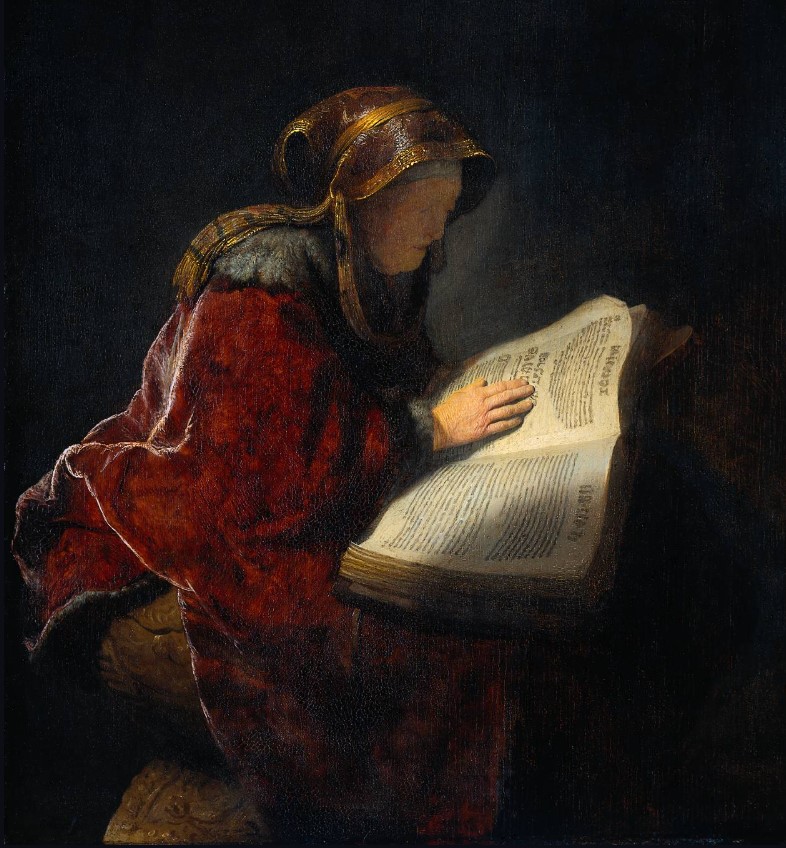
In 1631, Rembrandt painted a portrait of Anna called: “The Prophetess Anna Reading the Bible.” The painting is also known as “Rembrandt’s Mother Reading the Bible” since it was his 60-year-old mother who posed for the portrait. The painting is a tribute to age, wisdom and his mother. Themes most contemporary artists and influencers miss.
Rembrandt’s mastery of light and darkness helps us to focus on the subject. She sits in the middle of the painting without much detail, except for a hand that catches most of the light. A worn wrinkled hand that is guiding her earnest study of Hebrew scripture. His mother’s hands probably had done many things for him. Cooking, washing, mending, caressing, and in the quiet of the day reading through the Scriptures and prayer. Recently, a visitor to the Rijks Museum saw this painting and wrote: “I wanted to press this hand against my forehead. I wanted to warm and caress it, like the hand of my own dear mother, when she was still alive. I just stood there and watched, completely lost in time…”
Older figures like Anna and Elizabeth played significant roles in shaping the Christmas narrative and its meaning. While Mary is often the central figure next to Jesus, Anna and Elizabeth are the ones who offer essential support, affirmation, and spiritual wisdom. Unlike the shepherds who had to be told clearly by a large chorus of angels, Elizabeth and Anna are the ones who readily recognize Jesus as the Messiah and immediately give thanks to God (it is also women who first see Jesus after his resurrection). For Mary, their prophetic witness serves as confirmation of her child’s divine identity and mission. The faith and devotion of these people offer Mary the validation and encouragement she needs in a time of uncertainty and change. The Christmas story, like other parts of the Bible, underscore the value of intergenerational relationships. We need more Rembrandts today to show us anew the beauty and wisdom of our elders.