
Plan for Île-des-Chênes AI data centre draws ire
Advertisement
A plan for Manitoba’s first AI data centre set to be built in Île-des-Chênes has sparked concerns from experts over water and environmental impacts.
Las Vegas-based Jet.AI and Vancouver’s Consensus Core announced the purchase of 141-hectares (350-acres) of farm land, north of the town, through communications to investors.
The “hyper scale” data centre is set to be powered by six natural gas turbines built on site, Jet.AI said in a Dec. 4 announcement on its website. It didn’t disclose the land’s cost.
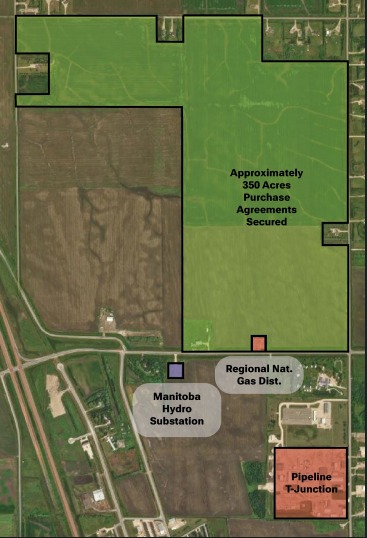
“As AI compute demand accelerates, energy-advantaged sites like this are becoming increasingly difficult to secure,” Jet.AI CEO Mike Winston, said in the release. “The combination of power, redundancy, and buildable scale here is extremely hard to replicate.”
The firm said in the release a transmission power load study application was completed and its working to secure an agreement with a natural gas supplier. In a investor presentation, Jet.AI labels the purchased land as a “Godilocks site” for data centres because of proximity to both natural gas pipelines and Manitoba Hydro transmission lines.
“This site aligns with the long-term compute and energy profile the industry is moving toward,” Consensus Core CEO Wayne Lloyd said in the release. “It offers the reliability, connectivity, and acreage required for multi-phase hyper scale deployment.”
Jet.AI is an aviation technology firm that has pivoted to AI data centre construction. Consensus Core states on its website it “optimize AI infrastructure end-to-end from data centers to the edge” and sources and builds processing units for projects.
A Manitoba Hydro spokesperson and the Crown corporation’s provincial minister Adrien Sala said no applications have been made for an AI data centre in Manitoba.
“Currently there are no applications to connect an AI data centre in the RM of Ritchot to Manitoba’s power grid. Any proposal for a facility like this is considered on a case by case basis with environmental and economic impact in mind,” a spokesperson for the minister said in a statement to The Carillon.
Both Jet.AI and Consensus Core didn’t respond to interview requests by deadline.
Ritchot CAO Shane Ray said in a statement, council hasn’t received any proposals or applications for a data centre.
“Until something is presented it would be premature for us to provide a comment,” he said.
On Oct. 31, the province released a report from its innovation and productivity task force, which made recommendations to help Manitoba navigate the economic shift from “a system rooted in physical production of tangible goods, into a new economy in which wealth, power and security are rooted in the ownership of intangible assets like intellectual property, data and artificial intelligence.”
After releasing the report, Premier Wab Kinew told reporters “You’ll see servers and data centres in Manitoba in the future.”
Statistics Canada currently lists eight data centres in Manitoba, not including sites at businesses or public institutions. Seven are in Winnipeg, one is in Winkler. None are AI data centres.
David Gerhard, a University of Manitoba professor and head of its computer science department, said AI data centres rely on graphics processing units instead of regular computing for AI systems, which consume more power and require more cooling to prevent overheating. When a program like ChatGPT processes a request, it has to perform multiple calculations to given an answer at a higher intensity level compared to regular computer program.
“The massive hyper scale data centers that we’re seeing crop up around the world are very power hungry, and so they’ll use whatever power they can find,” he said.
Water is a necessary component for AI data centres because if there isn’t any cooling system, the data centre would “practically melt,” Gerhard said. The water needed depends on the size of the data centre, but it would typically be enough for thousands of homes, he said. When water is pumped through, the high heat often evaporates the water and it returns to the atmosphere.

Municipal water would be a likely source for cooling because its often the cheapest option and non-treated water could “gum up the works,” he said.
“Water gets processed and cleaned and made suitable for human consumption, and then gets dumped on a computer to cool it down. It seems a little bit of an odd use of it,” Gerhard said.
Manitoba is potentially an ideal location for AI data centres because of the cold winter temperatures reducing the volume of water needed for cooling, he noted.
Gerhard called the data centre project in Île-des-Chênes “massive” and said it could be one of the largest data centres in the world.
He also expects the AI data centre would be noisy with the natural gas turbines operating and cooling system pumps and fans engaged.
James Wilt, a policy development manager for Climate Action Team Manitoba, was surprised by the scale of the proposed AI data centre. He said the reliance on six natural gas turbines for power would make it an “enormous emissions emitter.”
“It would be gigantic. It would be like the biggest power plant in the province, like bigger than any dam,” Wilt said.
The amount of water needed for the data centre could make southeastern Manitoba’s drought risk higher if its siphoned away, he noted.
Wilt said there isn’t evidence to support job or community benefits if the facility was built. There might be potential tax revenue for the province and rural municipality, but since details are scarce for the project it’s difficult to know the benefits, he said.
“At the end of the day, it’s a bunch of servers in a warehouse or in a building,” he said.
The power needed for the data centre would be better served to reduce emissions elsewhere in the province, such as electrifying public transportation, Wilt said.
– with files from the Winnipeg Free Press