
New curator announced at Mennonite Heritage Village
Advertisement
Hey there, time traveller!
This article was published 20/01/2026 (276 days ago), so information in it may no longer be current.
Former assistant curator Garth Doerksen has been promoted to the position of senior curator at Mennonite Heritage Village after two years of working at the museum.
“I’ve always had a strong interest in Mennonite history. But, what the museum does in terms of telling the story of Mennonites and their history, and the collection that we have, I mean, it’s really become important to me. I really believe in what we do here, and I think it’s such an important story to tell,” he said, noting all the artifacts at the museum, including the buildings, fall under the curatorial department.
“Andrea (Klassen) was a remarkable mentor and brought so very much to the museum, her expertise, and of course, being here for, I think, 11 years. She – over the course of time – learned so much about the collection and about the buildings. And so, I’m certainly hoping to continue the work that she had started.”
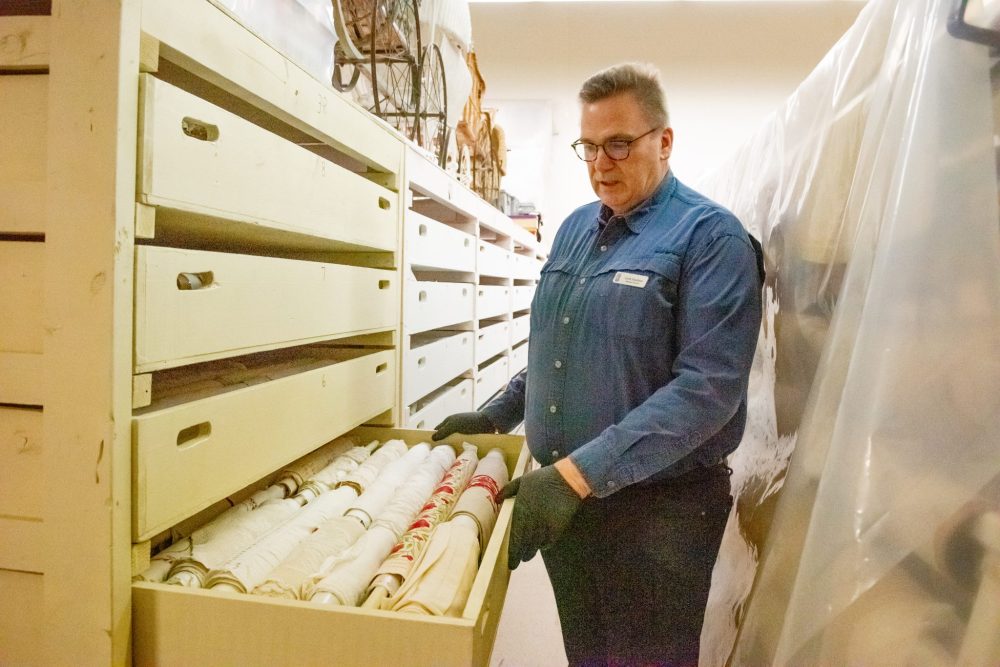
Klassen was the senior curator at the museum and moved on from that position late last year in order to concentrate on her family. Under her guidance the museum had a number of milestones, including the 2019 Award for Excellence by the Association of Manitoba Museums for its Russlander exhibit, which was brought back in 2023.
Doerksen was hired in December 2023, at the time Klassen said she hired him because his skills could be a benefit to the museum.
“To say, ‘Hey, here’s a guy with tons of experience, not necessarily right in the museum world, (but) experience and interest in Mennonite history might be an interesting direction to go in.’ Lots of those administration skills come into play here as well, dealing with the artifact collection especially, we need people who are into details, who are very exact, and organized and obviously if you’ve been a principal of multiple schools you have those skills,” she said at the time.
Doerksen spent his life as an educator, primarily as a school principal, in Winkler. There he raised his three children with his wife, who is also a teacher. When the Blumenort native moved back to his hometown a few years ago, he applied to work at the museum because it seemed like a nice fit since he has an interest in Mennonite history and has Mennonite ancestry.
In a 2023 interview, Doerksen said learning Mennonite history gives him the opportunity to know and understand where he came from in order to understand how he lives today.
Doerksen said he will be taking professional development courses from the Association of Manitoba Museums to increase his curatorial knowledge.
He said he has also built relationships with curators, historians, and museums in Manitoba whom he can call upon for guidance, such as Manitoba Mennonite Historical Society chair and Mennonite Heritage Archives archivist Conrad Stoesz.
“I regularly interact and learn from these people who have decades of experience working in Mennonite history,” said Doerksen.
The first exhibit Doerksen will introduce under his guidance will be Mennonites and Medicine, which is expected to open in the spring or early summer. The exhibit was Klassen’s idea prior to her departure.
“What we’ll do is, we’ll focus on the medical practices that the Mennonites used starting in about the early 1800s and until the early 1900s, so roughly 1800 to 1930, offering a look at how Mennonites understood illness, healing, and community care,” said Doerksen.
The exhibit will showcase stories and equipment from Mennonite bone setters, midwives, doctors, and nurses. Practices such as bloodletting, were common during this time as was the use of herbs and plants as medicine. Doerksen also noted the exhibit will show how instrumental the Mennonites were in establishing hospitals and other medical care institutions, both in southern Russia as well as here in Canada, specifically in Manitoba.
Not only were Mennonites bringing their medical practices to the New World, but they were also subjected to medical inspections during their migration to Canada.
“Not everybody passed, and sometimes they weren’t allowed to continue on the journey. And so, it even happened that families were broken up, like several of the family members maybe had some medical issues that wouldn’t allow them to continue, and so some would stay behind and some would continue, and then once those medical conditions improved enough, then they also could continue.”
But Doerksen noted that some of those who waited to get better, didn’t always make it.
“But there were some that, for example, stayed in – were held in England – and actually passed away there waiting for their medical conditions to improve. So, the journeys themselves were very difficult, and like I say, there were those medical inspections along the way.”
It’s estimated about 8,000 Mennonites immigrated to Manitoba in the 1870s from what is now Ukraine (Russlander Mennonites), followed by 21,000 after the 1920s; 12,000 between the 1940s and 1960s; and 15,000 in the late 20th century from South America and Mexico (the Kanadier Mennonites).