
Southeastern Manitoba 2025 border crossings into U.S. hit decade low
Advertisement
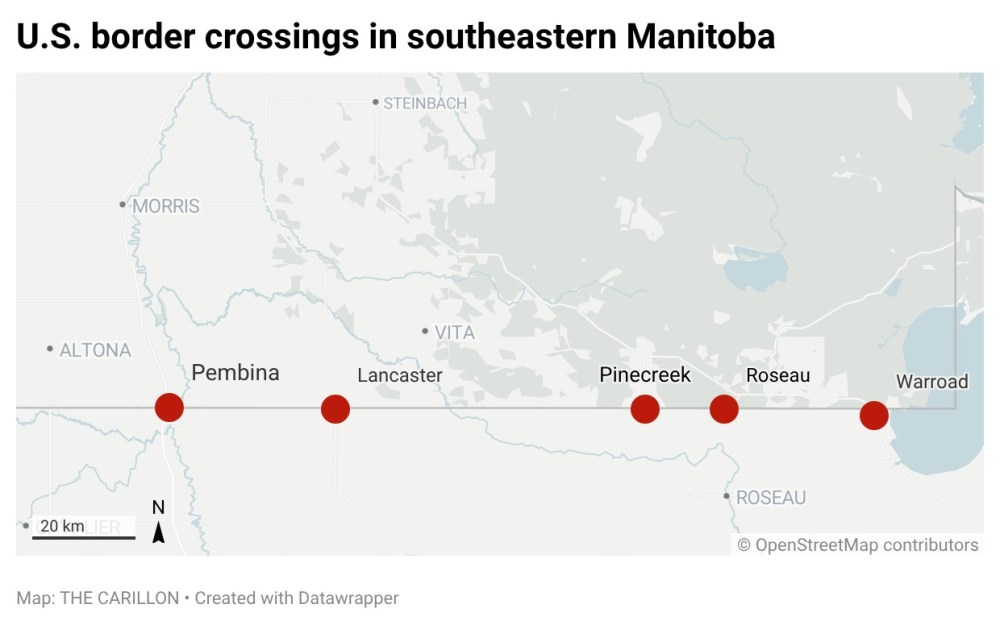
Travellers driving into the U.S. at southeastern Manitoba’s five border crossings have fallen to the lowest levels in 10 years excluding the COVID-19 pandemic.
In 2025, the Lancaster, M.N., crossing saw 27,996 personal vehicle passengers, a 40 percent drop compared to 2024, according to U.S. Department of Transportation numbers dating back to 2015. The Pinecreek port of entry had 2,985 last year, a 31 percent drop from 2024. Roseau and Warroad also saw falling numbers in 2025, with the former seeing an 11 percent drop and the latter 17 percent less.
“I don’t just don’t think people are traveling. I spend a lot of time in Tolstoi, and it’s not only the people’s apprehension of going to the United States now with all the trade turmoil that we have and everything else, but what customs has done (when cutting hours) is they are not very compassionate to the needs of the communities along the border,” said Wayne Arseny, a retired 35-year Canada Border Services officer.

The Pembina/Emerson, port of entry recorded 350,783 crossings last year, a 40 percent drop from the previous year.
He has worked at “every port in southern Manitoba,” with stints in the Canadian Sprague and Tolstoi ports. The now-retired Emerson resident attributed the drop in Canadian crossings to the falling Canadian dollar and earlier border closures at smaller crossings like Lancaster and Pinecreek.
The Lancaster border crossing is only open until 6 p.m., while Pinecreek closes at 5 p.m. and Roseau operates until 8 p.m. Only Warroad, Sprague and Pembina-Emerson allow traffic 24/7.
“So at 6 p.m., if you’re a family member and you’re having dinner in Tolstoi with your family, you can’t almost stay for dinner. You either eat at four or you got to go home, so you don’t miss the port and have to drive all the way back through Emerson,” Arseny said. “So it’s really made it inconvenient for locals along the border.”
Many people also don’t like the rhetoric from U.S. President Donald Trump because of the ongoing trade war and his reference to Canada as the 51st state, making some avoid all travel to the states, Arseny said.
While working at the Tolstoi and Sprague crossings, he would watch the constant flow of local commerce across the border, with residents on both sides going to the nearest bar, having cross-border jobs and or picking up necessary machinery parts for their farm equipment.
The less severe drop at the Roseau crossing is because of the provincial and municipal health care agreement with Minnesota and U.S.-based Altru Health System for Rural Municipality of Piney residents to access care in Roseau and Warroad, Arseny said.

Many of the community members are also dual citizens, with family in both countries and close ties to the U.S., he said.
Arseny suspects the shortened U.S. border crossing hours are a cost saving measure because it means less staff are needed.
During a summer road trip last year from Emerson to Michigan, Arseny said he saw less Canadian licences plates than usual.
“We saw a lot of Canadian trucks, but not Canadian vehicles. You used to go to Grand Forks and go in the parking lot at Walmart, and you see like 100 Canadian cars. Well, now if you find three or four, you’re probably pretty lucky,” he said.
A Statistics Canada study released on Monday found the number of Canadian resident return trips by vehicle from the U.S. hit 1.3 million for December 2025, a 31-percent decrease from the same month in 2024.
Lancaster’s Mayor Kathy Bernstrom said many businesses in town are hurting because of the drop in Canadian travel across the border. Local gas stations, golf courses and grocery stores have all been affected, she said.
She described Lancaster’s relationship with Tolstoi as “give and take” and said both towns would always cooperate with each other.
“We had lots of Canadian customers, and we like the Canadians. So we do miss them,” Bernstrom said.
She said the U.S. tariffs have been making Canadians feel unwelcome and avoid crossing into her community. The 6 p.m. border closure has made it hard for Canadians to visit a Lancaster restaurant or play a round of golf after work, Bernstrom said.
The community sent a delegation of businesses to Washington D.C. to plead their case in front of congress to extend the crossing hours, which changed during the COVID-19 pandemic.
If the hours aren’t addressed, Bernstrom is worried her town will start losing business and people will move away.
Charlie Bernstrom, owner of Bernstom Oil, a Lancaster gas station and convenience store, said his community has a strong connections with neighbouring Tolstoi on the Canadian side of the border. Bernstrom has no relation to the mayor.
“It’s sad it has come to this. Since I’ve been a little kid at the station, we’ve enjoyed seeing Canadians come down and become friends with a lot of people,” he told The Carillon.
He’s seen traffic drop at his shop and it became less busy last year. He said the shortened border crossing hours have to be fixed if Canadian travel is going to bounce back.
Bernstrom understands Canadians are upset because of the Trump’s comments and said the current political climate “stinks.”
“We like seeing them down here, and hopefully it comes back to some way of normal sooner than later because we are all a big community along the border here,” he said.