
COLUMN: Tales from the Gravel Ridge – The Rosengard School grounds of a bygone era
Advertisement
It’s that time of year, when those of us living on the eastern prairies of Canada are beginning to hope that clearing snow from sidewalks and driveways will soon become a distant memory. Slightly longer hours of daylight we know will hasten the day. However, as in days gone by, we may well be surprised by another snow storm, possibly one that dwarfs any we’ve experienced previously.
We acknowledge all of these natural signs even if they set us back for brief periods of time. These setbacks may dash our hopes momentarily, but we are renewed by the knowledge that inevitably spring will come. The children attending the Rosengard School back in the day were keenly aware of these seasonal changes.
In 1968 Rosengard School District #2168 ceased to exist. Its independent school became part of the Hanover School Division. In the years since its establishment in 1927, the Rosengard School was a vibrant place of learning, initially as a one-room school until 1957, and for the final eleven years as two classrooms, taught by two teachers.
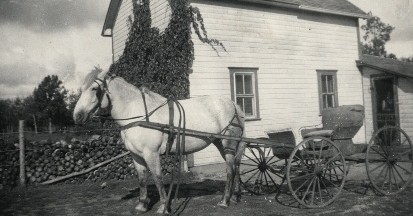
An important aspect of the education at that school was the playground. The school grounds included the school building itself located within large open play areas, with swings and teeter totters just west of the school. Located in the northwest corner of these grounds was a beautiful natural woodland of poplar trees. All of us were free to wander around and play in these areas during recess.
The school allotment also included an area in the north-east corner of the property where the teacherage as well as outbuildings were located. In addition to the buildings, a vegetable garden and a flower garden adjacent to the house, had the effect of creating a welcoming atmosphere.
In addition to relatively unstructured forms of play, we also enjoyed more organized activities mainly involving the older students. During the winter the game of choice was football as we called it back then, which was analogous to soccer as we name it today. Our equipment was basic, consisting of a leather soccer ball. Since we had a woodland nearby, I think cutting down the requisite number of trees for goalposts was our way of dealing with those important pieces of equipment. There was no net in the goal to stop the ball, …only the goalie. Perhaps needless to say, nobody had protective gear of any sort.
Our summer sport was similarly one in which it was mainly the older students who participated. Early in spring, after the snow had melted, we might get into a practice session by playing a game we called “Batter Up” which lasted perhaps a week or two. This game was in the nature of giving a batter an opportunity to practise batting a ball that was pitched in his or her direction. In due course, teams would be organized for more structured baseball games. As the seasons progressed it was not uncommon to play with students from other neighbouring schools, each team trying their best for the occasion.
A little later in the season we would choose teams and play regular baseball. As I recall it, there wasn’t too much in the nature of equipment, other than a baseball and a bat or two. As with winter sports, girls were also part of the line-up.
Those students who were not especially interested in organized sports could nevertheless participate in informal play, be it skipping or hopscotch, as well as bouncing a rubber ball against the school building in a range of different patterns
Mrs. Evelyn Wiens was our teacher when I was in Grade 4 at the Rosengard School.
I recall Mrs. Wiens engaging us in a rigorous outdoors fitness program, for which we won the award for funds for sports equipment from the Lord Strathcona Trust. For reasons not clear to me at the time, our school did not receive the award, being $15, because we students were led to believe that the funds had run out. I now know, of course, that the Lord Strathcona Trust stood at the time in ideological opposition to the pacifist traditions of our community during the Second World War, and consequently our school did not qualify for the award.