
Province, WSP meet with Ritchot council about twinning highways 59, 52
Advertisement
The twinning of Highways 59 and 52 are on the horizon with construction possibly beginning in four years.
Public servants from Manitoba Transportation and Infrastructure (MTI) and employees of consulting firm WSP met with RM of Ritchot council in March to discuss the twinning of the highways.
“So, the purpose of this study is to develop a functional design for twinning 59 from 52 to PR 210 and 52 from 59 to Broesky Road. And we’re also looking at the intersection of 59 and 52 as part of this study,” said Meagan Boles of WSP, noting the majority of the twinning will happen in the RM of Hanover and the balance in the RMs of Ritchot, Tache, and De Salaberry.
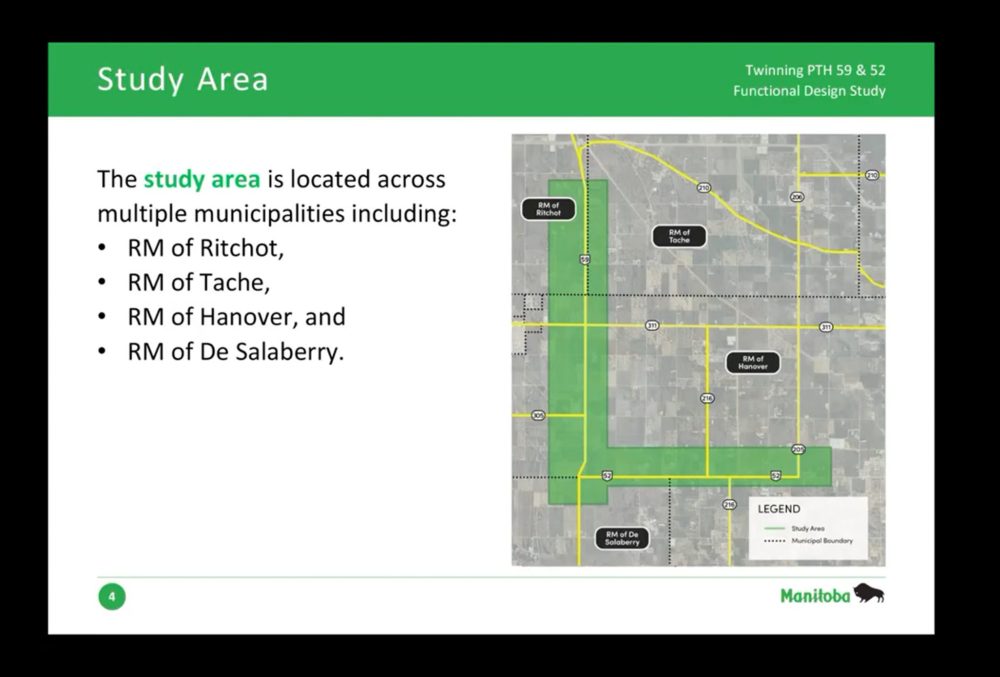
According to a provincial spokesperson, MTI has hired WSP to complete a functional design study for the more than 30 kilometres of highway construction (15.5 kilometres on Highway 52 and 15.3 km on Highway 59) at an estimated cost of $177.9 million.
The presentation to council provided information on the purpose and scope of the project and it allowed MTI and WSP to get information on any future development plans along the corridor, to identify potential impacts or constraints that they should consider, and offer council an opportunity to provide input and ask any questions.
The majority of twinning in Ritchot has already been done with past twinning projects. Right now, there is just a “small little section that’s left undone,” according to Mayor Chris Ewen.
“Having said that, I still think that it’s going to be a huge advantage for not just for Ritchot, but for the surrounding municipalities for safe access points, better traveling, logistics, possibly even creating an economic corridor along the 59 or a stronger version of that corridor along the 59,” he said.
Ewen expects the twinning will benefit other municipalities as it has done for Ritchot in regards to its growth of the Grande Pointe industrial park and Ile Des Chenes industrial centre, both of which are full or nearly full.
Boles said the project is in the beginning stages, of which engagement is the first step. Over the course of two years, the province and WSP will hold meetings with councils and stakeholders (government agencies, landowners, business owners, local interest groups, and the public) in developing highway alternatives first during this spring and then again over the summer and into the winter of 2027. A presentation on the alternatives and feedback from that will be conducted in the spring of 2027, followed by a decision on the final design and a final engagement in the fall of that year.
Part of the engagement process also involves a webpage about the project on MTI’s website and open houses for the public. MTI anticipates the functional design phase for the project to be completed in 2027/2028.
“So, this (part of the) project will take around two years to complete, and the goal at the end is to have that functional design study. It’s really an early phase of the design process where we identify the road right-of-way and roadway layout based on those projected travel patterns and demands,” said Boles.
“These studies are informed by both sort of technical aspects and public input through the process.”
During the process, MTI and WSP will look at confirming property boundaries, land development information and plans, the location and type of existing accesses, roadway condition assessments, collision history and any current data on pedestrian and cycling facilities, utilities, existing access permits in the areas, land drainage, social and economic impacts, costs, engineering and transportation, and environmental impacts.
“Engineering roadway design criteria, existing and projected traffic generation, we’ll look at that over the next 20 years for the roadway so we can make sure it’s designed properly, and looking at any existing safety concerns. Finally, consideration for school bus patterns, environmental and accessibility considerations, and we’ll also be completing a geotechnical investigation,” said Boles.
WSP project manager Kerra Mruss said the impacts on landowners are unknown at this time and that roads in the existing right-of-way can’t be twinned.
“So, obviously, we try to avoid buildings, businesses, homes where we can, but it’s not always possible. Again, we’ll be coming up with multiple options,” she said.
Once the functional design is completed, the project will move into the detail design phase, which should take about a year to a year-and-a-half to complete, followed by the construction phase.
“This is a long process. We still have, you know, public consultation, council consultations to go through. So, I don’t want people to think this is going to happen overnight. This is years away from being completed, but it’s a step in the right direction,” said Ewen.
Should everything go smoothly, those involved with the project estimate it will be at least four years before a shovel hits the ground and construction is completed.