
SRSD limits fee-based busing eligibility to K to Grade 6
Advertisement
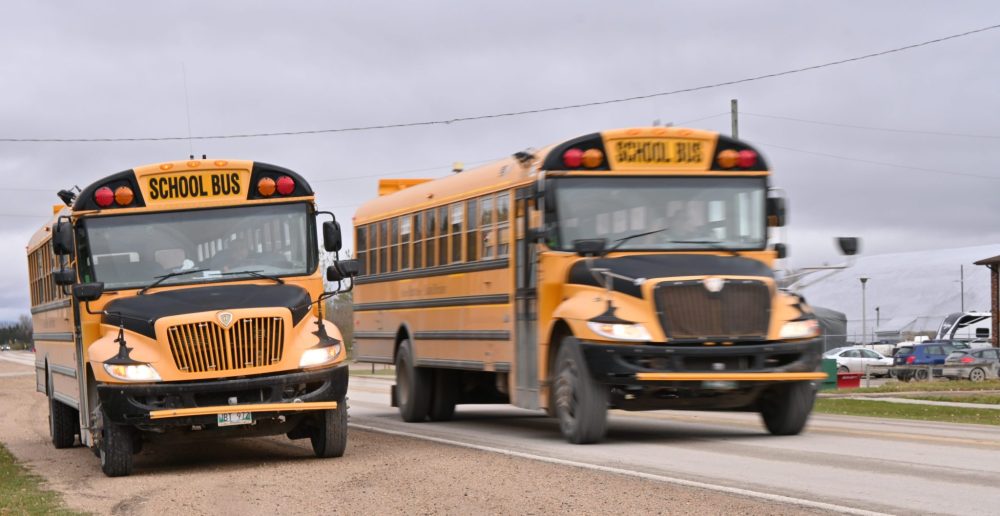
Seine River School Division is limiting the spots available for its fee-based busing service to free up more seats for students who have to cross railway tracks or walk along high-speed roads with no sidewalks.
Superintendent Colin Campbell and secretary-treasurer Karastin Michalycia presented updates to the school board on April 14 on the division’s transportation procedure to address safety concerns of students walking to school.
The division proposed expanding the eligibility for free busing to include Kindergarten to Grade 6 students who must walk across an uncontrolled railway crossing or roads with 70 kilometres per hour speed limits with no sidewalks. Only Kindergarten to Grade 4 students were offered the service in the previous version.
Colin highlighted “grey areas” for student safety, giving the example of Ste Anne’s Traverse Road, which has a 70 km/hr speed limit with only a shoulder and no sidewalk.
He said parents and community members were vocal about the safety risks when no sidewalks were available.
“The predicament that we’re in where we have full buses is coming from a place of care and wanting to get as many kids to school as we can on a bus, which has great intentions,” Campbell said during the meeting.
“However, its come to the point now where our buses are full, and then we have these safety areas that we want to try and take care of. To address that, we need to make some shifts.”
To offer the extra free busing space, the division needed to expand its capacity by reducing the eligibility for its fee-based transportation from Kindergarten to Grade 12 down to Kindergarten to Grade 6. The minimum eligible distance for the enhanced service will be set at 1 km. The division has roughly 400 students signed up for the fee-based busing as of April 15. The divison began charging families for the service in 2022.
“When enhanced (busing) was initially introduced, it was unknown as a new service how much uptake there would be,” Michalycia told the board.
“Now we’re looking at creating room, ensuring we have capacity long term, and are not dealing with scenarios where we are removing kids later because of full buses.”
The division will also stop charging families for busing whose homes are 1.6 km or more away from school according to Google Maps due to increased funding eligibility from the province. The province offers $290 per eligible urban student and $375 per eligible rural student for bus funding.
For parents with children in daycares, both the home and the daycare must be at least 1.6 km away from the school to get free busing. The updated policy also designates sidewalk and pathway snow clearing and maintenance as a municipal responsibility.
Michalycia said having the new guidelines will add clarity to parents and help avoiding difficult conversations when a fee-based student needs to be removed for someone who is eligible.
“We’ve filled our buses so much at this point with those fee-for-service students that we are at the point where everyone coming in a lot of areas, we have to remove someone,” she said.
“What we’d like to do is to be able to say yes more than we’re having to say no.”
Michalycia said only half of the students for the enhanced service have paid their invoices to bus. Families pay $500 to have their child on the bus for the school year. Some of the factors include confusion about needing to pay, an unwillingness to pay or setting up payment arrangements.
The division hopes to get payment upfront to avoid having students who are both not paying for a seat and taking up space for eligible students, she said, adding some buses have added new routes and second runs to meet demand.
Trustee Gary Nelson said the division needs to address the lack of payment issue and “nip it in the bud.”
“I’m empathetic in regards to the issue, but people are going into this knowing that there’s a fee for it, and then half of our parents aren’t paying the fee. That’s problematic from my perspective, and it’s kind of defeating what our intention was in the first place,” he said.
Trustee Marinus Van Osch said the division should set multiple payment options for parents to pay monthly, quarterly or annually.
“It’s not going to be an honour system. It’s going to be give your credit card, and we’re going to process it and they (families) are going to sign off on it,” he said. “Administratively, we can’t be chasing money. That’s not our job.”
Campbell didn’t say if bus operations would be impacted if the division didn’t recoup the outstanding payments, and instead said the administration will deal with each case individually. He said the division aims to have the transportation procedure changes finalized for the start of the 2026-2027 school year in September.
Trustees Nelson, Thersea Bergson, Lise Verrier, Robert Rivard and Vice-chair Vicky Kiansky all voiced concerns over the lack of sidewalks in new developments and the snow clearing throughout municipalities as safety issues that need to be addressed as students walk to school.