
Steinbach mayor labels relationship with The INN not healthy, says SCO is more collaborative
Advertisement
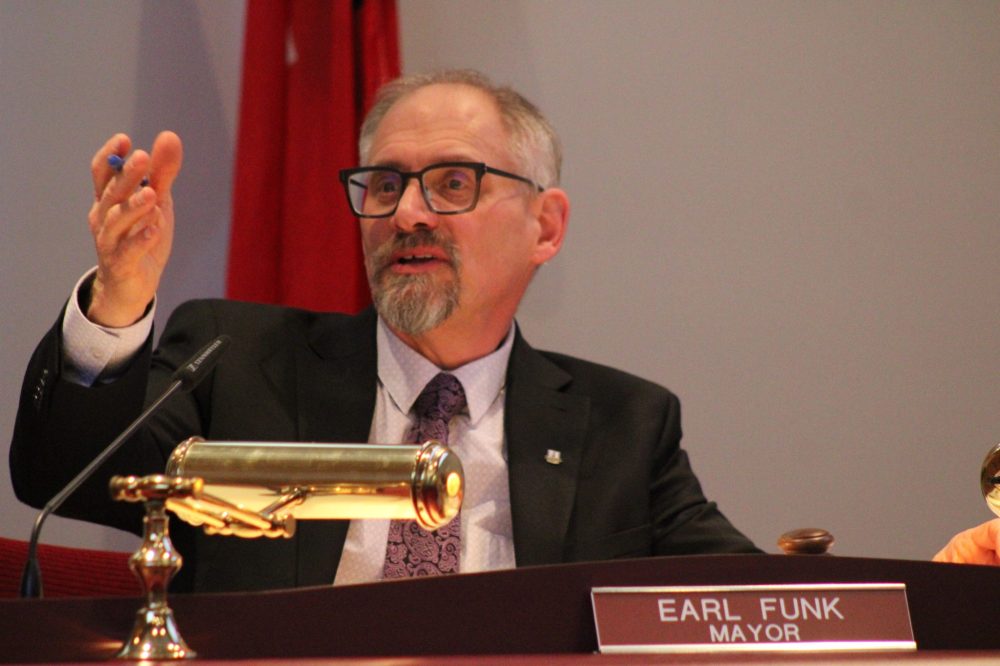
Steinbach Mayor Earl Funk said the relationship with a transitional housing non-profit “hasn’t been healthy,” and Steinbach Community Outreach has been more “collaborative” with council on its housing project.
Funk made the comments when speaking with reporters on April 21, after Steinbach city council voted to pass the first reading of The Initiative for Neighbourly Nights’s proposed transitional housing bylaw. The bylaw would add a transitional housing definition as a building requiring conditional use, which would spark a public hearing before receiving project approval.
The INN’s project would include 30 beds and offer wrap-around medical care and housing supports for people exiting homelessness. The estimated $2-million facility would be located at Main Street near Kroeker Avenue.
SCO and Eden Healthcare Services’s facility, billed as “supportive housing,” will also have 30 beds. On-site psychiatric care and medication management will be available 24/7 for half of the beds, located on Third Street.
“We work with everyone. It just hasn’t been as healthy,” Funk said. “I don’t know what we can do to make it, to make it be more effective.”
While The INN’s project has yet to go before council for approval due to difficulties finding a bylaw to apply under, and city council insisting it requires a public hearing before approval, SCO and Eden’s facility is set to begin construction in 2027 without needing a public hearing.
Funk said SCO and Eden didn’t need a public hearing because the land was already properly zoned as residential medium-density housing. He also noted the land was rezoned as residential in 2014, making it easier for the project.
“We’ve got a long history of them (SCO and Eden) being collaborative with us,” he said. “It’s just a really good working relationship.”
Funk wouldn’t say whether or not he wanted transitional housing in Steinbach, but said “something is needed.”
He said the city doesn’t want homeless encampments because they aren’t safe and there needs to be a more permanent option. The Carillon previously reported on multiple encampments which popped up around Steinbach in the summer of 2024.
“I’m not opposed to transitional housing. I just want to do this right so it fits into the community correctly,” he said.
Transitional housing and medium density housing “change the fabric of a neighbourhood,” Funk said, because it changes how a community operates if it was only single family homes previously there.
Funk said he’s been doing his own research on how to address the homelessness problem by chatting with homeless people in the community.
Coun. Susan Penner made the motion to accept the transitional housing bylaw definition and include changes that would set occupancy time frames ranging from three months to three years.
She told council the definition shouldn’t be a permitted use because residents deserve to have a say on any project.
“This even pertains to things like residential medium-density apartments. It’s important that the neighborhoods have an opportunity to weigh in when the project is going to potentially change the nature of the neighborhood,” Penner said.
She said the approach is consistent with how the city treats other projects.
Coun. Michael Zwaagstra seconded the motion and said he wouldn’t support the definition if it wasn’t conditional use. He noted any apartment building in a commercial zone would require a public hearing.
“We just did public hearings for some variances, as small as a couple of feet in terms of side yards and such. That is obviously important enough that we would have a public hearing for those kinds of variances,” he told council.
“For a project of this significance, it’s fully reasonable that it would be a conditional use so that way a public hearing would be triggered.”
The bylaw passing first reading marked the second time city council has crafted a bylaw for The INN. Steinbach’s council passed an emergency shelter bylaw in January that required a public hearing.

The INN has previously said city council didn’t consult the non-profit about the bylaw, despite it being created for its project, and cancelled multiple meetings with the non-profit’s team.
Aaron Moore, a University of Winnipeg political science professor who specializes in municipal affairs, said city staff and elected officials often prefer working with groups who they have a better relationship with to get things done easier.
“Should I give the mayor credit for actually acknowledging that they have different relationships,” he said. “Maybe he’s trying to indicate to The INN that ‘We are willing to work with you if you play ball, but you haven’t been playing ball.’”
Historically, being a new entity trying to get a project approved is more difficult than groups already known to a city council, he said. That impact is magnified in communties like Steinbach when there are more direct connections to city councillors and staff.
“As much as we would like to believe that everything is handled in the same manner, and there’s no biases. There always is,” Moore said.
Leona Doerksen said The INN’s proposed facility would positively change the neighbourhood because homeless people would have a safe place to stay.
“In terms of changing the fabric, we no longer will see people covered in layers of fabric on our streets just to keep themselves warm,” she said.
She said neighbours have no reason to be concerned because it will help reduce homelessness and increase safety in the area. Regardless of where The INN builds, there will always be some neighbourhood push back, Doerksen said.
The INN has been endorsed by 14 Steinbach churches as a necessary resource, and Winnipeg-based Main Street Project helped advise the non-profit when creating its proposal. The INN also has more than $800,000 in operating grants from the federal and provincial governments hinging on council’s approval.
“Our model is very evidence-based and approved both provincially and federally,” Doerksen said.
“Unfortunately, what we’ve come to realize is it’s who you know, not what you know, and so that has been a political barrier for us.”
While SCO and Eden’s project is necessary and address mental health treatment, it doesn’t serve people who are exiting homelessness and transitional housing fills that gap, she said. When The INN is up and running, Doerksen said she looks forward to refer clients to SCO’s housing projects as they leave the facility.
Steinbach residents need to know where each council member stands on ending homelessness because the non-profit isn’t confident that city council wants to address it, she said.
If there are no other options for homeless people, Doerksen said “of course there’s going to be encampments” because people need a place to live.
“We’re at the mercy of city council, but I think that city council owes it to the electorate to be honest about their views on homelessness, the causes of homelessness and the solutions of homelessness. I think it’s time for some accountability,” she said.