
Roseau River Anishinabe First Nation calls on province to remove gas line
Advertisement
A southeastern Manitoba First Nation is asking the province to remove a natural gas pipeline it says presents “significant and tangible” safety risks for residents.
Roseau River Anishinabe First Nation, located roughly 60 kilometres south of Steinbach, sent a March 30 letter, addressed to both Premier Wab Kinew and Manitoba Hydro president and chief executive officer Allan Danroth, outlining it would take legal action and prevent entry from unapproved workers if the existing roughly 1.5 km of pipeline isn’t removed and the planned pipeline isn’t rerouted.
The letter, penned by Coun. Evan Roberts, said the pipeline has disrupted drainage and hampered flood mitigation because it blocks gates and pumps near the community dike. It also mentions the risk of pipeline ruptures and explosions, citing the the 2014 Otterburne explosion as an example.
“There’s no guarantees that something could happen to this line. There’s been other situations and in the past where these lines have ruptured, and I think with those are risks we don’t want to take with our community,” Roberts told The Carillon.
The existing line running through the First Nation was built in 1962.
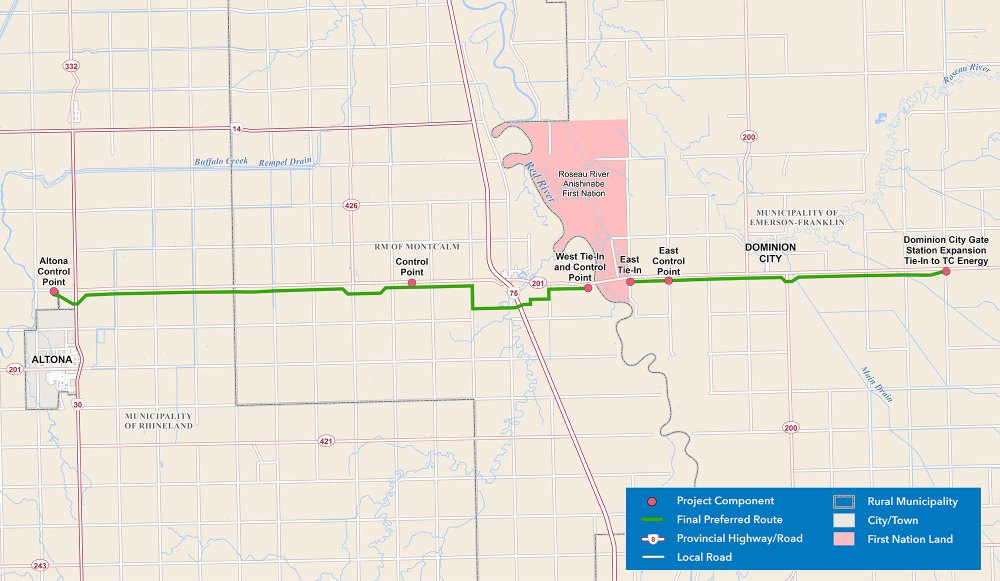
The proposed Dominion City to Altona Gas Transmission Pipeline would run 36.6 km, with the pipeline laid one metre below the surface. It would connect gas stations east of Dominion City to a control point north of Altona. Construction is slated for summer 2026, after an environmental licence was granted in March.
The letter said the proposed pipeline has “zero economic benefit” for the community. Roberts would like to see the First Nation have ownership over any pipelines and investment in reserve infrastructure.
“This is infrastructure that just passes right through our community, and we don’t gain anything from it. It doesn’t heat our homes, it doesn’t provide energy,” Roberts said.
A 2024 environmental assessment report stated the First Nation raised safety concerns about the pipeline and its proximity to Provincial Road 201. It also said the First Nation was interested in tying into the gas to supply the community. There would be no ground disturbances on any of the First Nations lands during the project as it would use the existing pipeline that runs beneath the Red River.
Roberts said the level of consultation with chief and council previously wasn’t clear and community members didn’t have a say in the project. He said there are no band council resolutions passed that supported the project. The only resolution referring to the project was to appoint a community liaison position, Roberts said.
“By meeting and sitting down with chief and council at the time doesn’t necessarily give you any kind of consent or permission to proceed and on projects like this,” he said.
Roberts said the council has rescinded the two band council resolutions: one from 2022 that appointed the community liaison position and one from 1962 when the pipeline was first installed.
“Our community is still dealing with high level of rates of poverty, and this infrastructure is servicing the neighboring communities. It’s servicing a lot of the agricultural operations and in the area, and yet our community is left behind and still struggling,” he said.
Adrien Sala, the minister responsible for Manitoba Hydro, said in an email statement the province appreciates the concerns raised by the First Nation.
”Since taking office, we’ve rescinded the directive that prevented Manitoba Hydro from dealing directly with First Nations. We expect that Manitoba Hydro will engage with the community in good faith, and respond formally in due course.”
Danroth responded to the First Nation’s concerns in a April 21 letter.
“It is apparent from your letter that the safety associated with these gas lines is of utmost importance to Roseau River Anishinabe First Nation. Safety is a fundamental value for Manitoba Hydro and our gas subsidiary, Centra Gas, and the cornerstone of all our operations,” he wrote.
Danroth said Manitoba Hydro wasn’t aware of any impact from pipelines on drainage or flood protection, but said the Crown corporation will follow-up with local leaders to address the concern.
Standard industry practice is to disconnect, clean and purge all decommissioned pipelines, while leaving it in the ground as to not disturb the environment, he noted. But Hydro is willing to work on an alternative plan if needed.
Danroth highlighted that Hydro had previously offered to explore connecting natural gas to the community. It shared a feasibility assessment on potential natural gas connections in May 2025, but never received a response from the First Nation’s leadership.
Manitoba Hydro’s project engagement staff have discussed the new pipeline with the First Nation, including training, employment and business opportunities on “multiple occasions” in 2024, he said.
Danroth noted that the engagement activities are still ongoing and Hydro is willing to meet to discuss further issues.