
1946 – 2026 Watching Steinbach Grow: Town status leads to urban amenities
Advertisement
With the incorporation of the Town of Steinbach came an explosion of civic pride and progress that saw little time wasted in adding urban amenities that were in keeping with the new status of the community.
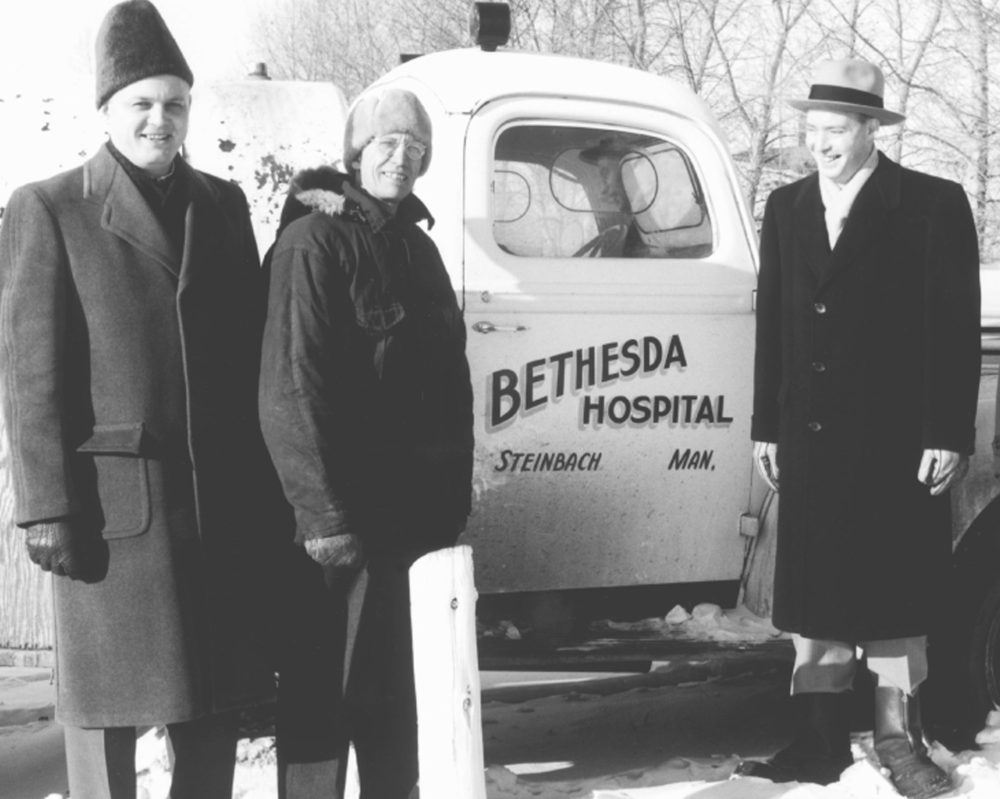
In short order, the town had a paved Main Street, an enlarged hospital, running water in a number of homes and door-to-door milk delivery, just like a big city. Residents got together to build a curling rink, which benefited both the community and neighbouring farmers who could be expected to do a little shopping when they came to town for their favorite winter recreation.
A number of churches made a concerted effort to help the aging population, with the purchase of the invalid home on Hanover Street and construction of a replacement, just off Kroeker Avenue, some time later.
And like the larger urban centres that dug up city streets, practically as soon as they were paved, Steinbach’s growing pains included a couple of years of less than passable roads while indoor plumbing made its way into Steinbach homes.
An advertisement in The Carillon News, by the Steinbach Chamber of Commerce in 1955, asked whether Steinbach could afford to be without waterworks. The ad pointed out that all major towns, except Steinbach had sewer and water.
“If we pride ourselves on progress and on being up to date, the many advantages of waterworks should be considered.”
Promoting a “yes” vote in a referendum later in the year, the Chamber of Commerce cited fire protection, safe disposal of sewage, good clean water available to all, and reduced building costs and lower insurance rates, as good reasons to go ahead immediately with a waterworks project.
Thoughts may have turned to freezing walks to an equally cold outhouse in the winter when a record number of voters turned out in December of 1955 to endorse the waterworks proposal with 72 percent voting in favour.
Half an hour after the polls closed, The Carillon News came out with the smallest “Extra” ever printed. The four 3.5 by 5 inch pages outlined the results of the vote, and told a story people wanted to hear.
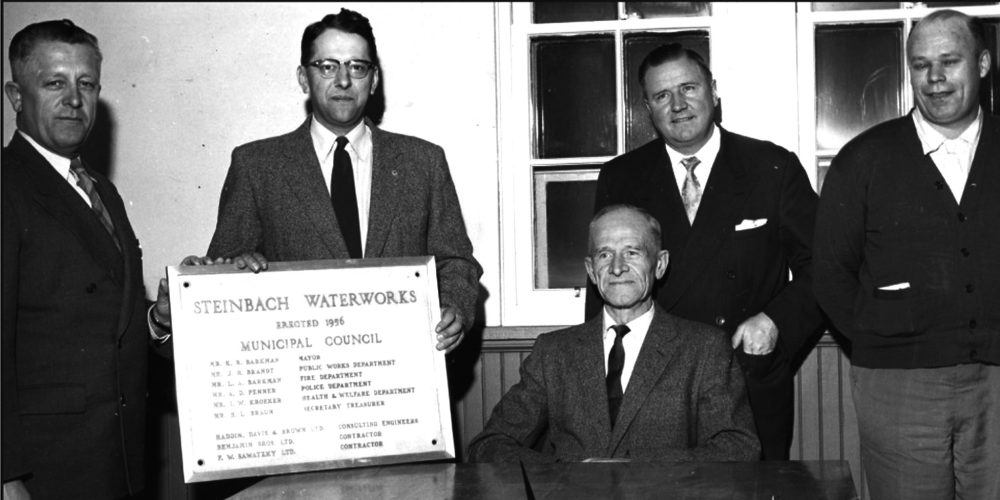
For the mayor and council, the referendum result was most gratifying, as they had expected the vote to carry, but had not realized the public was so much in favour.
The next step was to find a contractor to do the work, for there was no suitable equipment available locally to do this type of work. That situation was rectified for future projects as the town bought equipment and established its own public works department, as sewer and water infrastructure was to be continually expanded over the years.
With the coming of the water and sewage system to Steinbach in December of 1956, the town entered a whole new era as far as conveniences were concerned. It was the beginning of the end for the outdoor “privy”. It was also the end of the perennial post-Halloween “clean-up campaign”, and it was the beginning of the end too, for frozen disposal fields in mid-winter. Waterworks proved to be a wonderful boon to Steinbach as, year after year, more and more homes were added to the new system as fast as men, money and machines were capable of hooking up new streets.
From the standpoint of the town’s firefighting program, the waterworks of course proved its worth many times over. Firefighters now had an unlimited supply of water handily available almost everywhere in town, all under a high pressure, with which to fight fires.
But the town did not get its water system without certain inconveniences along the way. Streets which had been paved had to be ripped up to install the sewer system, and the following spring, residents of many unpaved streets found themselves getting stuck in quagmires. At one point, the conditions on Main Street were so bad, council was asked to provide free towing for out-of-town residents who got stuck, coming to Steinbach to spend their money.
However, after the first summer, this difficulty was mostly eradicated, and both the town and residents were beginning to feel the benefits of the system.
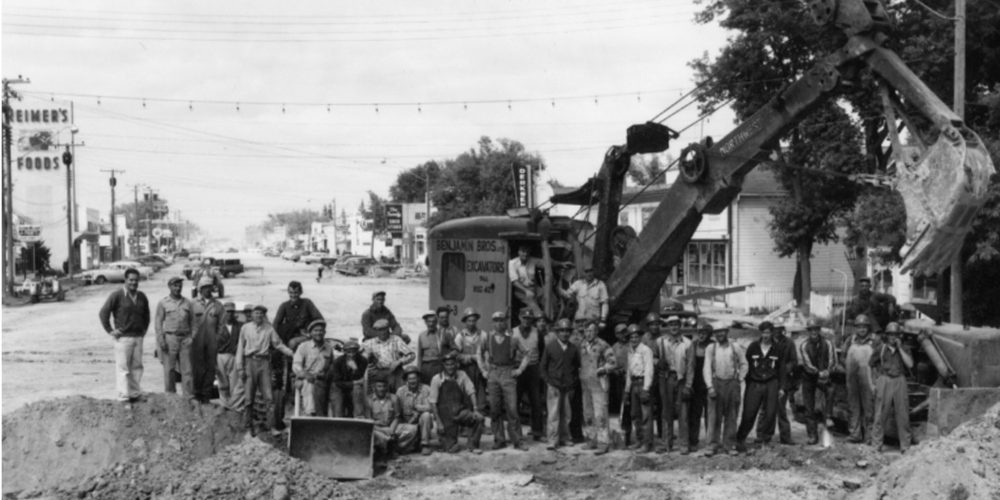
And those on the outskirts, beyond town limits, many who owned businesses or worked in town, were asking to be annexed by Steinbach in order to be hooked up to the sewer system.
Almost as great a boon as the waterworks system was a new automatic telephone exchange, which began functioning in Steinbach and district in November of 1959, replacing the outworn, and often faulty system with its party lines, habitual eavesdroppers, and poor reception, particularly on rural lines. The new system was expensive to install, but all agreed, like the modern waterworks system, it was well worth it.