
COLUMN: The Carillon Flashback June 19, 1991 – Terry Fox legacy lives on
Advertisement
Terry Fox died more than 10 years ago, but his story continues to become more popular around the world. The name Terry Fox is probably more well-known around the world than any other Canadian in our history.
But Terry’s mother, Betty Fox, says it is “extremely important to know that Terry was an ordinary young man.” That is what she told students at Springfield Collegiate in Oakbank, earlier this month, as she honored the students of that school for 10 years of participation in the Terry Fox Run.
Also present at the ceremony was Jean Hanson, who was Terry Fox’s Grade 2 teacher in Transcona, where the Fox family lived prior to moving to British Columbia.
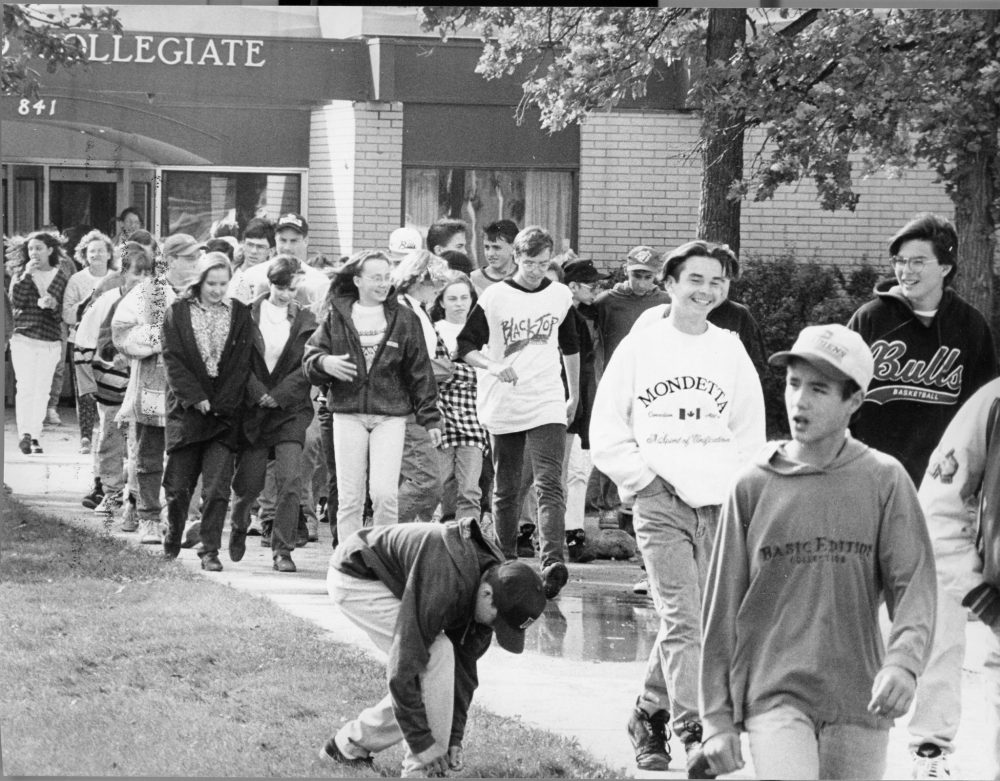
So the ceremonies at Springfield Collegiate took on a more special meaning, because Terry Fox used to live in the area. In speaking to the students, it was an emotional time for Betty Fox, as it was for all in the gymnasium that day.
With tears welling in Mrs. Fox’s eyes, she told the story about her world-famous son. A story that is well known to most, but hearing it from her makes it seem more real.
She went on to describe how Terry believed in hard work, loved a challenge, and felt that anything was possible.
Terry Fox was always a good athlete when growing up. In fact, in his first year of university at Simon Fraser, he made the university junior varsity basketball team. And it was during that first year of university, in 1977, that he developed a pain in his leg, but ignored it and refused to tell anyone about it, so he could finish the basketball season.
Betty Fox says that if Terry had done something about the lump in his leg at the time, her son would probably be alive today.
“Sports and schoolwork are very important to young people, but your health is more important.”
Within 24 hours after Terry Fox first went to see the doctor about his leg, he was told the leg would have to be amputated. The young athlete was devastated. He could no longer play sports.
He also underwent chemotherapy, which resulted in the loss of his hair. Terry’s mother said although the hair eventually grew back, at the time, the loss of his hair was more traumatic than the loss of his leg.
Terry’s recovery after surgery was very quick, and it was at this time that Terry Fox began to research cancer. He discovered that not very much money was being made available for cancer research in Canada, and he decided that something needed to be done to raise money for cancer research.
Terry Fox’s cross-Canada run began in St John’s, Newfoundland. When he was forced to stop running, 3,339 miles into his run, near Thunder Bay, he had averaged nearly a marathon a day for 141 consecutive days. An incredible accomplishment, considering he was running with an artificial leg.
Last year, on the tenth anniversary of Terry Fox’s death, his parents went to Newfoundland and drove the route that Terry took, retracing his steps.
“We now understand what he went through,” says Mrs. Fox.
Terry Fox’s initial run raised $27 million for cancer research. In total, more than $90 million has been raised worldwide through the annual Terry Fox Run. Today, the Terry Fox Run is the single largest event for cancer research in the world.
Mrs Fox believes that her son sounded the alarm about cancer. She feels that Canadians are more aware about the signs of cancer. Betty Fox concluded her story to the Springfield Collegiate students by saying she is positive that her son would be proud of Canadians as they continue to raise money for cancer research.
– with files from Terry Frey