
Mural unveiling of McMunn community completes set for local artist and historian
Advertisement
Community members and historical enthusiasts gathered at the Midwinter Heritage Site in East Braintree on June 27, to share a potluck meal and witness the unveiling of local historian and artist Lorna Feilberg Annell’s latest and possibly last historical mural of the once vibrant village of McMunn.
Exactly one year earlier, Annell had stood on the same stage attached to the old one-room schoolhouse that is now a local museum and revealed her first artwork featuring a meticulously accurate depiction of East Braintree, where she and sister Margaret were raised.
Both sisters are community icons, with Lorna having won awards such as the Lieutenant Governor General’s Award for historical preservation and promotion, and Margaret serving as president of the Midwinter Heritage Association, with their many years of hard work making the site a historical tourism showpiece.
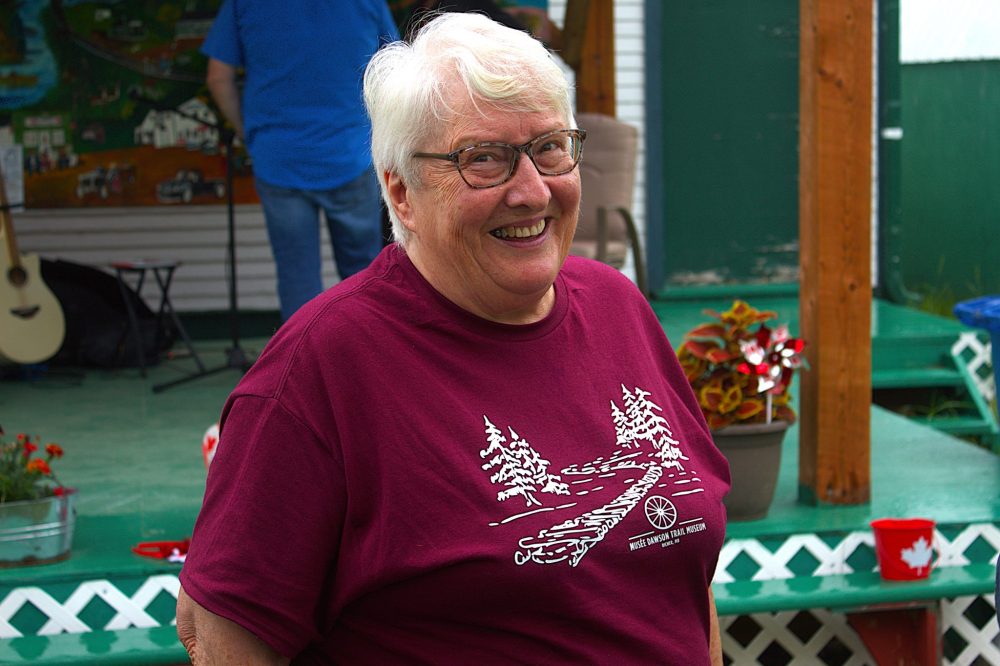
“She’ll tell me what to do and when and where to stand. She’s the boss. She’s my younger sister, but she’s the boss,” laughs Lorna.
The connection between the murals is more than the proximity of the two communities, but also that the sisters were raised in East Braintree while their mother was from the next community “down the line” of McMunn.
When the railway companies were still constructing routes through these lands, the companies intentionally laid out grids of towns along their tracks, spacing them roughly seven miles apart. The distance between them was determined by the operational limits of early steam locomotives and the distance farmers could travel with a horse-drawn wagon in a single day.
Like the mural of East Braintree beside it, Annell’s mural of McMunn is a historically accurate representation of what the town used to look like in its heyday. More importantly, the two murals represent the essence of what life was like in the towns, from the principal locations to the industries to the houses where notable people used to live.
“It’s a depiction of the era rather than a painted Polaroid,” says Lorna. “Although this time, (unlike the first mural) I put the names on the houses of where the people used to live so those coming here can see where their families used to be. I grew up here, (in East Braintree) so I already knew who lived where.”
Annell says this second mural took three months to complete and was much harder to lay out than the first one as she had fewer photos to work from. Conversations with previous residents about family stories, descriptions from letters and notebooks, and some intuition helped with the design.
“I followed the curve of the river, which was confirmed by the photos I had, then put in the rail line and finally the highway, and then made the placements from there,” said Annell.
Like the first mural, the McMunn painting features the industries and the activities of the community that used to call this place home. From the cutting of logs to farming, along with where the general store once stood, Annell has included activities in the mural such as collecting blueberries and the school where Ukrainian dancing lessons took place.
“I included some of the activities like berry picking and making hay and plowing and sawing firewood, and quarrying rock from the McIntyre Quarry, which was at mile 73 (of the railway),” said Annell. “My mother told me that Scotty McMunn taught all the kids to skate by pushing a chair down the ice on the river. So, I included that in our winter scene up to the left.”
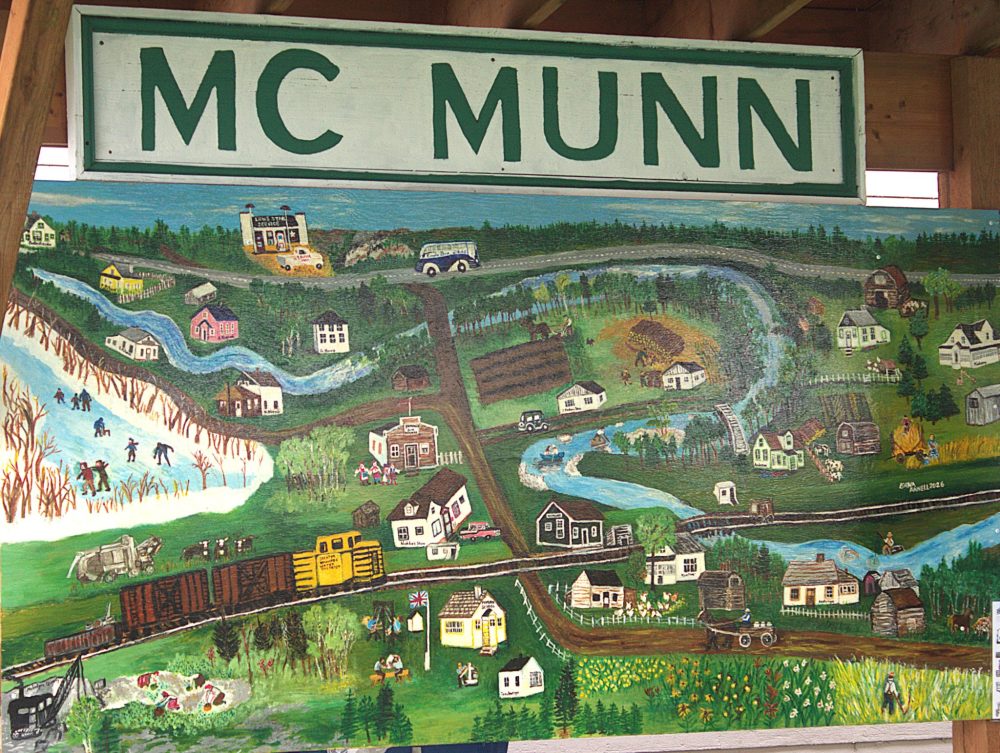
After the bedsheet-veil was removed, several onlookers got up on the stage to immerse themselves in the details of the painting, where an older gentleman could be overheard saying to his daughter while pointing to a spot on the mural, “I had my wedding social there,” while another woman said to herself through a sigh of nostalgia, “I went to school right there.”
Annell whispers with some pride, “There was a hall called the Taras Shevchenko Enlightenment Society Hall that was in McMunn; McMunn Hall and I just had to put it in. It was built in 1922. Some people had wedding socials there or baby-shower socials in McMunn Hall. And I had to paint it at an angle so you could see the front of the hall. It actually faced the road, not kitty corner like it is there, so you can see the Ukrainian sign above the door.”
After giving a brief address to an appreciative crowd, Annell said to those in attendance, “I hope you enjoy the mural and I don’t have any plans for anymore … I don’t know enough about Prawda or Hadashville (to do them); I never lived there.”
The Midwinter Heritage Site is part of the Manitoba Museum Network that seeks to preserve the history and community of the province and donations of funds, time or labour can be sent to: Midwinter Heritage Association at Box 73, East Braintree, MB R0E 0L0.
“You wouldn’t find those buildings there now for sure,” says Annell. “Knickerbocker Store is still there but it’s not a store anymore; it’s an old house hidden along with the Lady Slippers blooming on the side of the road … We’re cottage country now.”