
COLUMN: Tales from the Gravel Ridge – Stories that should not be forgotten
Advertisement
All of us have stories to tell, many in fact. After all, there isn’t a day that goes by when something we hear or experience becomes in one way or another, a story. Whether it’s worth repeating may or may not depend on whether you consider it important to do so. It might also be the case that no one else deems what you shared as being noteworthy. Sometimes it is the skill of the storyteller or the circumstances under which it is told that determine whether a story will come alive, or will be retained by the listener.
There are stories however that tell us a great deal about ourselves and about those who have shaped our lives in ways that are truly immeasurable. Such stories for me are the ones our parents told us about events in the life of our family in somewhat more recent times, but also, more particularly, the stories of the personal lives of members of our family before they arrived in Canada.
Some of those stories, augmented by photographs, hold enormous value for me on countless levels. The longer I live, the more compelled I feel to celebrate and honour those stories, not only for their historical value, but also for the examples of grace and courage my parents, and many others in like circumstances displayed, functioning as they did with phenomenal resilience. Frequently such qualities were demonstrated in circumstances fraught with loss of enormous proportions.
I have no doubt that the people of Rosengard were, in large part capable of such resilience, by the sense of community that they exhibited and fostered. Such was the environment of my home and community throughout my childhood and youth.
Rosengarders had to be forward looking. In some ways perhaps, this applied particularly to those, like my parents who had come to Canada after experiencing the turmoil of the First World War, the Russian Revolution resulting in the overthrow of the monarchy, in addition to anarchy and civil war, not to mention famine and epidemics, including tuberculosis and typhus.
Those of us who were born in Canada tend to forget, or indeed fail to realize that political stability is by no means something to be taken for granted. My mother used to say that she could live with poverty, as long as she did not have to fear “the knock on the door at night”. What she meant by the term the knock on the door at night was that the secret police would come to arrest a family member, usually the father of the family, and take him away. It was not an uncommon occurrence in the Stalinist era following the Russian Revolution.
In 2001, my husband Bernie and I joined a Mennonite Heritage Cruise down the Dnieper River in Ukraine. It was during that cruise that we were able to take a day trip to the former Mennonite village of Schoeneberg, now called Smolyane, where my parents and grandparents had lived. When I mentioned our planned day trip scheduled for the following day to Johan Froese, a fellow traveller on the cruise, his eyes lit up. He too was going to Smolyane since he had lived in that community as a child, and had vivid recollections of that time. When he was a child, the secret police vehicle commonly called the “Black Raven” came down their driveway one night, and an officer came to their house and knocked on their door. Johan’s father went to say “good-bye” to his children, who had already gone to bed. That was the last time Johan saw his father. Such incredibly poignant stories have a way of lingering indefinitely.
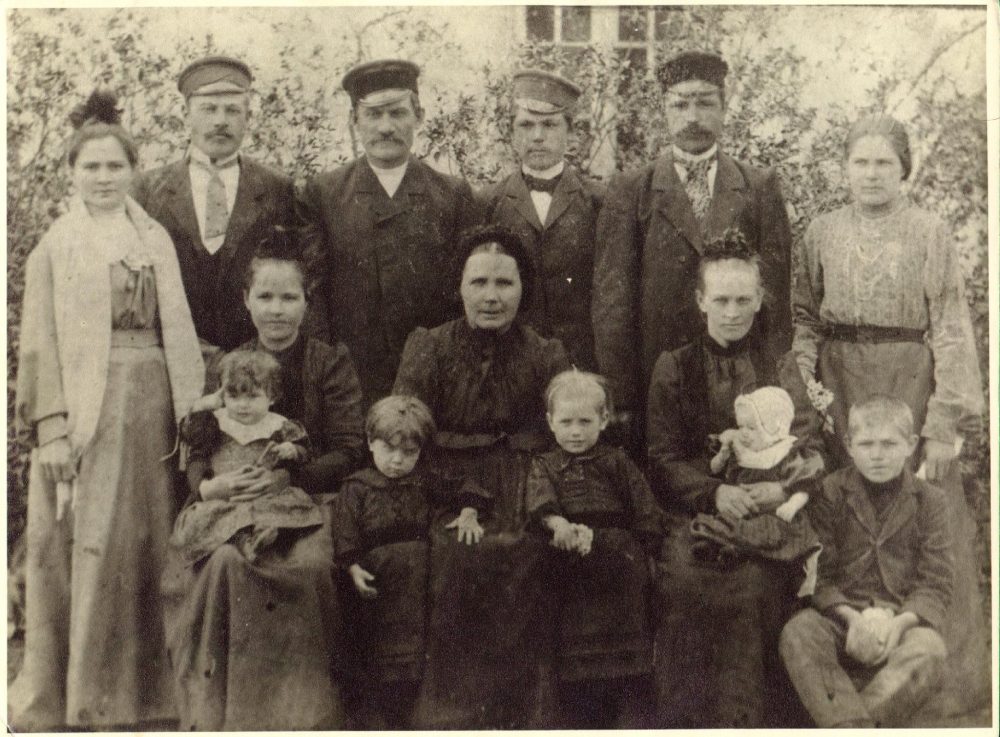
Our stories have a way of connecting us to others, sometimes in entirely unexpected ways. Sometime ago I was contacted by an individual who was keenly interested in a photograph I had submitted in the context of one of my stories. The photograph in question was one of my parents, Cornelius and Katarina Falk, in the company of my mother’s large blended family, possibly taken on September 29, 1922.
The individual who had called me regarding the family photograph I had submitted along with a story, was the son of the late Johan Froese we had met on the Mennonite Heritage Cruise. My caller was seeking information to corroborate his attempt at identification of the individuals in that old archival photograph in my possession. I had more or less identified to my satisfaction who belonged to which of the clans in this blended family photograph, and in fact had identified the two younger members of my mother’s birth family. Following this new request, I made a search of my family’s archival material and found my mother’s handwritten note naming the individuals in that photograph, confirming for my caller that he had been on the right track.
On June 20 we have once again observed World Refugee Day. For people such as my parents who in their day were refugees, along with their three young children, it is sometimes the case that not only did they leave behind all that was familiar, it also was an unfortunate fact that most of what little of their personal belongings they were able to take with them to their new homeland, was mysteriously lost enroute. No doubt refugees the world over could share similar stories, and in many instances, much worse.
According to the UNHCR there are currently more than 117.3 million people around the world who have been forced to flee their homes due to war, persecution, climate shocks and other emergencies.
We owe it to refugees to listen patiently and respectfully to their stories.