
COLUMN: Tales from the Gravel Ridge – The delights of foraging for fruit
Advertisement
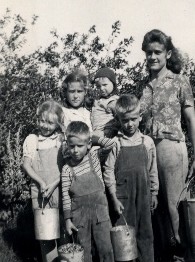
For youngsters, foraging for fruit on our Rosengard farm had few downsides, if any. Mosquitoes might, on occasion, be an inconvenience but not as a rule, given that berry-picking usually occurred during the heat of the day.
We were fortunate to have a number of varieties of wild fruit on our property, including saskatoon berries, chokecherries, high bush cranberries and plums. Our parents, having been accustomed to the luscious fruits that grew in abundance in the orchards of Ukraine, before they emigrated to Canada, found it difficult to relish the wild fruit so readily available in the bush. While my mother preserved some of those wild fruits, she much preferred canning the peaches and damson plums in addition to pears that were available in the grocery stores in Steinbach, having been produced in milder climates in Canada’s west coast as well as in Ontario.
When Bernie and I visited the village where my parents, Katarina and Cornelius Falk had lived before emigrating to Canada, we had the pleasure of meeting Ivan and Maria, a Ukrainian couple who lived in the house that had been home to generations of my family many decades ago. They invited us into their home, and indeed, made us feel welcome to explore the home that was part of my family’s history. Their welcoming spirit was truly heart-warming, and even more so the fact that they gave us a bowl full to the brim, of damson plums, and a large watermelon.
Seeing the built-in brick stove in that house on which my mother will have prepared countless meals, and my paternal grandmother as well, was a memorable experience. The living room too brings to my mind the fact that Katie and Ben, as well as baby Margaret, being my eldest siblings, who were born in Ukraine, will have played in that house; a house that holds so much of my family’s joys and sorrows within its walls.
On occasion my parents mentioned having made or enjoyed watermelon syrup during that long ago part of their lives. Although I thoroughly enjoy maple syrup, that prototypical symbol of the Province of Quebec, I personally have never sampled watermelon syrup. I did, however, see large quantities of watermelon in a field as we were driving along the country roads of Ukraine. Obviously, watermelon still held a place of honour in Ukraine in 2001, that now besieged country of my parents’ place of birth, as well as numerous ancestors, and my eldest siblings.
Back to foraging on our Rosengard farm, in addition to the chokecherries, high bush cranberries and plums that we harvested, several other varieties also grew here and there in our woods. I recall several small bushes, among them, two varieties of low bush cranberries, one a deep purple and the other a brighter red. Here and there we could find some wild gooseberries, and on very rare occasions, a small strawberry, nestled among the undergrowth of our woodland. A rather large bush with bright red fruit and very sharp thorns grew near our vegetable garden. I seem to remember that the fruit had a very mealy taste and texture. I think it was a hawthorne bush.
A large attractive shrub grew near the entrance to our woodland and the meadows beyond. What made it especially pleasing to see was the deep red colour of the bark on the branches of this shrub, from which sprouted green leaves. These in turn set off clusters of white flowers very nicely. These, in time, produced clusters of white berries which we were cautioned not to eat, as they were considered toxic.
Long after I, along with my mother and my younger brothers, had left Rosengard, my life and that of my husband, took an interesting turn. In 2001 Bernie and I decided to move for five years, to Iqaluit, the capital city of Nunavut. Living in Canada’s newest territory was a unique experience; …an understatement to be sure. Among the countless memories of our time in Nunavut, is one that is truly unique for us. Essentially, Nunavut is a treeless tundra. There is however profuse groundcover, including very low shrubs that bear fruit. For us going berry-picking on the tundra was in the nature of a pleasant Sunday afternoon walk. For Inuit, the variety of berries available to them were important for a range of usages, the knowledge of which has been handed down from generation to generation, since time immemorial. Much like the rest of us, everyone living in Nunavut today has countless modern day opportunities and advantages available to them. However, berry-picking on the tundra remains a significant cultural memory and expression of identity for the Inuit.