
COLUMN: Tales from the Gravel Ridge – The laughter of August from a fresh perspective
Advertisement
To my mind there is something slightly melancholic about the month of August when it rolls around in our part of the world. According to The Song My Paddle Sings, the poem written by E. Pauline Johnson, “…August is laughing across the sky”. To my mind the very meaning of laughter doesn’t necessarily negate a sense of melancholy. Indeed we may have valid reasons for sadness, but that doesn’t exclude laughter. And in any event, we know that as we approach the month of September we may well have to cover especially delicate plants that still remain outdoors, but which we want to bring back indoors before freezing temperatures set in. Or quite possibly, there is produce that we still hope to harvest.
Memories of summertime in my childhood invariably include the great outdoors of our subsistence farm in Rosengard. To my mind it could impossibly be otherwise. Gradually the plants in the garden are beginning to look tired, and appear more or less ready to call it a day. The potatoes in the other garden are less vulnerable to frost, but those too will have to be dug up and gathered into the cellar for winter storage.
Our farmyard included a home for our family along with a summer kitchen. In addition to these structures, there were barns for livestock and chickens, and some older structures that still served as overflow for various activities. And in addition to all of these designated areas, there was a fairly large yard where family, friends and neighbours could enter for visits or for business purposes. And most importantly, it was where children could play, and in due time, learn to ride a bicycle.
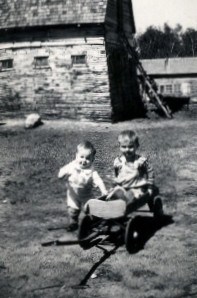
In addition to a vegetable garden and a potato patch, some parts of our farm property were less cultivated. These untilled and uncultivated areas however had their own rules and means of production and survival. For me personally the woods and meadows of this unpretentious subsistence farm hold a treasure trove of memories from my childhood.
It was indeed a humble subsistence farm. Nevertheless that place holds memories from a distant past and a simple plot of land that provide me with riches that cannot readily be chronicled.
How could anyone not having experienced the home life our parents built for us on that Rosengard farm, possibly envisage the riches that were ours — riches that continue to nourish my soul to this day.
As my mind saunters through the uncultivated woods and meadows of my childhood and early youth, I wander down the path the cows have cut through the woods on their way to the meadows beyond. I stop here and there to take note of a delicate columbine blossom that the cows have somehow managed not to crush even though the path is narrow. And just beyond, I find several gooseberries, slightly overripe and all the more sweeter for it.
Before long I reach the first meadow, and for awhile take a break, leaning against the only large boulder on our property. As I rest against this sturdy rock, I wonder what sort of event occurred on our patch of land in the distant past to create this unique scene.
As I resume my solitary saunter across the meadow, I too take note of the laughter of August as it plays out in my memories, both distant and more recent ones. During my school days at our school in Rosengard, I don’t recall ever imagining that I might some day canoe on any one of the many rivers that traverse Canada. All that changed when I and various members of our family began traversing several heritage rivers in Manitoba. In time, our river expeditions included the Yukon River from Whitehorse to Dawson City. For the most part, our paddles sang during those days when everything played out as planned. And, if on occasion the song of the paddle was slightly rougher then we had expected, it never failed to sing again before long.