
Niverville holds climate action plan open house to get resident feedback
Advertisement
The Town of Niverville held an open house last week to get input from residents to its proposed climate action plan, which shows residents how climate change will impact the town’s infrastructure and what might be done to address the affects of climate change.
Town manager of engineering Daniel Wiebe said grants from the federal government (Green Municipal Fund) and provincial government (Climate Action Fund) were used to hire consultants to create the plan.
“It was a great opportunity to further not only our asset management system, but also our climate resilience as well. We hired some consultants, they put this plan together for us just to show us where our assets may be at risk and what we can do about it,” said Wiebe.
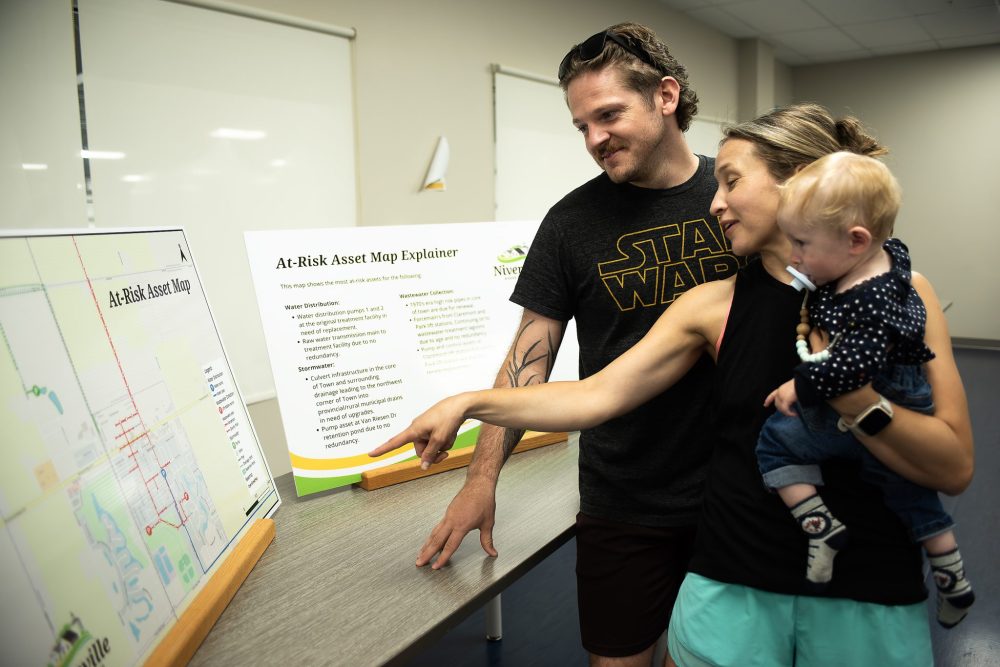
The plan has been in the works since last fall when the town conducted a community climate survey, but director of communications and public relations Cyrus Reimer said council and administration have been discussing the impact of climate change on infrastructure for about two to three years. Wiebe said action was taken now because of funding.
Boards around the room showed the town’s at-risk underground infrastructure and the upgrades that need to be done. Replacements are needed urgently for pumps one and two for the water treatment facility. The plan also looked at the stormwater infrastructure which needs its culverts upgraded from the town core, and the surrounding drains, leading to the northwest corner of town and draining into provincial and RM of Hanover drains.
When it came to the town’s sewers, the 1970s era pipes in the core need to be renewed and forcemains from Clairemont and Park lift stations to the lagoons and the pumps and controls at those lift station locations also need to be renewed or replaced.
Wiebe said the new Red Seine Rat Wastewater Treatment plant that is currently under construction just north of town, although not addressed in the study, will take care of the town’s sewage as the town grows and won’t require new infrastructure as the town’s lagoon is in the same location.
Regarding storm flooding, the consultants made recommendations to adjust Niverville’s stormwater design flows to climate projections not only for today, but for what could happen in 50 years.
“But we have to balance projections versus reality too and we don’t want to be causing undue costs (for residents), right? Either to developers. But we also want to make sure we’re protected. So, it’s something we haven’t decided on what we’re going to do yet. That was one sort of recommendation that we could look at, but we haven’t made any decisions there,” said Wiebe.
Although the town has been able to handle large storms and overland flooding, Wiebe does acknowledge that there are areas in town (older areas according to the consultants) that could use some improvements. Wiebe said the town goes through a four-year cycle in cleaning sewer mains and it costs less than $100,000.
Chase Harms and his wife Chantelle Braun, two of only 10 residents that attended the open house, wanted to see how the town would be addressing climate change impacts. The couple noted how their street floods when there is heavy rainfall. The couple lives in their 1970s home in the north end of town on First Street North.
“Every time we get a really heavy rainfall, the road essentially becomes a mini lagoon. And I’m hoping things like this, creating ditches (in the neighbourhoods) and whatnot, will improve that,” said Harms, noting the fall storms in 2024 and 2025, that hit municipalities in the Southeast, flooded his yard and the back lane. Braun said the couple’s sump pump never stopped working during the storm.
“We’ve only lived in that house for four or five years, and I’ve never seen that before. And so the fact that there was water coming onto our backyard that just hasn’t happened before is telling,” said Harms, who moved to town 10 years ago.
Braun has lived in Niverville her whole life and said she has never seen flooding like that from a storm.
“If you just think about the current situation and don’t take into account what could be (weather wise in the future), we’re just not going to be prepared for what does happen,” said Harms, who noted the municipality did put drains near his home recently and that has helped with drainage.
The consultants acknowledged that climate change is bringing hotter summers and warmer winters and temperature swings. This will impact the performance of the town’s lagoons, as well as its roadways which could rut due to the asphalt softening. Increased rain events would also affect drainage, capacity of stormwater ponds, and overland flooding routes.
Wiebe said the town has a dike that the province built to protect it from the Red River overflowing its banks, which is set to the flood of 1997 levels plus two metres. Should water go over the dike, Wiebe said the town would just pump it back over.
“The other potential is overland flooding. And so any new developments that we put in, we make sure that they have stormwater ponds and ways of getting water to a low point. And the rest of our community just flows through ditches and slowly flows out through town,” he said.
While Wiebe said it is hard to measure whether climate change has affected the town’s infrastructure, he said it seems as if there are more storm events.
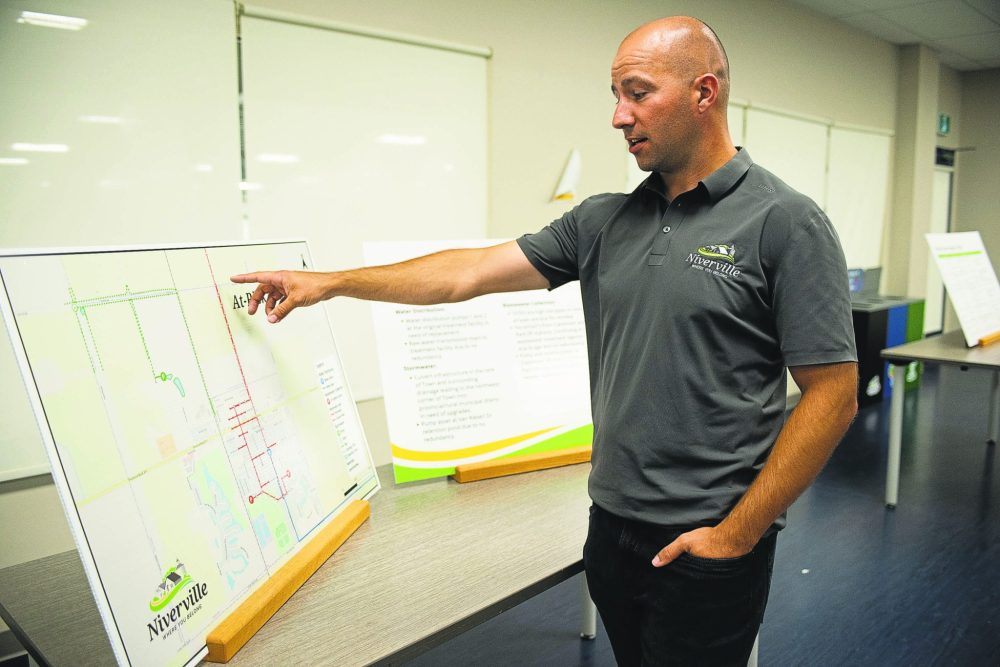
“In the past number of years, it definitely seems like we’ve experienced a lot more one-in-50-year storms, one-in-100-year storms, which should only be coming (once), it should only have a one or two percent chance of happening, yet we seem to experience one or two every year. So, it certainly would appear that we’re going through a phase of increased stormwater events,” he said.
Climatedata.ca was used as the primary resource for the Climate Action Plan and it cites Niverville will have a median temperature of 35.7C for its hottest days up to the year 2030, that is almost two degrees hotter than the hottest temperatures between 1971 and 2000. By 2050, the median temperature is expected to reach 36.8C.
The consultants noted a trend towards a strain on wells during summer months when there is a drier summer in times of drought with low winter precipitation. One of the recommendations is for the town to consider alternative sources of water beyond the well system.
The town put in a water treatment plant in 2007, but about 700 homes are still on private wells. The town held a referendum to see if those homes would like to be put on the main line and the majority of residents voted to stay on the well system citing cost as the main factor.
“The best time to do something was 40 years ago; the second best time is to do it today. And that’s the same thing with the individuals who have wells, is that it’s not going to get cheaper to install that infrastructure. We may as well get on board now when it will be as cheap as possible,” said Harms, who is on the private well system.
“As Niverville grows, not everyone can have their own personal well. There’s limited water. So, it does make sense that we’re going to have to get on to the system,” said Braun. “So, we’re totally willing to do that. Absolutely. But yeah, financially, that’s a huge hit. We get it.”
Harms said that climate change is always on his mind as he thinks about the future his young daughter Noah will be living in.
“My childhood, I didn’t have to think about stuff like this, or at least I didn’t think about stuff like this. Whereas I get the feeling that her generation is going to be…they’re going to be dealing with some really terrible things that we don’t even know are coming yet. And so to be prepared, and to prepare her as well as we can, is really top of mind at this point,” he said.
In order to adapt to climate change, the consultants recommended the town leverage its climate risk assessment to pursue federal funding, to work with the provincial government when it came to drainage, and to establish improved asset management practices and capital plans to fund upgrades and/or renewals over time to its infrastructure.
While the consultants gave dollar amounts for potential projects in their report, Wiebe said they were “pretty high level” and that he wouldn’t trust those estimates when it comes to budgeting.
For now, Wiebe stressed that these are preliminary recommendations and that council still needs to go over the plan and discuss it before any decisions are made. The town will release the plan to the public after council has approved it.
As for what residents can do to help the town manage the effects of climate change on its infrastructure, the town recommends limiting water use during a storm, such as bathing or turning on the washing machine or dishwasher, as it may overwhelm the wastewater system; have the sump pump move water onto the street and not into the sewer line; installing a backwater valve to prevent flooding into the home; and having proper grading and downspout extensions, as some recommendations.