
COLUMN: Tales from the Gravel Ridge – Learning to listen to our lives
Advertisement
For Canadians living on the prairies the month of October is a reminder that summer is winding down. Needless to say, this also applies to our entire country. In our area, however, the reality of the coming of colder weather, and the likelihood of snow decking our fields soon, cannot be ignored. By failing to take note of the signs of impending change all around us, we may well miss the joy and beauty of the season. Surely that also includes the gifts others bestow on us in our day to day interactions.
For me personally, memories of harvest arise in a variety of scenarios. How could I fail to remember stooking at the Goritz farm, situated across the road from what was then named the Hanover School. I vividly recall the experience where, under our father’s supervision and assistance we arranged sheaves of grain in the shape of a pyramid. What a beautiful sight a field of stooked sheaves in their golden glory was back in the day.
A most memorable detail of that particular income-earning experience was the meal we were served that day so long ago. In total we were a team of five, my father, Cornelius Falk, along with my older sister Anne, and my younger brothers, David and Ernie, and I. At noon, all of us were invited to sit down at the kitchen table, whereupon Mrs. Goritz spoke a prayer and then served us a wonderful meal. Imagine the impression that meal must have made on us if I remember it so many decades later.
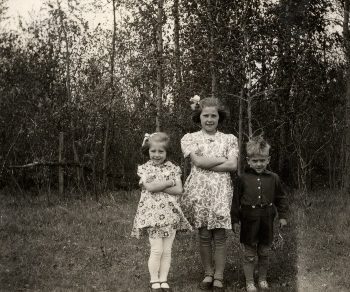
On another occasion we also did some stooking for Abram and Maria Dueck whose farm was a short distance down the road from the Goritz farm. I recall that Mrs. Dueck graciously served us “Faspa” that quintessential afternoon meal among Mennonites of that era. Such a meal invariably called for coffee and something in the category of home-baked bread, accompanied by butter and other condiments, and possibly also some more dainty fare. I wonder how Mrs. Dueck must have felt when she observed the capacity that children and young adults have for practically inhaling the food she served us that day, especially in light of the fact that there were no children in their household.
At home too there were numerous fall tasks in which we children were required to engage, such as gathering newly dug potatoes, and taking them to the bins in the cellar, along with such menial tasks as clearing soot from the stovepipes. All served their purpose in preparing us for the winter months to come. The rhythm of the seasons have their own importance.
We do ourselves a disservice when we fail to take note of the beauty of this glorious season of the year. How can I possibly forget or disregard the magnificent backdrop to the playhouse on our Rosengard farm. To begin with, this was no ordinary structure. Indeed, I am quite convinced that it was one of a kind. Our playhouse was of sturdy wooden construction, and although it had seen better days it nevertheless retained its exquisitely crafted characteristics. In its day the playhouse had been a very solid well-built closed in cutter situated on solid runners.
I have no idea how the playhouse came to be on our farm, but I suspect it had been located at the edge of our farmyard long before my parents bought our property. While this structure had its own merits, its natural setting was utterly magnificent. Imagine the beauty of a highbush cranberry tree with enormous clusters of scarlet berries and nearby, immense, very dark purple bunches of chokecherries. Such was the backdrop to our humble playhouse.
The late Frederick Buechner reminded us to, “Listen to your life. See it for the fathomless mystery it is. In the boredom and pain of it, no less than in the excitement and gladness: touch, taste, smell your way to the holy and hidden heart of it, because in the last analysis all moments are key moments, and life itself is grace”.
Surely there is much to learn when we pay attention to our lives, including the beauty of the gifts others bestow on us in our daily social interactions with those around us.