
COLUMN: Tales from the Gravel Ridge – Rural women of my Rosengard childhood
Advertisement
The examples set for me by the women of my early childhood continue to shape and enhance my view of life and how to respond to it. During my childhood in Rosengard, the women of my neighbourhood were rural women in the truest sense of the word. Our community was located some 15km from Steinbach, the nearest major town. We had no convenience store that could supply the range of grocery items or basic pharmaceutical products that can sometimes be needed by a family, and that perhaps, on occasion, on short notice.
Depending on the circumstances of the respective families of our neighbourhood, women were not infrequently engaged in the farm work of their relatively small farms. Women helping with the milking of the cows was a common occurrence. Their assistance might well be required for both the early morning milking and again before nightfall. This was not without some concern, especially on the part of the mother who might be preoccupied with thoughts of what could, quite possibly, be going on in the house. The preschoolers left to fend for themselves, might be getting into mischief that could only too readily become a disaster. These concerns were by no means exaggerated — toddlers can very quickly undertake projects that are well beyond their ability to comprehend fully or to control.
The first “International Day of Rural Women” was observed on Oct. 15, 2018, pursuant to a resolution of the General Assembly of the United Nations on Dec. 18, 2017. This relatively new international day recognizes “the critical role and contribution of rural women, including Indigenous women, in enhancing agricultural and rural development, improving food security and eradicating rural poverty.”
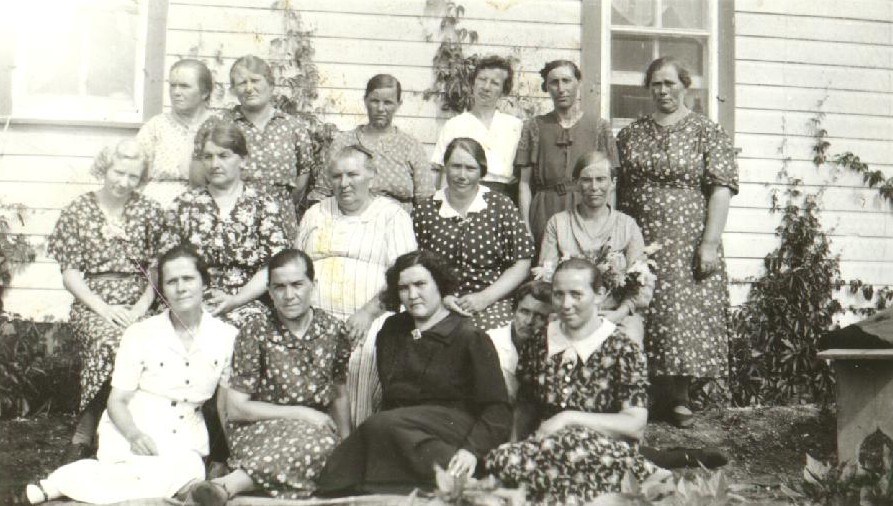
Much of the work of the women in our neighbourhood during my early childhood did not normally generate income directly. Nevertheless, the enormous degree of support, encouragement and monetary contributions represented by the tasks and projects of the women are, to put it mildly, astronomical.
I am deeply humbled when I reflect on my mother’s phenomenal strength of character exhibited in countless ways, and under a broad range of circumstances. How could I fail to be grateful beyond measure for the legacy she left us, her family, and by extension, her now large extended family. When my father, Cornelius Falk died suddenly of acute pancreatitis, my brother-in-law, Jake Penner spoke for all of us when he observed that he had always known that our mother, Katarina Falk, was strong but that he had not realized how strong she was until she had to deal with the sudden death of our father.
For me the small snippets of memories of our family’s history that my eldest siblings shared with us, are becoming more valuable day by day. I am keenly aware of the fact that those sources are now no longer available to me. Indeed, since my sister Anne, four years my senior, died on Feb. 23, 2026, I am unable to “fact check” with her on various details of our family’s history. I strongly suspect that I may well be the eldest surviving cousin of my late father, Cornelius Falk’s extended family.
During the challenging economic years of the world wide Depression of the 1930s, my father, as a means of supplementing our family’s income, spent some time away from home helping with harvesting on the farm of relatives. My mother remembered those times vividly, recounting how on one occasion when she was splitting some wood for kindling, a small piece of wood struck her eye. My mother was not given to moaning about her own aches and complaints. Many decades later, my eldest brother Ben recalled that on that occasion our mother was in fact on the ground moaning, not because of her pain, but of her fear of irreparable injury to her eye. Fortunately her injury was not as serious as she had feared.
The women of my Rosengard childhood had to be strong. As a means of supporting each other they met in their respective homes for mutual encouragement, both socially and spiritually. In addition, these gatherings provided a means of exchanging practical ideas such as sharing patterns for sewing garments or household items, and sharing recipes. Judging by several photographs of that era in our family archives, the gatherings served a most important purpose.