
Harv’s Air takes steps to prevent another mid-air collision after two students died: report
Advertisement
Harv’s Air Service has taken steps to prevent another mid-air collision following the death of two students last summer, according to a recently released report.
The Transportation Safety Board of Canada released its report last Wednesday, which showed Harv’s Air will have a limit of three aircraft in the circuit at any given time; radio calls made on the final leg must include the aircraft’s distance from the runway; all students and aircraft renters must attend a safety briefing on the importance of using effective lookout techniques and maintaining situational awareness and aircraft blind-spot awareness; and all aircraft lights must be on at all times during flights. It is unknown whether the students had their lights or beacons on at the time of the crash.
The company also began upgrading its fleet by installing LED lighting to increase the aircraft’s visibility in the air and by expanding the number of aircraft equipped with automatic dependent surveillance—broadcast (ADS-B) in and ADS-B out capabilities. At the time of the accident, neither of the two aircraft were equipped with an airborne collision avoidance system (ACAS) or ADS-B in, nor were they required to be by regulation.
Harv’s Air did not return a request for an interview by press time.
The pilots were previously identified as Savanna Royes, 20, of Aurora, Ont., and Sreehari Sukesh, 23, a certified private pilot and international student from India.
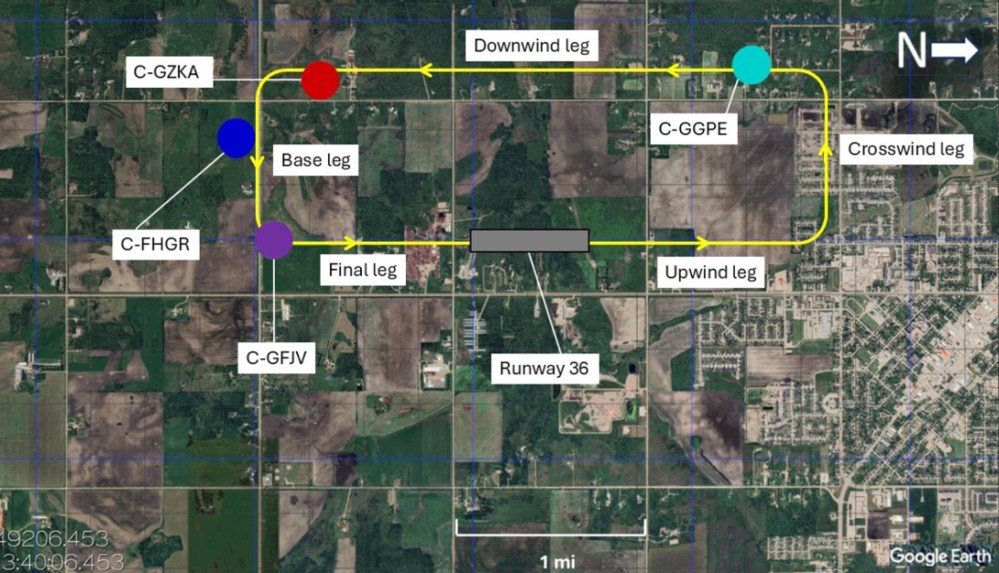
On July 8, 2025, at around 8 a.m., the two planes, one a Cessna 172R registered as C-GZKA flown by Sukesh and a Cessna 152 registered as C-GGPE, flown by Royes, were each doing solo training in a four-plane circuit under visual flight rules (VFR) at the Steinbach South Airport.
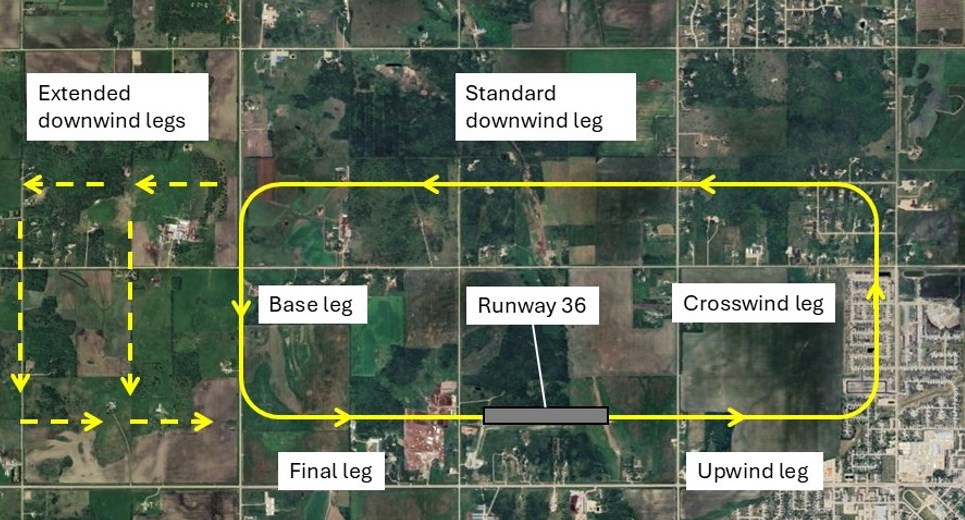
The circuit pattern is a left-hand circuit flown at 1,600 feet above sea level. The circuit is divided into five legs: upwind, crosswind, downwind, base, and final. At one point the two planes both announced they were preparing to land. They were separated by one mile on approach and 200 feet vertically, according to the report.
At 8:41 a.m., both aircraft were one mile from the runway. Sukesh was approximately 100 feet directly above Royes. At 8:42 a.m., the two aircraft made brief contact for the first time. Royes immediately applied full power, and the aircraft pitched up, causing the two to collide again. They became entangled and crashed to the ground, landing a quarter of a mile south of the runway near PR 33N, in a farmer’s field in the RM of Hanover. The planes were engulfed in flames and both pilots died.
Sukesh held a private pilot’s licence since August 2024 and had accumulated 169.4 total flight time hours, including 73.2 hours solo flight time. Royes held a student pilot permit since April 2025 valid until July 2029. She had accumulated 59.3 total flight time hours, including 14.4 hours solo flight time. Both were working towards a commercial pilot’s licence.
At the time of the collision, Harv’s Air president Adam Penner told The Carillon that one of the students was in the first third of completing their commercial pilot’s licence and the other was in the last third of completing their commercial pilot’s licence. He didn’t provide the names of which student was near completing training for their licence. Penner did say the students were practicing their take-offs and landings.
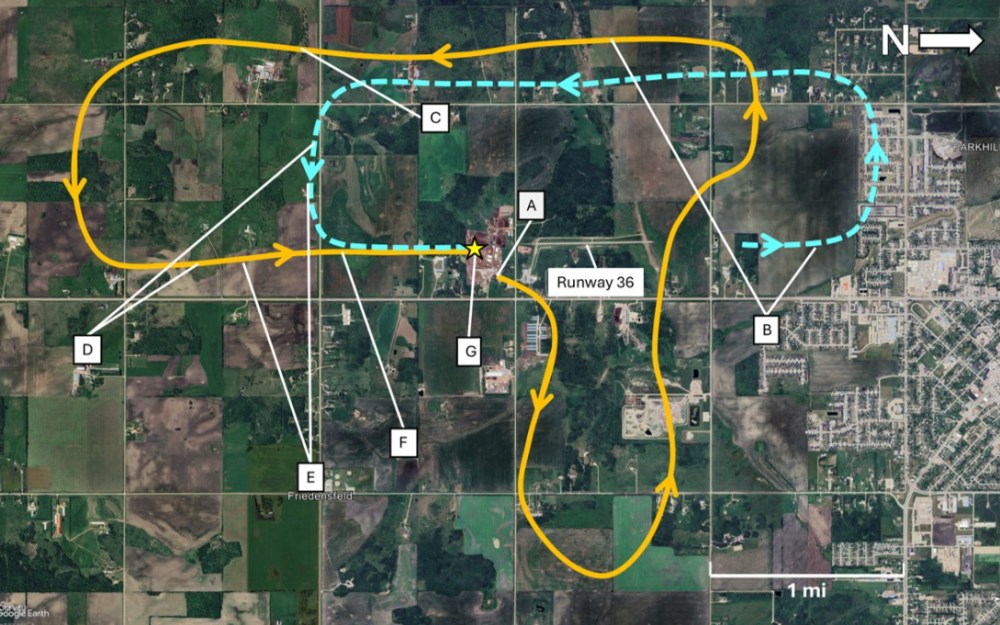
The report recognized that although visibility was limited due to smoke from northern wildfires at the time, meteorological conditions were suitable for VFR flight. The sun was also directly in the path of the final leg towards the runway; it is unknown whether either pilot was wearing sunglasses.
The report also stated that when the circuit is particularly crowded, some pilots may elect to extend the downwind leg before approaching the final leg towards the runway to maintain sufficient spacing between their aircraft and the preceding traffic. To do so, pilots will normally fly an extra half mile to one full mile on the downwind leg and subsequently extend the final leg to one-and-a-half miles to two miles. Sukesh extended the downwind leg by one mile twice to create more spacing between his aircraft and other traffic in front of him.
The Transport Canada Aeronautical Information Manual states pilots must report when entering the runway for departure, and when conducting continuous circuits, reporting when joining the downwind leg, on final approach for the active runway, and clear of the runway surface after landing are required.
The manual also states pilots conducting continuous circuits should also radio their intentions, for example planning a touch-and-go or a full stop, when they are established on final approach.
The see-and-avoid principle is the basic method used for visual surveillance and collision avoidance in VFR flight. It is based on active visual scanning, as well as on the ability to detect conflicting aircraft and take the necessary action to avoid them. This method has been examined in a number of other TSB investigations. Some of those investigations concluded that given its limitations, “[r]elying solely on visual detection increases the risk of collision while in uncontrolled airspace,” according to the TSB report.
About six months prior to the fatal crash, two other students also found themselves in the position of a near collision, but no contact occurred. This prompted Harv’s Air to require all pilots to radio their distance from the runway on final approach so that they are aware of each other’s position in the sky. Neither Sukesh or Royes radioed their distances to the runway during their radio communications.
Harv’s also discussed limiting the number of aircraft on a circuit prior to the Sukesh and Royes crash, but no specific policy was ever drafted.
There is no air control tower at the runway for Steinbach South Airport.
NAV Canada currently requires all aircraft flying into Class A and B airspace to be equipped with a transponder with ADS-B out. This mandate will be expanded to Class C, D, and E airspace by 2028. The Steinbach airfield is a Class G. At the time of the report, there is no requirement for aircraft to be equipped with ADS-B.
Including this collision, the TSB has investigated 13 mid-air collision accidents since 2011. In several of these occurrences, the TSB identified the ineffectiveness of the see-and-avoid concept for avoiding mid-air collisions and stated that until there is wide adoption of traffic awareness systems, “the risk of mid-air collisions will not be substantially reduced.”