
Pharmacists open to protective equipment from province
Advertisement
Hey there, time traveller!
This article was published 01/05/2020 (2396 days ago), so information in it may no longer be current.
Two local pharmacists say they’d welcome a change in the policy surrounding who gets personal protective equipment (PPE) from the Manitoba government.
Currently, pharmacists working in acute and long-term care facilities can access PPE through the provincial government, while pharmacists working in retail locations like drugstores must fend for themselves.
During a news conference earlier this month, Dr. Brent Roussin, Manitoba’s chief provincial public health officer, said serving someone across a counter poses a low transmission risk because the coronavirus is spread through close, prolonged personal contact.
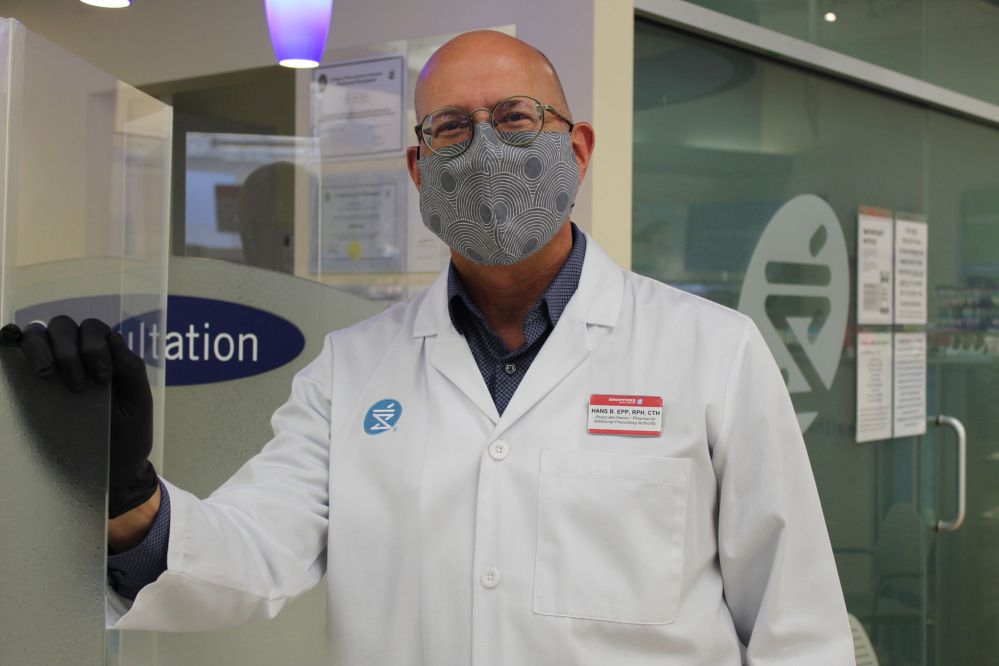
Hans Epp, pharmacist and owner of Shoppers Drug Mart in Steinbach, said he doesn’t disagree with Roussin, but would welcome inclusion in the province’s PPE supply network.
“I think even to protect the front line workers in pharmacies, in retail pharmacies, that the government should look at that as an essential need to provide those (protective) products as well,” Epp said.
In the meantime, parent company Loblaw is supplying PPE to Shoppers pharmacy and store staff, which Epp said together number about 50.
“I would say right from the start, the support structure for Loblaw through all of their banners has been just unbelievable,” Epp said.
“We really had the advantage of having a team working on our behalf…to help support us on the front lines.”
Epp said he’s confident in Loblaw’s procurement chain even if precautionary measures stay in place for several more months.
Shoppers pharmacy staff have access to fabric barrier masks, face shields (used during injections and other close-contact situations), and a small number of medical-grade N95 masks, which Epp said are reserved for “unique patient contact interactions” with someone who could be infectious.
Wearing the equipment is optional but encouraged, and Epp said he tries to lead by example, donning gloves and a mask while on shift.
“About half or more of our staff are wearing barrier masks right now, including probably about half our pharmacy personnel,” Epp said.
The store has also installed Plexiglas shields at checkouts and pharmacy wickets, and is enforcing physical distancing throughout the store.
Epp said it’s harder for pharmacy staff to distance themselves from one another behind the counter.
“In our pharmacy we may have up to 10 people working in a very small area…We just don’t have the space to do that, and yet we have the workload to need to be there.”
But staff are taking other precautions. Injection services have been suspended except when urgent or essential to a patient’s health.
Pharmacy staff were also divided into two half-day shifts that don’t overlap. That way, if someone tests positive for COVID-19, the pharmacy can continue to operate while exposed staff quarantine at home, Epp explained.
Shoppers Drug Mart also operates the pharmacy inside Bethesda Regional Health Centre. Epp said those staff, who procure their PPE through hospital channels, have “minimal to no interaction with our store team.”
Guylene McLean of Pharmacie Seine in Ste Anne said the six staff there haven’t been wearing gloves or masks, but have the items on hand.
Surfaces are sanitized between customers and staff wash their hands frequently.
McLean said she isn’t worried about contracting the coronavirus at work, but would welcome the option to source PPE through the province.
“It would be nice if it would be made available to community pharmacies as well. That way we would have to option to wear those things or not,” McLean said.
“If you’re going to make it available for pharmacists, you should probably make it available for everybody, because we could potentially come into contact with patients that have (COVID-19) as well.”
Asked about Roussin’s position, McLean noted droplets can hang in the air after a customer has left. Pharmacists also come out from behind the counter to assist some customers.
Gary Funk of Southeast Wellness Pharmacy in Steinbach declined to be interviewed for this article.
A spokesperson for the College of Pharmacists of Manitoba said advocacy efforts lie outside of its scope as a regulatory body.
Dr. Brenna Shearer, CEO of Pharmacists Manitoba, provided The Carillon with a written statement.
“Pharmacists are essential front-line health care professionals and Manitoba’s most accessible health care providers. We understand that personal protective equipment is scarce and supply must be allocated carefully.”
“As the government does recognize pharmacies and pharmacy staff as essential health care providers, we would appreciate our inclusion as part of the provincial PPE stock allocation process.”
Shearer added Pharmacists Manitoba is willing to work with provincial officials to find practical solutions.