
Advocates raise environmental alarms over North Dakota dairy farm approvals
Advertisement
Hey there, time traveller!
This article was published 15/10/2025 (210 days ago), so information in it may no longer be current.
Environmental advocates on both sides of the border are concerned the approval of two large-scale dairy farms in North Dakota will damage the Red River and Lake Winnipeg’s water quality due to potential untreated manure runoff.
North Dakota’s Department of Environmental Quality approved a permit on Sept. 24 to build the Heberg Dairy, a 25,000- cow farm near Hillsboro, roughly 235 kilometres south of Steinbach. The state department also granted another permit in January for a separate 12,500-cow farm in Abercrombie, nearly 110 kilometres south of Hillsboro.
Both farms are owned by Minnesota-based firm Riverview LLP and are located within 2.5-kilometres from the Red River. Combined, the two farm’s cow populations nearly equal all of the dairy cows in Manitoba. In 2024, the province had 43,500 dairy cows shared between 226 farms.
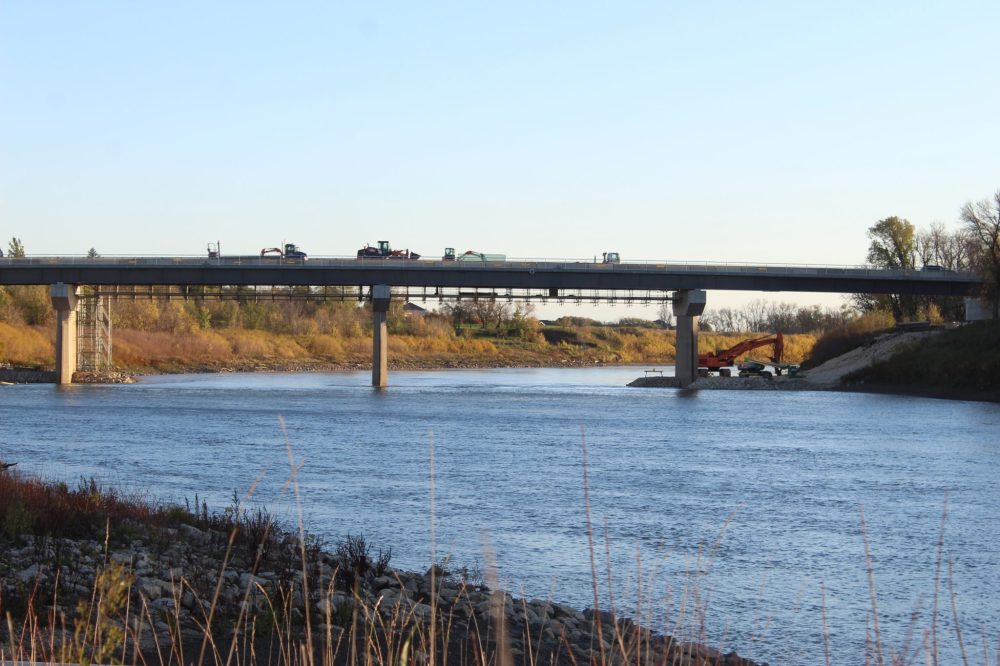
James Beddome, executive director for environmental non-profit Manitoba Eco-Network, sees the potential run-off from land sprayed with the manure causing irreparable damage to the Red River and Lake Winnipeg.
The two farms could generate enough manure each year worth the equivalent of a 1.5 million-person city’s raw sewage, he said.
“You have that much volume, and they’re only going to apply it to the land, and you’ll see the runoff. It’s not as if they’re putting it through a sewage treatment plant, and going through all of those processes which remove pathogens and nutrients,” he said.
While the soil will absorb some manure’s nutrients, Beddome said tiled and drained farmland can only handle so much before it runs off into the Red River watershed.
Since Lake Winnipeg and the Red River also have problematic levels of phosphorus and nitrogen, any additional runoff nutrients will make conditions worse for both water bodies, he said.
Nutrient levels in the Red River have already exceeded targeted amounts. In 2022, the tested phosphorus concentration was 0.40 milligrams per litre, more than doubling the target of 0.15 mg/L, according to a 2023 International Red River Watershed Board report.
Nitrogen samples from the river also spiked, testing at 2.49 mg/L compared to its target of 1.15 mg/L.
The potential manure runoff could also introduce diseases and bacteria, like e-coli and H1N1, into the river and Lake Winnipeg, he said. Wildlife, like fish, are particularly at risk because rising nutrient levels can kill off the animals because there isn’t enough oxygen, Beddome said.
Lake Winnipeg already has had issues with algal blooms for nearly 30 years, and the potential manure runoff could make it worse, said Vicki Burns, director for Save Lake Winnipeg Project.
She said high nutrient counts can cause blue-green algae to form, which is toxic to both humans and animals. When the algae dies, it uses up all the oxygen, creating dead zones and “choking the lake,” Burns said.
“It’s very frightening, what this (manure) will do to both the Red River and Lake Winnipeg,” she said.
She said Lake Winnipeg is already suffering from the algal blooms and the two farms could be the final “nail in the coffin” for the lake.
In an email sent to The Carillon, a spokesperson for Riverview LLP said both dairy farms were designed and operated to meet the state’s environmental standards and prevent discharge of manure into waterways.
“Riverview takes pride in being a good neighbor and a responsible steward of shared resources. Discharges to surface waters are prohibited by state and federal law, and our farms are designed and operated to prevent such discharges,” the spokesperson said.
North Dakota’s director for the division of water quality Marty Haroldson said the state pulled all acres designated for spreading the manure that fell into the 100-year flood plain for the Abercrombie farm to prevent the risk of runoff into the waterways.
He said there were no acres within the flood plain for the Herberg dairy permit.
“We review all of these facilities against our regulations to keep in mind not only the environmental safety, but also the human safety as far as drinking water, soil health and air quality,” Haroldson said, noting permits are only issued if all the requirements are met.

For every large-scale farm permit in North Dakota, Haroldson said operators need to have and follow a nutrient management plan that designates a number of acres to handle the manure’s phosphorus and nitrogen content based on the crops planted. More than 30,000 acres have been approved for the two farms, he said.
The state leaves the responsibility for testing the manure and doing soil sampling to the farmer and requests those records annually during routine site inspections, he said.
Manure on both farm’s designated acres won’t be sprayed, but instead injected eight to 10 inches into the soil, Haroldson said.
Even if the field is drained and tiled, he said the tiles are roughly three feet deeper than where manure would be injected and there’s enough clay in the soil to create a natural barrier, preventing runoff.
Madeline Luke, a volunteer with environmental non-profit Dakota Resource Council, has taken issue with the nutrient plans for both farms. The group hired agronomists to view the plans.
At the Abercrombie dairy, Luke said they found the nitrogen levels were already too high in the plans, making the nutrient management plans “meaningless” because it would skew the results when calculating how many acres are needed for the manure.
For the Herberg dairy, the larger farm, agronomists found gaps in the plan for stating when the manure is applied and how much, and the lack of flooding contingency plans to prevent runoff.
“If you don’t know what’s already there, you have no way of knowing how much you can safely put on,” Luke said, noting continual injections or spreading manure on soils will increase the chance of it getting into water.
She said the projects are far from the usual farming operations in the state because of their size, and the state hasn’t taken it into account properly. More state oversight is needed to ensure environmental protections are being followed, Luke said.
Since the Red River flows across the border, disputes are settled by the International Joint Commission, a body created by Canada and the U.S. to manage shared waters.
The commission, which follows the 1909 Boundary Waters Treaty, regulates water use and is tasked with improving water and air quality. According to the treaty, both nations agree that neither country will pollute water flowing across the border that would “cause harm to health or property in the other country.”
Manitoba Environment Minister Mike Moyes said the province has reached out to the federal government, North Dakota government and the commission to address the concerns and potential impacts from the farms.
“We’re very concerned any time that we have this amount of agricultural production this close to the watershed,” he said, noting that water doesn’t respect borders and collaboration between countries is needed.