
1946 – 2026 Watching Steinbach Grow: Pasteurized milk delivered daily
Advertisement
SEPTEMBER 5, 1952—Every morning, without the benefit of franchise or bylaw, Steinbach Creamery delivers 700 to 800 quarts of fresh milk to Steinbach’s 2,100 citizens. The milk is pasteurized, some is homogenized, and tests from 3.5 to 4.6 percent butterfat. It is produced on 11 of the districts leading dairy farms, all of which are inspected periodically by the Red River Health Unit sanitation inspector.
A dozen years earlier, the town cowherd would take the cows down Main Street, blowing his bugle for all to hear, announcing it was seven o’clock and time to bring the cows to be taken to the community pasture. Practically everyone had their own cow.
But even before the cowherd hung up his horn, and before the common pasture was made into a farm, commercial enterprise was at work.
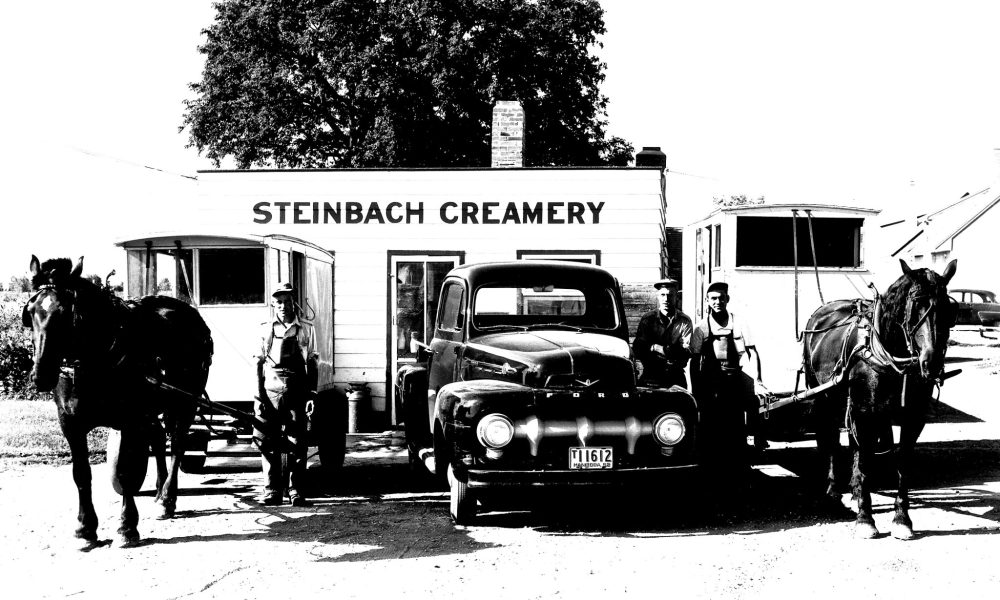
A.A. Regehr made a sharp bid to take over the milk business, erecting the present Steinbach Creamery building. A 180-foot well was drilled to supply running water to cool the milk and provide water to wash bottles and milk cans. Equipment included bottle washers, cooling vats, and sterilizers. It was quite an ambitious undertaking under the circumstances, and during the first year, deliveries were only 200 quarts per day.
Regehr sold the business in the fall of 1944 to William Hastings of Marchand, who hoped that Steinbach would prove to be a good outlet for some of the milk being produced at Manitoba dairy farms. Two years later, in 1946, the business was sold to the present owner, Robert Scarrow, who has since installed a pasteurizer and homogenizer.
Volume has increased to the extent that Steinbach Creamery has become a paying proposition for the owner, which will ensure regular milk delivery to the town’s ever growing population. Cows in town have decreased to the point where even the watching eye of Bob Scarrow can find only five within town limits.
One method of pasteurization (the only one employed at the Steinbach Dairy) is to raise the temperature of the milk to 143 degrees Fahrenheit in a large vat and then hold it there for 30 minutes. At the end of this time, the milk is rapidly cooled, bottled, and capped by machine. The final product is thus untouched by hand.
Frequent and regular supervision is carried out by the Red River Health Unit to ensure there is adequate pasteurization. The quality of the milk is never injured by this process.
As some people prefer the cream to be well mixed in with the milk, some of the milk at the Steinbach dairy is put through a special machine which splits up the cream into such fine droplets that it remains there in suspension to create homogenized milk, which is always pasteurized as well. Others prefer to see the cream on top – but in either case, the value is unchanged. Tests on butterfat content are done frequently on both types, and according to records for 1952, the average content for milk delivered to Steinbach customers is between 3.5 percent and 3.8 percent.
The minimum standard for this is 3.25 percent, so Steinbach is therefore getting a high quality product at the regular price. It should be noted that Steinbach Creamery has the only pasteurizer used solely for the processing of milk for public consumption east of the Red River.