
COLUMN: The Carillon Flashback November 28, 2002 – Straw burner slashes barn heating costs
Advertisement
The owner of a Landmark-area poultry farm expects a new $150,000 heating system will easily be worth the investment.
Ron Penner of Primrose Farm anticipates the Rama Biomass Gasifier, which uses waste straw as heating fuel, to save $60,000 in heating costs annually.
A three million British Thermal Unit (BTU) per hour heating system developed by Vidir Biomass Inc. of Arborg was unveiled in a grand opening ceremony at the farm.
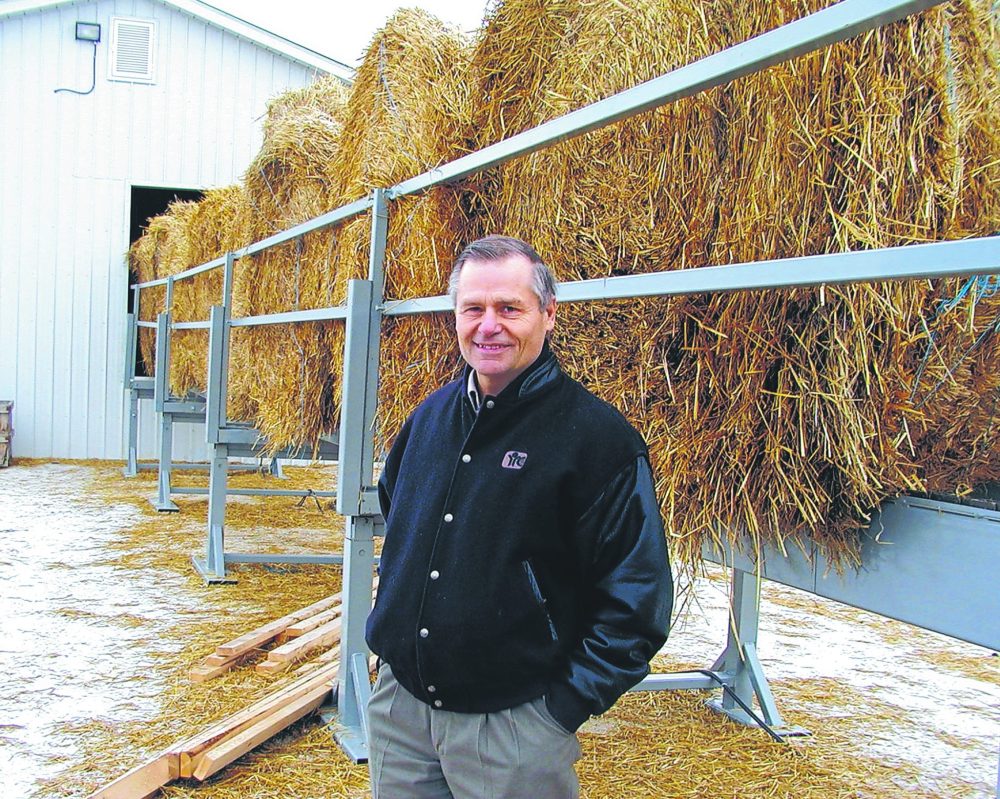
On hand for the occasion was Industry and Trade Minister MaryAnn Mihychuk, who pointed out the newly developed heating system takes advantage of a readily available resource in the form of waste straw. In the process, it eliminates the straw without the need for farmers to burn it in the field.
“Vidir is a success story built out of nothing but the company’s own creativity. The company’s new energy system will revolutionize our energy production.”
Effective use of straw to produce energy has been something the province has long been looking toward, Mihychuk added.
Conversion to the system will be eligible for support under the province’s REDI (Rural Economic Development Initiative) program.
Penner noted he will need to use three or four 500-kilogram bales of straw daily, costing $10 to $15 each, to heat his broiler barns.
Information provided by the company points out a 500-kilogram straw bale produces about seven million BTUs of heat per hour. A single 1,000-pound straw bale outputs the heat equivalent of roughly 1,500 pounds of coal.
The same amount of energy as produced by one bale would require approximately $124 of fuel oil, $80 of electricity or natural gas, $103 worth of propane or $45 of coal.
Penner pointed out his farm will continue to be connected to natural gas.
Cheaper heat will be particularly valuable for broiler farmers. Penner noted he sets the barn temperature at 90F when he brings in a new batch of pullets.
According to company information, the straw is shredded before being augered into a primary combustion chamber. Ash is removed at that point.
Oxygen is mixed into the system prior to the hot gases entering the secondary combustion chamber and water is heated for distribution in a third chamber.
Temperatures in the secondary chamber reach 2,000F. Water is heated to 180F in the system, Vidir owner Raymond Dueck pointed out.
Exhaust from the system is clean, he promised.
At three million BTUs, the system installed at the Penner farm is the minimal configuration, Dueck noted, adding, however, there is almost no limit on how large they can ultimately be made.
The system at the Penner farm is equivalent to about 25 average residential heating systems.
Vidir is well known for its specialty metal work, including motorized storage and cutting frames used in many carpet stores and bicycle display racks used by retailers throughout North America.
In 1999, Vidir replaced the coal-fired heating system at their Arborg manufacturing plant with a three million BTU straw-burning system, reducing heating costs by up to $50,000 annually, compared to the electric hot water heaters they used previously.
– with files from Tim Plett